
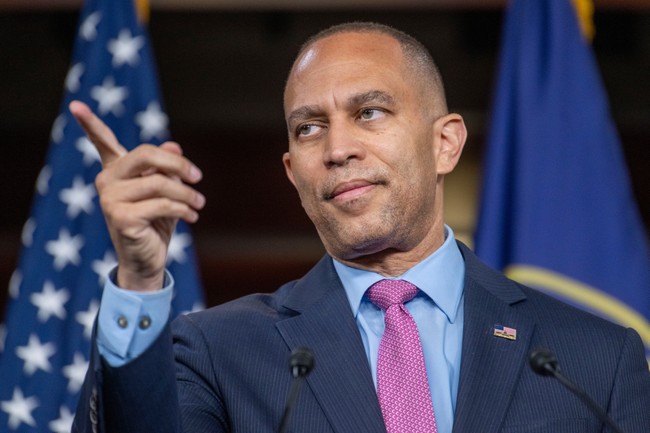
The House Oversight revelations about Jeffrey Epstein’s contacts with Democratic lawmakers are creating political pain for the party. New records show text exchanges and a fundraising email that raise real questions about judgment and judgment calls, and Republican leaders are using those details to press for answers. This piece lays out what the documents reveal, the awkward responses from Democratic leadership, and how those moments played out on camera. You’ll see the key quotes and the moments that have turned this into a political liability for Democrats.
The story centers on records released from the Epstein estate that reveal interactions between Epstein and several Democratic officials. One notable example involves Delegate Stacey Plaskett, a non-voting member from the Virgin Islands, who was texting with Epstein during a February 2019 congressional hearing. Those texts suggest Epstein was feeding material to be used in questioning former Trump attorney Michael Cohen, which complicates the narrative that Democrats were simply victims of Epstein’s actions.
Republicans on the House Oversight Committee say the files show a pattern of continued contact and even fundraising overtures after Epstein’s 2008 conviction. Committee Chair Rep. James Comer highlighted an email sent in 2013 soliciting money for House Minority Leader Rep. Hakeem Jeffries. That email — sent well after Epstein’s known legal troubles — was cited as proof that Democrats accepted attention and donations from a discredited figure.
Democratic attempts to explain away the contacts have not landed well. Rep. Jamie Raskin and Delegate Plaskett argued the exchanges amounted to a “call from a constituent,” a defense that strains credibility when the interactions read like coordination. Critics point out that a random constituent rarely has a lawmaker’s personal phone number, and that describing ongoing texting as casual outreach is a weak look for leaders defending transparency.
CNN reporter Kaitlan Collins pressed Rep. Jeffries directly about both Plaskett’s texts and the fundraising email, and those moments were telling. Jeffries said Plaskett wasn’t accused of “breaking any house rule, any law, any statute,” hoping to draw a hard line on legality instead of answering ethical questions. When Collins pressed further, Jeffries said he “hadn’t had a conversation” with her about it, a response that came off as evasive and suggested a lack of internal oversight.
That exchange left many Republicans arguing that leadership accountability matters as much as legal technicalities. Saying someone did not break a law does not address whether they took actions that were politically or morally unwise, especially when those actions involve a convicted sex offender. For a party that frequently talks about standards and accountability, Democrats’ reflexive legalism here looks like an effort to shut down debate rather than engage with the substance.
The fundraising email itself contains a striking phrase that has been widely noted and mocked in conservative circles. Media coverage points to language that described Jeffries as “Brooklyn’s Barack,” an eyebrow-raising line given the context and the recipient. The email has been seized on as an example of poor judgment and tone-deaf outreach that Republicans say underscores deeper cultural problems in Democratic fundraising practices.
Jeffries told reporters he had no recollection of the email, which only added to the awkwardness for Democratic leadership. Claiming ignorance of a campaign communication that described you in grandiose terms does not reassure voters that party leaders are on top of vetting or donor relationships. Republicans argue this moment illustrates a broader unwillingness among Democrats to reckon with problematic connections until pressure is applied.
Republicans also emphasize how the Epstein files show donations and interactions that continued even after public outcry in 2019. Delegates and members who later returned funds or redirected donations still face questions about why the money was accepted in the first place. Those follow-up decisions do not erase the original choices, and GOP critics are using that gap to press for deeper transparency.
Across the board, the political fallout reflects a simple point: lawfulness and ethics are not the same thing. Democrats leaning on legal defenses while sidestepping ethical concerns has become a recurring theme in Republican messaging. This episode gives Republicans a clear example to highlight when discussing standards, donor vetting, and what leadership should look like when a scandal lands in your backyard.
As the Oversight Committee continues to parse records and press for answers, the public moments with Jeffries and Plaskett remain the snapshots that define this phase of the story. Those exchanges, the fundraising email, and the text messages are all cited by Republicans as evidence that Democrats need to be more forthright. For now, those moments are shaping the conversation and giving GOP lawmakers concrete material to use in hearings and media appearances.



Add comment