
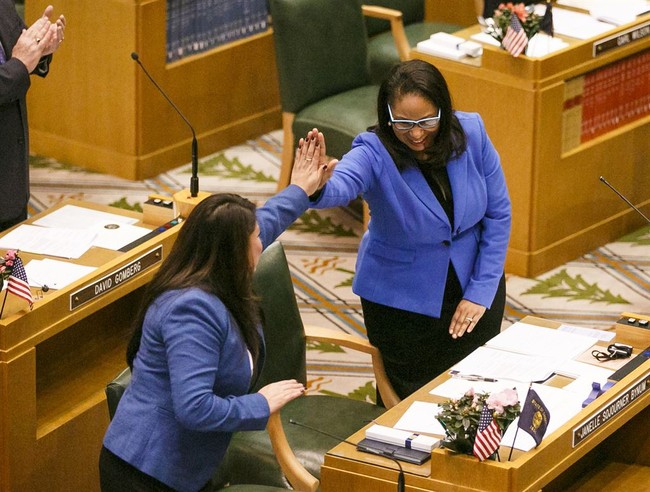
Checklist: summarize the confrontation on a CSPAN clip, highlight Representative Janelle Bynum’s responses, reproduce key quoted lines exactly, explain the political stakes around the Continuing Resolution and SNAP benefits, and note who holds responsibility for the shutdown.
This piece looks at a short but revealing exchange on CSPAN where Democratic Representative Janelle Bynum (OR-5) struggled to explain why she voted the way she did as the government shutdown continued and SNAP benefits face interruption. The clip, shared by House Speaker Mike Johnson, shows a lawmaker floundering when pressed about a clean Continuing Resolution and who actually controls whether benefits keep flowing. The stakes are immediate: November 1 is the deadline for SNAP funding as Democrats refuse the clean CR, and the political blame is squarely assigned. The following paragraphs trace the back-and-forth, preserve the direct quotes, and make clear which party has the power to end the shutdown.
The exchange opened with a simple question about whether Democrats would pass a standalone bill to fund SNAP benefits, a proposal Republicans offered. Bynum avoided a straight yes or no and instead pointed to institutional control, claiming the party with the White House, House, and Senate has “all the ‘control to make sure Americans get what they need.'” That framing flips the basic reality: the minority party can still force a shutdown, and that fact matters when benefits are at risk.
House Speaker Mike Johnson posted the clip to highlight what he called widespread confusion among House Democrats, and he introduced the footage bluntly to make the political point. In his post he wrote exactly: “Everyone should watch this incredible clip. Many House Democrats literally DON’T EVEN KNOW what they voted against when they closed the government! (Remember: Our CR was totally clean and nonpartisan, and only 24 short pages in length.)” That quote lands hard because it identifies the clean CR as straightforward and nonpartisan, and it frames the Democratic strategy as responsible for the current cutoff of services.
The CSPAN host pressed for clarity: was Bynum willing to support a standalone bill to keep SNAP funded? Instead of accepting responsibility, she said, “I just got here. I don’t play politics. I want a clean bill that focuses on the American people. That makes sure kids have a full belly.” Those soundbites appeal to compassion, but they dodge a concrete answer about action and timing as the deadline approaches.
When asked whether Republicans had already put a clean CR to a vote, the host tried to pin down whether Bynum had acted on that opportunity. Bynum countered by accusing Republicans of attaching extra material to bills, calling such additions “poison pill” provisions. She said she “disagrees with” the host’s “characterization and want to make clear what Republicans have been doing. Any bill that they’ve put forth, they’ve always had some extra stuff to it. There’s always been a poison pill to it.” That claim was presented without specifics, and when asked to identify those poison pills she deflected rather than point to precise language or votes.
The political reality is blunt: a clean CR identical to the one passed in March was offered and would have kept funding at the same levels, avoiding a lapse in services. Friday marked the 31st day of the shutdown described in the exchange, and SNAP funding is set to lapse on November 1 if Congress does not act. The situation puts families, schools, and local agencies in a bind, and voters are watching who steps up to prevent the cutoff.
For Republicans pressing the point, the narrative is simple: Democrats have the power to avoid this political and humanitarian outcome but are choosing leverage instead. Even some Democrats have reportedly acknowledged that leverage is in play, an admission that strengthens the argument that the party in charge is prioritizing political goals over steady funding for critical programs. That reality shapes how the public interprets responses like Bynum’s—rhetoric about kids and clean bills rings hollow if it isn’t matched by votes.
Bynum’s repeated refusals to name specifics or acknowledge the prior clean CR left a vacuum that Johnson and other Republicans were quick to fill politically. The clip illustrates how a short interview can crystallize a larger dispute over responsibility and messaging. When lawmakers sidestep direct questions about actual votes and timing, it creates openings for opponents to frame the story as incompetence or bad faith.
The exchange also highlighted how messaging and political theater intersect with real deadlines and real people. Saying “I want a clean bill” is not the same as voting to keep the government open or to approve funding mechanisms that directly prevent benefit interruptions. With the November 1 SNAP cutoff looming, voters will evaluate which side offered concrete, practical remedies and which offered rhetoric without action.
Editor’s Note: The Schumer Shutdown is here. Rather than put the American people first, Chuck Schumer and the radical Democrats forced a government shutdown for healthcare for illegals. They own this.



Add comment