
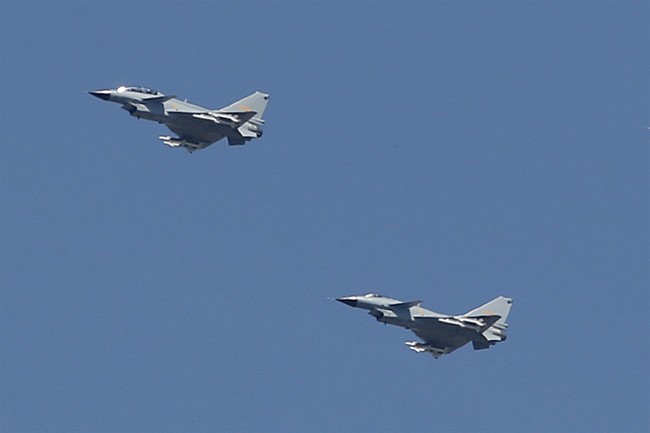
China’s recent use of a fire-control radar on Japanese F-15s off Okinawa has raised the stakes in the Western Pacific, testing Tokyo’s new leadership and U.S. commitments while reviving Cold War-style confrontations that could spiral if mishandled.
In early December, two Japanese F-15s reported being illuminated by Chinese fighters’ fire-control radar, a move widely seen as hostile because it signals a weapons lock and could precede a missile launch. Japan described the action as “dangerous” and “extremely regrettable,” lodging a formal protest and publicly warning Beijing that such behavior crosses accepted norms for safe air operations.
China’s foreign ministry pushed back aggressively, with Wang Yi accusing Japan of “threatening China militarily” and blaming Tokyo for stoking tensions over Taiwan. Wang’s comments dragged historical grievances into the argument, repeating that Japan should be more cautious as a “defeated nation” from World War II and suggesting Tokyo has no standing to raise security concerns.
Those personal attacks and historical lectures don’t change the basic fact on the table: pointing a fire-control radar at a partner’s fighters is an escalatory act. It’s a tactic straight out of a bygone playbook, the kind of calculated risk that pressures rivals and probes for weakness, and it forces a response from both Japan and the United States.
Japan’s leadership has been sharpening its posture, and Prime Minister Sanae Takaichi responded firmly, calling the radar illuminations beyond what is necessary for safe flight and stressing Tokyo’s protest. Her tone reflects a Japan rediscovering a tougher strategic voice, one that is willing to contest Chinese gray-zone coercion instead of backing down to intimidation.
Tokyo also insists its fighters kept a safe distance during the mission and disputes Beijing’s claim that Japanese jets obstructed Chinese operations. Those operational details matter because they tie into treaty obligations and the credibility of mutual defense assurances between Japan and the United States.
This incident isn’t isolated; it fits a broader pattern of Chinese probing along maritime and air boundaries around Taiwan, the East China Sea, and the South China Sea. Beijing tests neighbor and rival resolve with calibrated incidents, and when those probes succeed, the space for peaceful de-escalation narrows while the room for miscalculation grows.
From a Republican perspective, strength and clarity matter here: deterrence only works when it’s paired with a willingness to act and a visible capacity to do so. Displaying unwavering support for allies, investing in advanced defense systems, and ensuring operational readiness discourage provocations that invite dangerous responses in the sky.
The leadership question inside Beijing also deserves attention. Xi Jinping’s hold on power affects how risks are managed; if leadership becomes less predictable, rival capitals must assume a wider range of possible Chinese responses. That uncertainty increases the premium on allied cohesion and clear signaling to prevent misreads that could spiral into conflict.
Japan’s demographic headwinds and China’s massive forces both shape the balance, but capability and will are distinct. Japan fields high-quality platforms and has been upgrading its Self-Defense Forces. China has greater numbers, but quantity alone does not guarantee advantage when alliances, training, and technology are in play.
Diplomacy still has a role: clear channels between military commands, agreed rules of engagement, and crisis communication reduce the odds that a dangerous encounter turns into something far worse. That said, diplomacy works best backed by credible deterrence and a demonstrated commitment to defend partners if attacked.
Putting this in practical terms, Japan and the United States should keep improving interoperability, strengthen early warning and command links, and make clear the costs of escalatory acts like radar illumination. Such steps are straightforward ways to lower the risk of accidents and reinforce deterrence in a tense neighborhood.
For now, the radar incident is a reminder that the Pacific remains a competitive security environment where old tactics resurface and new leaders are tested. How Tokyo, Washington, and Beijing manage these encounters will shape regional stability for years to come, and nobody should mistake restraint for weakness when security is on the line.



Add comment