
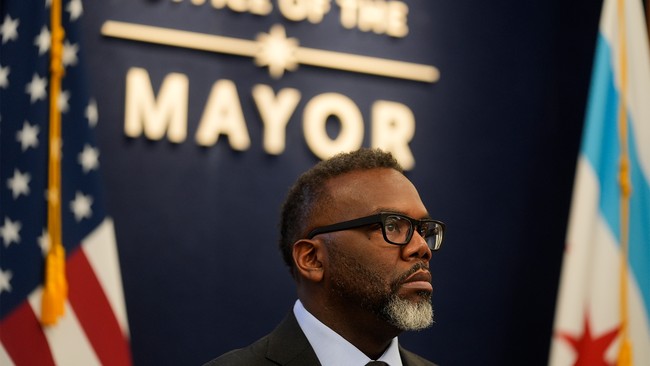
The family of Sheridan Gorman has publicly rebuked Chicago Mayor Brandon Johnson after his short statement about her killing, arguing that calling the slaying “senseless violence” without confronting policy failures is insufficient; the family demands accountability and concrete action to prevent future tragedies, while local and state leaders face criticism for delayed or evasive responses.
Sheridan Gorman was an 18-year-old Loyola freshman who was killed while walking with friends on Chicago’s lakefront. Her death has ignited a fierce debate over public safety, border policy, and political leadership in Illinois. The suspect is a 25-year-old repeat offender identified as Jose Medina, whose immigration status has become central to critics’ arguments about systemic failure.
Governor JB Pritzker and Mayor Brandon Johnson both faced heat for their initial responses. Pritzker did not immediately speak about the case and only issued a written statement through a spokesperson several days later. That delay and the tone of the remarks opened him to accusations of politicizing the tragedy instead of addressing its root causes.
When a reporter pressed Mayor Johnson about whether his policies had any role in Sheridan’s death, he replied in a way that many found evasive. The exchange was captured exactly as follows:
“Will you take this opportunity to apologize to Sheridan’s parents for the policies that you have promoted, that have directly caused her death? That suspect would not be in the city, would not be in the country, but for your policies. Will you take this opportunity to apologize?” a reporter asked.
“Once again, I believe that we’re all grieving the loss of Sheridan and other folks who have lost their lives because of senseless violence,” Johnson responded.
Less than a day after that exchange, Mayor Johnson publicly unveiled a snowplow emblazoned with anti-ICE messaging, a move critics called tone deaf given the family’s grief and the national attention on the case. That incident amplified the view among Sheridan’s family and supporters that political theater was taking priority over public safety. The snowplow event is now a focal point for those arguing leadership is out of step with community needs and demands for accountability.
The Gorman family released a detailed statement that rejected the label of a random tragedy and demanded candid answers. Their words are reproduced here exactly as issued to convey the force and specificity of their demands:
We acknowledge Mayor Johnson’s statement five days after our daughter, Sheridan’s murder and his condolences to our family, as well as his recognition of the work of the Chicago Police Department.
But what happened to Sheridan cannot be reduced to a “senseless tragedy,” nor can it be explained in general terms about public safety. Sheridan was our daughter. She was 18 years old. She was doing something entirely normal—walking near her campus with friends. She should be here.
This was not random. It was not inevitable. And it cannot be treated as though it were.
We appreciate the efforts of law enforcement in making an arrest. But safety is not defined by how quickly a case is solved after the fact. It is defined by whether a young woman like Sheridan is protected in the first place.
Our daughter was not in the wrong place at the wrong time. The system failed her.
Calling this “senseless” is not enough. There must be a clear and honest accounting of what went wrong.
We are not interested in rhetoric. We are asking for accountability.
We will not allow Sheridan’s life to be reduced to a talking point or a generalization. We expect leadership that is willing to confront hard truths and ensure that what happened to her does not happen again.
We stand ready to engage with the Mayor and any public official willing to approach this with seriousness, transparency, and a commitment to real change.
The family’s language is blunt and unambiguous: they want action, not platitudes. That stance has resonated with residents who feel unsafe and with families who expect their leaders to prioritize protection over politics. Across the city, people are asking why policy choices that shape enforcement and public-safety priorities were not being confronted head-on earlier.
Critics point to a pattern where local officials emphasize symbolic statements or campaigns while avoiding hard policy trade-offs that could affect public safety. The Gorman case has highlighted this tension, turning grief into a political flashpoint. Families and community members are demanding reforms that would prevent repeat offenders from being on the streets and address enforcement gaps they say allowed this suspect to remain at large.
Law enforcement has made an arrest, and that development brought relief to the Gorman family, but it did not end the debate. The family insists that a solved case is not the same as safety restored. Their insistence on accountability focuses attention on prevention: who failed, how the system let it happen, and what leaders will do to stop similar tragedies.
There’s also a cultural element fueling criticism: many residents feel that rhetoric about compassion or reform cannot eclipse the immediate need for public safety. That argument has become more pointed when the suspect’s immigration status is mentioned, turning a criminal case into a larger showdown over immigration policy and local priorities. Those debates are not going away as calls for concrete policy fixes grow louder.
Editor’s Note: Democrat politicians and their radical supporters will do everything they can to interfere with and threaten ICE agents enforcing our immigration laws.

Add comment