
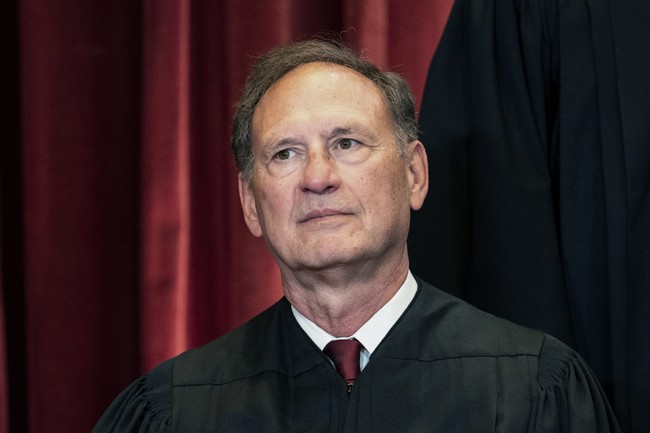
The Supreme Court declined to lift a lower court order that stops the immediate deployment of National Guard forces to Chicago, prompting a sharp dissent from Justice Samuel Alito who called the majority’s move “unwise” and “imprudent.” This piece explains Alito’s objections, the court’s reasoning about “regular forces,” and the political heat surrounding the decision, while preserving the core quotes and embedded materials.
The decision left the administration barred, for now, from sending Guard members into Illinois, and it sparked predictable frustration among conservatives who see judicial obstruction of executive action. Supporters of the president argue that protecting federal officers should be straightforward, especially when officials on the ground report threats to their safety. Opponents counter that the law strictly limits military or paramilitary involvement in domestic law enforcement without clear statutory grounding.
Justice Alito’s dissent reads like a rebuke to the majority’s approach, emphasizing deference to the president when federal personnel face danger. He explicitly criticized the 6-3 ruling for what he called “unwise” and “imprudent” legal determinations that, in his view, improperly shifted authority away from the executive branch. Alito’s language made clear he believes the court’s action could undermine on-the-ground protection for federal agents.
Alito wrote in part: “The majority also did not give enough deference to Trump after the president found that agitators were hindering immigration officers and other federal personnel from doing their jobs in Chicago and that the National Guard needed to step in to help.” He went on to state, “Whatever one may think about the current administration’s enforcement of the immigration laws or the way ICE has conducted its operations, the protection of federal officers from potentially lethal attacks should not be thwarted.” These sentences were central to his critique of the majority’s restraint.
Conservative commentators and some federalist observers echoed Alito’s concern that delaying Guard support risks the safety of agents in volatile situations. They argue the president has constitutional duties to protect federal officers and property, and that the courts should avoid second-guessing urgent security judgments. That view frames the majority order as a legal overreach with real-world consequences rather than a mere technical ruling.
The majority’s unsigned order focused narrowly on what constitutes “regular forces,” drawing a distinction between the U.S. military and civilian law enforcement like ICE. The court said “regular forces” means the U.S. military and found no evidence that the military was being considered or was necessary before turning to the National Guard. That textual interpretation drove the decision to keep the lower court’s block in place for now.
A key passage the majority relied on explained that because the president had not shown any justification for using the regular military for domestic purposes in Chicago, the option could not be deemed exhausted before considering Guard deployment. That reading of statutory and constitutional limits on domestic military use is what led the court to withhold immediate approval for the Guard mission. For the majority, adherence to statutory categories mattered more than urgent executive judgments about local threats.
Alito did not stand alone; Justice Clarence Thomas joined his dissent, and Justice Neil Gorsuch filed a separate dissent of his own. Alito pressed further that the president’s inherent constitutional authority to protect federal officers should have been enough to validate the Guard’s use in the affected areas. He signaled serious doubts about the majority’s legal conclusions and strong disagreement with how the application was handled.
Alito wrote: “On top of all this, the Court fails to explain why the President’s inherent constitutional authority to protect federal officers and property is not sufficient to justify the use of National Guard members in the relevant area for precisely that purpose. I am not prepared at this point to express a definite view on these questions, but I have serious doubts about the correctness of the Court’s views. And I strongly disagree with the manner in which the Court has disposed of this application.” That language frames his core constitutional argument.
After Alito’s dissent, commentators warned that the ruling could “Will put agents in danger and cede the authority to protect them to the Supreme Court.” Those reactions capture the immediate political fallout and the urgent security worries cited by the dissenters. The dispute now centers on how far judicial review should reach when the executive claims authority to deploy forces to protect federal operations within a state.
The majority’s technical reading and the dissent’s constitutional argument set up a broader debate about separation of powers, emergency response, and the boundaries of domestic force deployment. The controversy will likely continue through further filings and possible future rulings that test how courts balance statutory text against claims of executive necessity. Meanwhile, federal officers and local communities remain in a tense limbo as the legal fight plays out.

Add comment