
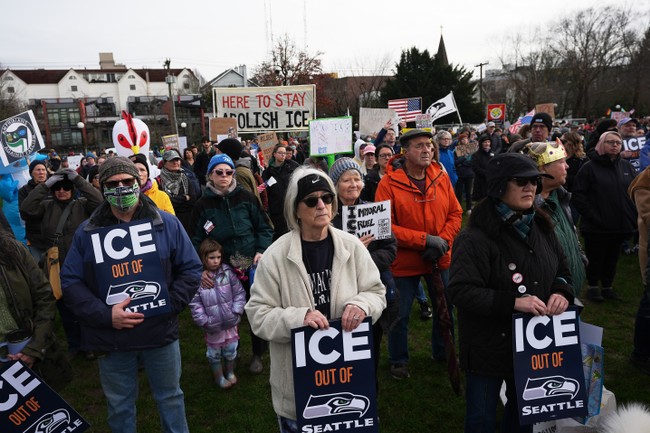
This piece examines a proposed Washington state bill that would bar recently hired ICE agents from future state or local law enforcement jobs, explains the constitutional and practical stakes, records reactions from lawmakers, and notes similar measures elsewhere while arguing the bill is politically motivated and harmful to public safety.
The debate centers on House Bill 2641, introduced by Rep. Tarra Simmons, which would prevent ICE agents hired after Jan. 20, 2025, from later taking law enforcement positions in Washington. That cutoff date tracks the start of President Donald Trump’s second term and makes the ban clearly targeted at a specific federal administration. The proposal treats federal service as disqualifying based on politics, not on individual conduct or qualifications.
Constitutional conservatives and law enforcement advocates see this as a raw power play that undermines federal authority. The Constitution assigns immigration enforcement to the federal government, and ICE exists to carry out those lawful duties. When a state punishes people for following federal law, it creates a dangerous precedent that chips away at cooperative public safety efforts.
Supporters of the bill argue it protects local policing culture from federal influence, claiming “training differences” justify the restriction. Rep. Simmons said, “I think the people who are signing up to be part of this administration’s immigration enforcement and the tactics they’re using across Washington is really concerning, and I don’t want people that are trained in that culture to come and infiltrate our culture.” That line makes plain the bill’s intent: to keep out people because of the policies they implemented under a different administration.
Opponents call the measure discriminatory and damaging to an already thin recruitment pool. Republican Rep. Brian Burnett, a former Chelan County sheriff, warned that Washington ranks last in the nation for officers per capita and that excluding qualified professionals based solely on prior federal service is arbitrary and harmful. Practical public-safety concerns matter when recruiting and staffing local police and sheriff’s departments.
Beyond staffing, the policy reflects a broader trend: state-level hostility toward federal immigration enforcement. Similar proposals have shown up in Maryland and Illinois, aiming to shut out ICE veterans from local roles. When states adopt recruitment bans for political reasons, they genuinely risk reducing the number of experienced investigators and administrators who could help keep communities safer.
There’s also a factual record about ICE’s enforcement results that matters to this debate. During the referenced period more than 670,000 illegal aliens, including serious criminals, were removed and roughly two million reportedly self-deported, according to a Department of Homeland Security recap. Framing enforcement of immigration law as an existential threat to local culture ignores the concrete public-safety outcomes that stem from federal action.
Labeling federal immigration enforcement “the tactics they’re using across Washington” as a local problem is a political framing, not a neutral assessment of law enforcement practice. Federal accountability mechanisms, oversight, and legal constraints already exist, so the proper response to disputed tactics is oversight and litigation, not blanket exclusion from unrelated local jobs. Rules that single out former federal employees for political reasons are discriminatory by design.
On Wednesday, Rep. Tarra Simmons, D-Bremerton, introduced the ICE Out Act of 2026, a proposal aimed at barring ICE agents from later becoming law enforcement officers in Washington state. House Bill 2641 specifically applies to ICE agents who were hired after President Donald Trump began his second term on Jan. 20, 2025.
Making public-safety policy on the basis of political revenge invites long-term harm. Communities need qualified officers, investigators, and leaders who understand how federal and state enforcement intersect. When political litmus tests start deciding who can serve, expertise and public safety lose out to partisan theater.
Policymakers who genuinely want safer streets should prioritize recruitment, retention, and cooperation across jurisdictions rather than reducing the pool of candidates. Banning experienced candidates because of their agency affiliation is a blunt instrument that responds to politics instead of facts. The stakes are straightforward: more qualified professionals mean better outcomes for citizens, not fewer.
I think the people who are signing up to be part of this administration’s immigration enforcement and the tactics they’re using across Washington is really concerning, and I don’t want people that are trained in that culture to come and infiltrate our culture.
In short, a policy that disqualifies people for state employment based on their federal role is a politically motivated approach with real consequences for public safety. Legislatures should weigh those consequences honestly and craft law that protects citizens, not punishes public servants for enforcing federal law. The debate will continue in Olympia, but the practical implications for recruitment and community safety deserve the spotlight.

Bullshit! These Demoncraps are insane and even evil! They can take a flying leap into hell!