
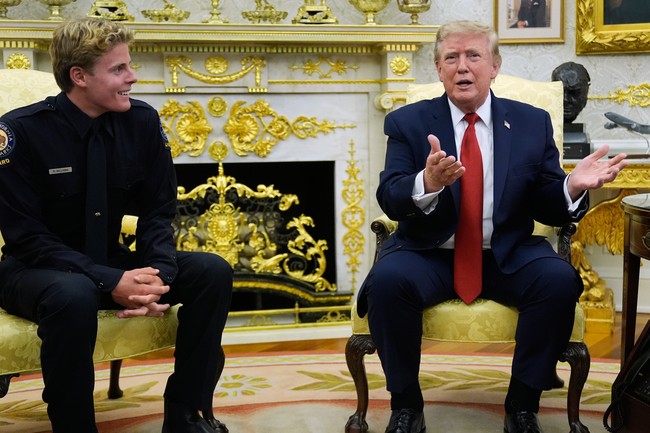
This piece recounts how 16-year-old lifeguard Ryder Williams pulled a 10-year-old from powerful surf at Seabright Beach and was later honored in the Oval Office by President Donald Trump, highlighting the rescue, the White House meeting, the boys’ brief remarks, and Ryder’s message to his generation.
The rescue happened in dangerous 8- to 10-foot swells driven by distant tropical storms, and the footage of the incident drew massive attention online. The clip that captured the rescue has tens of millions of views, and it turned Ryder into an instant example of calm skill under pressure. His quick thinking and training saved a young life, and that action carried him all the way to Washington.
President Trump followed through on a promise to honor the teenager, inviting Ryder Williams and the boy he rescued, Nathaniel Rai, to the Oval Office. The meeting had moments of warmth and levity, with the president joking about not being on lifeguard duty that day and praising Ryder’s bravery. It was a public acknowledgment of a citizen act that illustrates personal responsibility and courage.
https://x.com/EricTrump/status/2081834610757927248
During the Oval Office visit, the president praised Ryder as “a real hero” and made light remarks meant to ease the moment for the kids in the room. The exchange was brief but sincere, underscoring the value of young people stepping up in emergencies. The White House setting elevated a local lifeguard’s deed into a national example of selflessness.
Trump spoke directly to Nathaniel and Ryder, offering admiration and a touch of humor, telling the boy he was lucky it wasn’t “Lifeguard Trump” that day. He called Ryder “a real hero” and noted that God was watching over Nathaniel during the incident. Those lines framed a simple rescue as both a civic act and a human moment.
You know, it’s so exciting to see something like this happen. He’s a real hero.
You know, when you see that… I don’t know if I’d do it — I wouldn’t, probably. [Laughter.] You’re lucky; I wasn’t on the service that day. I don’t know.
But no, he’s a real hero. It’s an amazing thing. [Indicates Nathaniel.] And here’s a real lucky guy, too.
God was watching you, right?
Nathaniel: “Yeah.”
The spotlight on Ryder didn’t stop at the Oval Office. Interviews and follow-up pieces focused on how he handled the emergency and what motivated him to act when others might have frozen. The uniform training and the quick assessment of risks were central to his own explanation of what happened. That preparedness is exactly what communities need in moments when seconds matter.
Ryder described falling back on training to get the boy to safety, emphasizing that lifeguards are drilled to respond in these exact scenarios. He said he was thinking about how to get the boy out of the water as fast as possible, a straightforward account from a teenager who clearly kept his head. The calm in his words is as impressive as his actions on the sand.
The young lifeguard’s future plans lean toward public service; he said he wants to be a firefighter and hopes to attend paramedic school. President Trump joked that recommendations would be on the way, and the room laughed, but the point stuck: Ryder’s instincts push him toward service roles that protect others. People who act like that are exactly the kind of citizens communities want more of.
When asked what message he had for his generation, Ryder offered a simple but meaningful plea: look out for one another and help as much as you can. That is a practical, action-oriented ethic that resonates beyond the beach. It’s a reminder that small acts of responsibility add up to safer neighborhoods and stronger communities.
Nathaniel’s life was saved thanks to a teenager who trained, stayed focused, and acted decisively. The Oval Office recognition recognized more than one rescue; it highlighted a character trait we should encourage in young people. Ryder Williams’ conduct is the kind of example that deserves attention and respect.


Add comment