
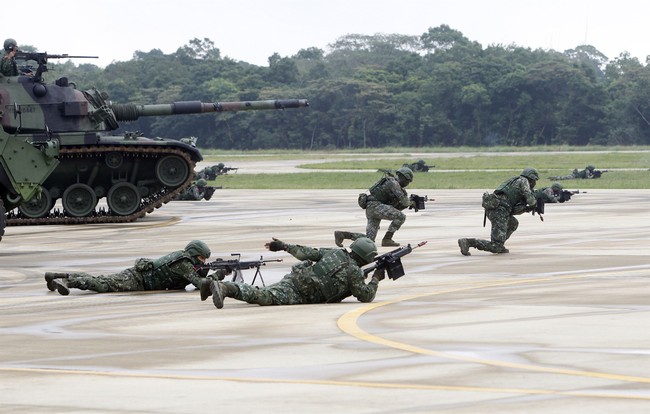
This article reviews the new 2025 China Military Power Report, the Trump administration’s $11 billion arms package to Taiwan, and the broader strategic picture across the Taiwan Strait, arguing from a Republican perspective that strong deterrence, timely deliveries, and co-production are essential to keep Taiwan secure and deter Beijing’s coercion.
The Pentagon’s 2025 China Military Power Report is blunt: China has intensified pressure on Taiwan, and the document mentions Taiwan 232 times. The report catalogues a sharp uptick in Chinese military activity, from a surge in air defense identification zone incursions to near-weekly joint combat patrols, and it calls attention to named exercises that simulated blockades and encirclement. For Republicans who prioritize hard power and clear-eyed deterrence, the report reinforces the case for equipping allies to impose real costs on aggression.
The PLA’s pressure around Taiwan can be placed in three categories: daily activity around the island, near weekly joint combat patrols, and response exercises conducted during periods of heightened political tension. In 2024, the PLA increased the number of entrances into Taiwan’s air defense identification zone to 3,067 incursions from 1,641 in 2023, according to Taiwan Ministry of National Defense (MND) data. In 2024, PLA conducted 38 total joint combat readiness patrols, a near-weekly surge of air and naval activity around Taiwan. Additionally, in 2024 the PLA conducted two largescale shows of force through named exercises in response to perceived provocations. These exercises—JOINT SWORD-2024A and JOINT SWORD-2024B— were conducted in response to President Lai’s inauguration in May 2024 and his National Day 44 speech on 10 October 2024, respectively. During both exercises, the PLA conducted simulated joint blockade operations around Taiwan, including the China Coast Guard publicly highlighting an encirclement of Taiwan during the second iteration.
The report makes a sober assessment of Beijing’s intent, noting the repeated omission of “peaceful unification” in recent high-profile statements and combining that with escalating military maneuvers. It warns that Beijing is pressing for coerced progress toward unification and is actively refining military options to make that outcome possible. From a Republican vantage point, this underlines the need not just for rhetoric but for credible, practical measures that raise the price of aggression and strengthen allies’ capacity to defend themselves.
Beijing is undertaking a determined effort to coerce Taiwan to unify with China. It does not merely seek to deter Taiwan from formally declaring its independence; instead, it seeks to apply near constant pressure on Taipei to reach meaningful but coerced progress toward unification on Beijing’s terms. The repeated omission of “peaceful unification” language in high-profile statements in 2024 and 2025, combined with China’s substantial military operations around Taiwan in 2024 and 2025, indicate that Beijing is seeking to compel Taipei’s unification through a concerted pressure campaign, combined with positive inducements, rather than only deterring independence.
The report also outlines concrete options Beijing could use to seize Taiwan, including amphibious invasion, precision strikes, and maritime blockade, and it estimates PLA strike ranges that could reach 1,500 to 2,000 nautical miles. Those capabilities, if fielded in sufficient volume, would pose a serious challenge to U.S. forces operating in the region. Republicans who prioritize national security must accept that deterrence requires not only statements of support but arms, logistics, and industrial capacity to make deterrence credible.
In pursuit of these goals, the PLA continues to refine multiple military options to force Taiwan unification by brute force. Those options include, most dangerously, an amphibious invasion, firepower strike, and possibly a maritime blockade. Over 2024, the PLA tested essential components of these options, including through exercises to strike sea and land targets, strike U.S. forces in the Pacific, and block access to key ports. PLA strikes could potentially range up to 1500-2000 nautical miles from China. In sufficient volume, these strikes could seriously challenge and disrupt U.S. presence in or around a conflict in the Asia-Pacific region.
In response, the Trump administration approved an $11 billion arms package to Taiwan in December, the largest proposed sale to the island to date. Beijing reacted predictably with diplomatic protest and sanctions against U.S. defense firms, but the move sends a clear signal: the United States will back Taipei’s ability to defend itself. From a Republican perspective, backing Taiwan’s porcupine defense with modern systems like drones and long-range rockets is the right mix of deterrence and economy.
China’s foreign ministry invoked the one-China principle to denounce the sale, but Washington’s longstanding one-China policy is distinct and pragmatic: it recognizes Beijing’s view without endorsing forced unification. Republican strategy emphasizes that U.S. commitments should be clear—help Taiwan defend itself—while refusing to appease coercion. Reagan-era guidance and the Taiwan Relations Act remain the baseline for how to balance deterrence with diplomatic ambiguity when necessary.
Taiwan’s own defense reforms and President Lai’s supplementary budget aim to boost asymmetric capabilities, a porcupine approach designed to make any invasion prohibitively costly. The U.S. package overlaps with Taipei’s priorities and can meaningfully strengthen cross-strait deterrence. That outcome matters for our allies in the region and for maintaining a balance of power that favors freedom over coercion.
Delivery timelines are a serious concern: the current U.S. weapons backlog to Taiwan sits at $21.54 billion, and procurement without prompt delivery reduces deterrent effect. Republicans pushing for robust support should also press to fix bottlenecks, accelerate approvals, and expand co-production to relieve pressure on the U.S. defense industrial base. Congressional steps like the PORCUPINE Act aim to speed transfers and treat Taiwan similarly to NATO partners, which is a practical, pro-defense measure.
Co-production and industrial cooperation are practical ways to increase resilience and capacity while deepening interoperability with Taipei. Recent co-production deals and NDAA provisions that fund Taiwan security initiatives and a joint drone program are steps in the right direction. If the United States wants to deter Beijing effectively, Republicans should keep contesting gray-zone coercion and investing in real capabilities that strengthen allies and preserve a free Indo-Pacific.


Add comment