
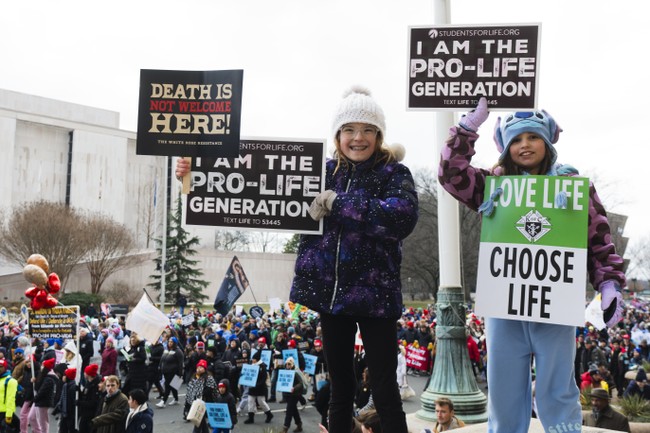
The March for Life marked its 53rd year in Washington with a clear Republican message: the current administration and Congress are pushing policies that protect unborn life, restrict federal funding for abortion providers, and shift research and international aid away from practices viewed as morally unacceptable by social conservatives.
Friday’s march carried the theme “Life is a Gift,” and Secretary of Transportation Sean Duffy shared personal testimony celebrating that idea through his daughter Valentina, who has Down Syndrome. Duffy praised the administration as “the most pro-life administration in U.S. history” and thanked the president for publicly defending the unborn. Personal stories like Valentina’s have become a focal point for advocates who want policy aligned with their moral convictions.
I am so proud to be a part of the most pro-life administration in U.S. history & work for a President who fully supports the most important human rights march in America – the annual March for LIFE
Thank you @POTUS for defending life in the womb & for reminding every child, as you did before Congress last year, that “God made you perfectly.”
90% of babies diagnosed with Down Syndrome are aborted. Our youngest daughter, Valentina, has Down Syndrome. She is the best thing that ever happened to our family. An angel on earth!
God bless our pro-life marchers who brave the cold to fight for our most vulnerable and voiceless citizens – the unborn & those with special needs.
That endorsement ties into recent policy moves in Washington. Congress and the administration have targeted federal funding streams that previously flowed to abortion providers and have pursued regulatory changes to limit federally funded research involving fetal tissue. These actions signal a coordinated approach that mixes legislative and executive tools to advance a pro-life agenda.
Historically, pro-life policy has had fits and starts: the Hyde Amendment in 1976 restricted federal Medicaid funding for abortions, and the Partial-Birth Abortion Ban was signed during the George W. Bush era. The current administration has focused on expanding those protections, while Congress has used appropriations riders and the One Big Beautiful Bill to cut funding to groups like Planned Parenthood for at least a year.
That funding restriction, though temporary, had practical effects. Lawmakers argued it was a way to pass broader legislation without triggering a full-scale partisan fight, and the result helped accelerate clinic closures. A 2025 survey by Operation Rescue reported 54 clinics closed or stopped doing abortions that year, with 36 of those being Planned Parenthood affiliates.
Planned Parenthood also closed an additional 28 referral locations since OR’s last survey, which amounts to a record total of 64 Planned Parenthood closures in one year.
“It’s been a gloriously bad year for Planned Parenthood,” says Troy Newman, President of Operation Rescue, “which means a banner year for the preborn. When abortion clinics close, babies are saved.”
A federal appellate court later upheld the administration’s pause on funds to Planned Parenthood, noting the executive branch may withhold payments not appropriated by Congress. The ruling underscored the administration’s authority to enforce funding priorities and redirected roughly $792 million away from groups that performed abortions. Supporters argue those dollars can be rerouted to programs that promote life-affirming alternatives.
The administration also moved to end the use of fetal tissue in federally funded research and to restrict international aid to organizations that perform or promote abortion. Officials framed these changes as both moral and scientific: investing in modern alternatives while aligning taxpayer-funded research with conservative values. NIH leadership described the shift as part of a broader modernization effort.
Effective immediately, National Institutes of Health funds will no longer be used for research that involves the fetal tissue of aborted babies. That policy will apply to all NIH grants, cooperative agreements, transaction awards, research and development contracts, and the NIH Intramural Research Program.
The move is a significant win for the pro-life movement, which has long pushed for the United States to respect the dignity of the unborn, whose tissue is bought by researchers after abortions. Under the first Trump administration, the president banned intramural use of aborted fetal tissue, meaning research conducted within United States government facilities.
This time, Trump’s NIH is going further, stating that it will not fund any research involving tissue from aborted babies. The institute frames the move as a significant milestone in the Trump administration’s efforts to “modernize biomedical science and accelerate innovation,” but it comes just one day before the annual March for Life, a significant nod to the pro-life Americans gathering in Washington who have worked for years to arrive at this moment.
“NIH is pushing American biomedical science into the 21st century,” NIH Director Jay Bhattacharya said Thursday. “This decision is about advancing science by investing in breakthrough technologies more capable of modeling human health and disease. Under President Trump’s leadership, taxpayer-funded research must reflect the best science of today and the values of the American people.”
The House also passed a bill requiring universities that receive federal funds to provide pregnant students with information on carrying pregnancies to term rather than steering them automatically to abortion referrals. Advocates called this a common-sense protection aimed at giving young women real options on campus.
JUST IN: US House PASSES legislation on the eve of March for Life requiring universities that receive federal dollars to give information to pregnant students on carrying the baby TO TERM – rather than abortion, 217-211
This is the way.
Save the children.
Title X funding was another battleground, with the administration freezing grants tied to DEI initiatives and enforcing new regulations that bar funds from programs where abortion is a method of family planning. After a court fight required the funds to be released, several Planned Parenthood affiliates declined the restored grants, a move critics took as proof that the organization prioritizes abortion access above other family planning services.
1008 – The Prohibition of Abortion
None of the funds appropriated under this title shall be used in programs where abortion is a method of family planning.
SCOOP: Several Planned Parenthood affiliates have notified the Trump administration that they are refusing $2.3 million in grants that were recently unfrozen as part of a federal lawsuit, according to a letter obtained by @DailyCaller.
The grants were originally frozen because of DEI-related investigations.
The admin previously made it clear that the restored grants would still be reviewed under new grant regulations permitting HHS to consider whether these grants were effectuating Administration priorities, an official tells me.
Vice President JD Vance spoke at the march and announced a dramatic expansion of the Mexico City Policy, extending restrictions across a broader swath of foreign assistance and tying funding standards to opposition to DEI and certain gender ideologies. His remarks framed these moves as part of a sustained commitment to pro-life principles in both domestic and international policy.
Vance’s speech included this declaration:
And today, our administration is proud to announce a historic expansion of the Mexico City Policy. We’re going to start blocking every international GO that performs or promotes abortion abroad from receiving a dollar of U.S. money. Now, we’re expanding this policy to protect life, to combat DEI, and the radical gender ideologies that prey on our children. And with these additions, the rule will now cover every non-military foreign assistance that America sends. All-in-all, we have expanded the Mexico City Policy about three times as big as it was before, and we’re proud of it because we believe in fighting for life.
For activists and political leaders on the right, these policy wins are tangible outcomes rather than rhetorical promises. The administration’s mix of regulatory action, funding decisions, and legislative priorities has reshaped the federal landscape on abortion, research, and related funding streams in ways social conservatives say reflect their values.
Those outcomes will keep the debate active in Congress and on the campaign trail as the 119th Congress and the administration continue to press for policies that prioritize unborn life and support alternatives to abortion.



Add comment