
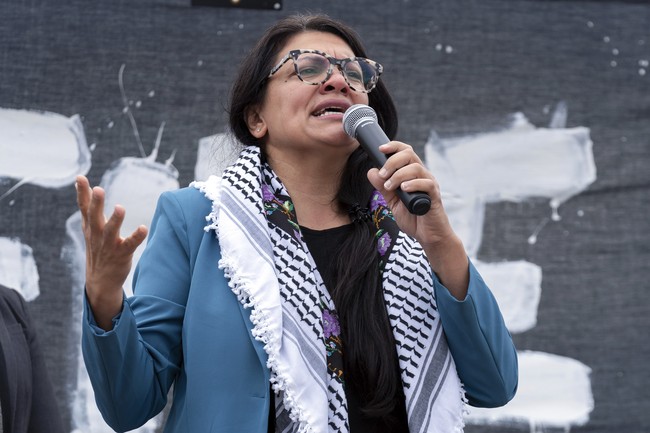
The ISGAP Action briefing accuses Representative Rashida Tlaib of sustained connections to individuals and groups tied to U.S.-designated terrorist organizations, citing paid consulting work, shared stages with convicted operatives, and rhetoric that allegedly aligns with violent militants. The report highlights nearly $600,000 in campaign payments to a consulting firm led by Rasha Mubarak, appearances with figures linked to the PFLP, and public statements that the authors say glorify violence. Those findings raise ethical and national security questions, and they have sparked calls from conservative observers for accountability in Congress.
The new ISGAP Action briefing lays out a pattern of relationships and actions that conservatives find alarming. It claims Tlaib has shared platforms with convicted operatives and appeared at events displaying banners of groups the U.S. has identified as terror proxies. From a Republican viewpoint, those associations are not idle political disagreements but potential risks to institutional integrity and public safety.
The report points to campaign spending as one of the clearest pieces of evidence, noting the nearly $600,000 funneled to a consulting firm run by Rasha Mubarak. The briefing highlights Mubarak’s prior affiliations and the firm’s anti-Israel activities, arguing the payments merit scrutiny. For those concerned about foreign influence and soft support for terror-linked networks, the money trail is a central concern.
“Key areas of concern include her participation in conferences organized by or featuring individuals affiliated with U.S.-designated terror organizations,” the briefing states, including remarks about sharing stages with Wisam Rafeedie and speaking at events where Samidoun banners were displayed. The report preserves those exact words to underline its point that rhetoric and associations were documented. Conservatives read that passage as confirmation that this is more than political posturing.
The briefing also quotes Tlaib’s comments at events as aligning with ideological frameworks that glorify martyrdom and resistance. “Her comments at these events have included the glorification of ‘martyrs’ and calls for continued resistance, aligning her rhetoric with the ideological framework of jihadist organizations,” the report reads. That language is meant to show a link between public statements and extremist ideology, and it is being used to justify calls for formal inquiries.
The PFLP, one of the groups referenced, has been tied to deadly attacks in the past, including an incident involving the killing of a 17-year-old girl. The report mentions such incidents to provide context for why associations with affiliated individuals matter. From a Republican perspective, any links—direct or indirect—to groups that have committed violence demand thorough investigation.
Beyond events and rhetoric, the briefing digs into campaign operations and personnel, arguing those operational ties matter for ethics and national security. It raises the question of whether a member of Congress should maintain campaign relationships with firms whose leaders have controversial histories. For conservatives, this is not merely a political debate; it’s a question of who should be trusted to represent the nation in sensitive matters.
“The conduct of Congresswoman Rashida Tlaib, including her rhetoric, affiliations, campaign infrastructure, and ideological alignment with certain individuals and organizations, raises serious concerns about potential risks to the ethical and institutional integrity of the United States government,” the report reads. That passage has been widely cited by critics who argue the House must consider stronger measures than censure. Republicans argue the statement makes clear that institutional risk cannot be ignored.
The ISGAP Action briefing also revisits past episodes cited by critics, including appearances at art shows and public events where slogans and materials associated with militant groups were displayed. Conservatives stress that these were not isolated incidents but part of a pattern across years. That pattern, they contend, shows a steady proximity to actors and messages hostile to American allies and values.
Conservative analysts emphasize prior problematic behavior, noting earlier censure and instances of sharing disinformation used by militant backers. They view Tlaib’s public defenses of controversial causes and her emotional protests as politically convenient cover for deeper sympathies with violent actors. Many Republicans say those patterns warrant formal ethics investigations and tougher consequences than have been applied so far.
Observers in the GOP are particularly focused on the national security implications of campaign payments and organizational ties, arguing that money and messaging create vulnerabilities. The nearly $600,000 highlighted in the report is framed as proof of a sustained relationship that went beyond casual contact. Republicans who see national security through a hard lens believe these details cannot be dismissed as partisan smears.
Those calling for action argue it is not enough to express outrage; concrete measures are required to protect the House and the country. They want clear, transparent investigations into the financial and organizational links the report documents, and they want answers about Tlaib’s judgment and fitness for office. In the GOP view, protecting institutions means holding members to high ethical and security standards.
Toss that evil Criminal Traitor into GITMO!