
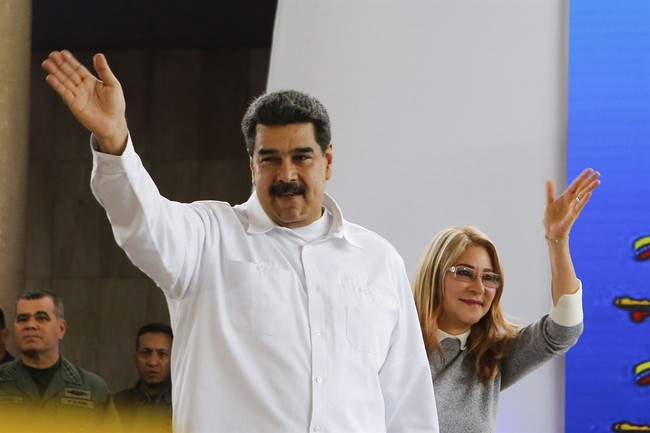
The Southern District of New York has returned indictments against Venezuelan President Nicolás Maduro and his wife, Cilia Flores, charging them with narcotics and weapons offenses after their capture in a U.S. operation that President Trump called a “large-scale strike.” This report lays out the charges, the official statements, and the known logistics of how the pair were taken into U.S. custody.
Nicolás Maduro and Cilia Flores have been formally charged in Manhattan, according to Attorney General Pam Bondi. The indictment lists counts that include narco-terrorism conspiracy, cocaine importation conspiracy, possession of machineguns and destructive devices, and conspiracy to possess those weapons against the United States. Those are severe federal charges that carry significant penalties and place the case squarely in federal court in New York.
Bondi released a statement to social media early Saturday confirming the indictment and outlining the specifics. “Nicolas Maduro and his wife, Cilia Flores, have been indicted in the Southern District of New York,” Bondi said. “Nicolas Maduro has been charged with Narco-Terrorism Conspiracy, Cocaine Importation Conspiracy, Possession of Machineguns and Destructive Devices, and Conspiracy to Possess Machineguns and Destructive Devices against the United States.”
The attorney general also praised the executive branch and the military for the operation that led to the capture. “They will soon face the full wrath of American justice on American soil in American courts,” she added, and she publicly thanked President Trump and military forces for the mission. That language signals the Justice Department intends to push the case through the federal system and to emphasize accountability for alleged international narco-trafficking activity.
President Trump announced the operation in a brief morning statement, describing the mission as a coordinated effort with law enforcement. “The United States of America has successfully carried out a large-scale strike against Venezuela and its leader, President Nicolás Maduro, who has been, along with his wife, captured and flown out of the Country,” he said. He emphasized the law enforcement partnership that accompanied the operation.
Trump provided additional color in a later interview, describing the transfer by helicopter and the route taken after the capture. “The helicopters took them out, and they went by helicopter on a nice flight. I’m sure they loved it, but they’ve killed a lot of people, remember that,” he said. “Even people in their own country. They killed a lot of people to maintain power. He’s a very vicious person.”
Officials say Maduro and Flores were moved onto a U.S. Navy vessel after the capture, with the USS Iwo Jima named in early reporting as the staging point for their transfer. From there, the pair were transported to the continental United States to face federal proceedings in Manhattan. Federal authorities have signaled the possibility of an early court appearance and rapid processing under typical federal protocols for high-profile international defendants.
Legal experts note that indictments from the Southern District of New York carry broad investigative reach and considerable prosecutorial experience with international narcotics networks. The narco-terrorism count in particular links organized trafficking to violent or destabilizing conduct and elevates the gravity of the case. Prosecutors will likely pursue evidence tying international shipments and weapon procurements directly to the defendants and their alleged network.
There are geopolitical implications tied to bringing a foreign head of state into U.S. custody and trying them in ordinary federal court. The move could provoke diplomatic fallout and will almost certainly be scrutinized by allies and adversaries alike. Within legal circles, debates will arise about sovereign immunity defenses, political questions, and the proper venue for such claims, but the indictment itself establishes the U.S. government’s criminal framework for moving forward.
Federal court timing and logistics remain fluid as authorities prepare arraignment and detention proceedings in Manhattan. Court watchers expect an initial appearance to follow the usual pattern: formal reading of charges, appointment or confirmation of counsel, and decisions about detention and plea scheduling. Given the high-profile nature of the defendants and the national security component, security and secrecy measures will likely be heightened during early hearings.
Domestic reaction includes statements of approval from law enforcement allies and praise from some political leaders for decisive action. Critics and foreign governments may respond with objections or reciprocal rhetoric, and international courts or human rights organizations could weigh in on procedural fairness. Still, the immediate legal reality is a federal indictment that moves the case into the U.S. judicial system for adjudication.
The coming days will flesh out the prosecution’s public filings, the defense response, and how the judiciary manages such a rare and consequential case. Media coverage will track court dates, evidence disclosures, and any diplomatic developments that stem from the transfer and indictment. For now, the charges filed in Manhattan frame a major federal criminal case with global implications.



Add comment