
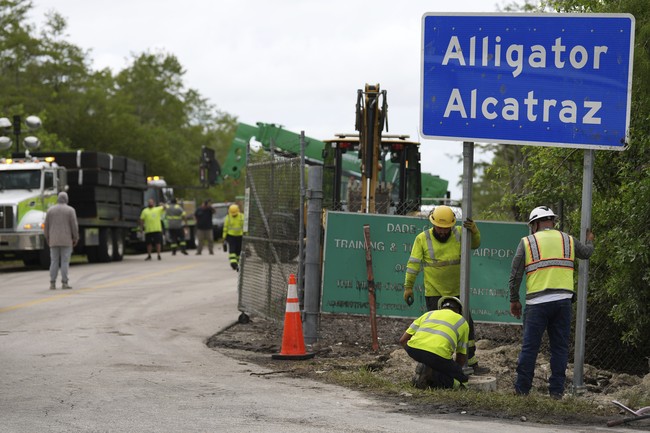
The 11th Circuit Court of Appeals has overturned a district court injunction that halted construction and ordered the dismantling of the immigrant detention center nicknamed “Alligator Alcatraz,” finding that the project lacks sufficient federal involvement to trigger the National Environmental Policy Act and that courts have limited power to enjoin immigration operations.
11th Circuit Torpedoes Injunction Against Alligator Alcatraz became the headline after a three-judge panel vacated the sweeping order that had paused construction and required the facility to be emptied within 60 days. The earlier decision by District Judge Kathleen Williams concluded NEPA was likely violated and imposed a broad remedy, but the state and federal defendants appealed and won a stay pending appeal. The appeals court sent the case back for further proceedings without the injunction in place.
The 11th Circuit emphasized that Florida officials, not federal agencies, built and controlled the site, pointing out that the state paid for and retained final authority over decisions about size, materials, and operation. The opinion found the only federal involvement was the choice not to perform an environmental review, and that alone does not count as final agency action under existing precedent. Because NEPA applies when there is federal decision-making, the court concluded the Act did not apply here.
A central passage of the court’s opinion states, in part:
Florida, not federal, officials constructed the facility. They control the land and “entirely” built the facility at state expense. The only federal action the environmentalists can identify is the decision not to conduct an environmental review. And that decision alone, as all parties agree, is not final agency action. See Pub. Citizen v. U.S. Trade Representative, 5 F.3d 549, 552 (D.C. Cir. 1993) (“[A]n agency’s failure to prepare an [environmental impact statement], by itself, is not sufficient to trigger [Administrative Procedure Act] review in the absence of identifiable substantive agency action.”).
…
The facility was constructed “with no or minimal federal involvement,” and Homeland Security could not “control the outcome of the project.” 42 U.S.C. § 4336e (10)(B)(i)(II); see also United States v. S. Fla. Water Mgmt. Dist., 28 F.3d 1563, 1573 (11th Cir. 1994) (holding that a project cannot be called federal “when the state agencies retain their state law authority to make the decisions concerning the project”). As the Secretary explains, Florida officials retained final authority over every decision regarding the project, from “the size of the detention facility” and “how many beds it has” to “who will build it, or what materials will be used.” Indeed, if Florida officials decided to stop building or to dedicate the land to address a new emergency, such as hurricane relief, federal officials could not overrule them. Federal authority is, at most, indirect: it is involved in the construction only insofar as it sets the terms for which the facility may be used for detention of aliens, but Florida officials dedicated its land to that use. The Environmental Policy Act applies “only when there is federal decision-making.” S.Fla. Water Mgmt. Dist., 28 F.3d at 1573. Federal officials made no construction decision capable of triggering the Act.
…
Even if the environmentalists and Tribe were likely to succeed on their claim, we would still vacate a portion of the injunction. The district court enjoined federal officials from “bringing any additional persons onto the . . . site who were not already being detained” there. The injunction conflicts with a provision of the Illegal Immigration Reform and Immigrant Responsibility Act that strips the “authority” of district courts “to enjoin or restrain the operation of [sections 1221–1231 of Title 8 of the United States Code]. . . other than with respect to the application of such provisions to an individual alien.” 8 U.S.C. § 1252(f)(1); Reno v. Am.-Arab Anti-Discrimination Comm., 525 U.S. 471, 481 (1999).
The decision was 2-1, with Judges William Pryor and Andrew Brasher forming the majority and Judge Nancy Abudu dissenting. The dissent accuses the majority of minimizing federal involvement and reworking factual findings, signaling that the split was as much about interpretation as it was about legal doctrine. That divide suggests the plaintiffs may seek rehearing en banc or ultimately petition the Supreme Court.
Practically speaking, the appeals court summarized the case in three points: there is no federal action to challenge, the project is not federal enough to trigger environmental law even if some federal elements exist, and courts have limited ability to block immigration operations under statutory restrictions. Those takeaways leave the plaintiffs with a narrow set of options for relief and shift the battleground back to the district court level.
With the injunction vacated and the case remanded, defendants are likely to press procedural defenses like venue challenges and motions to dismiss. Plaintiffs will have to decide whether to press on with the same claims, pivot to different theories, or pursue further appellate review. Expect a string of filings and possibly an en banc petition as the contest moves forward.
For now, Florida and federal authorities count a clear legal victory: the appeals court curtailed the immediate judicial remedy that had paused construction and ordered dismantling. The ruling reframes the fight as one about federal accountability and the proper limits of NEPA when state actors carry the project’s weight, and it underscores how immigration law can limit district court remedies.
- There’s no federal action to challenge in the first place
- The project is not federal enough to trigger environmental law
- Court authority to enjoin immigration operations is statutorily constrained



Add comment