
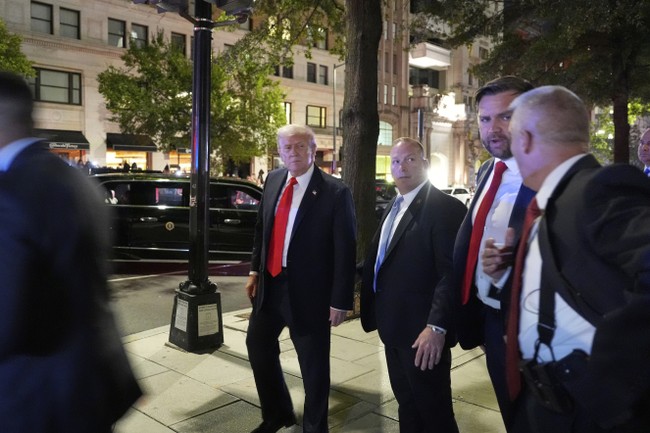
I’ll examine the security lapse at Joe’s Seafood that let protesters approach President Trump, detail Judicial Watch’s FOIA lawsuit seeking internal Secret Service communications, quote experts and officials who called the incident “an unbelievable security lapse,” and outline broader concerns about repeated screening failures and unanswered questions surrounding presidential safety.
Concerns about the safety of President Donald Trump have only deepened after a recent incident in Washington, D.C. Security is supposed to be airtight around a sitting or former president, especially after assassination attempts and a charged political environment. When protesters were able to get within arm’s reach of the president and members of his Cabinet, it signaled a breakdown that needs explaining.
The incident at Joe’s Seafood, Prime Steak & Stone Crab in September put that breakdown on full display. Protesters chanted, “Trump is the Hitler of our time!” as they closed in on Trump’s party, triggering immediate alarm among those watching how the Secret Service handled the scene. How protesters learned of the president’s dinner plans and how they bypassed screening are central questions.
Tom Fitton of Judicial Watch has been pushing for answers and made clear his concern publicly. “I’m just really concerned about the president’s safety,” Fitton told The NY Post. He says Judicial Watch has been trying for months to obtain records that could show what officials knew and when they knew it.
Judicial Watch filed a lawsuit on Dec. 18 in Washington D.C. Federal Court seeking “all internal emails and text messages among USSS officials in the Presidential Protective Division regarding the presence of Code Pink protestors” at the eatery. The complaint also requests “all emails sent between USSS officials and any email account ending in @codepink.org.” Court papers claim the government ignored a Dec. 9 deadline to provide the information under the Freedom of Information Act.
The obvious questions follow: why the delay on a FOIA request tied to presidential safety, and how did the activists know the president would dine at that restaurant? If law enforcement cannot determine who tipped off protesters, it suggests vulnerabilities in operational security and coordination. Every unanswered detail chips away at public confidence in protective measures.
The Secret Service maintains that guests were screened before the president’s arrival and declined to comment on the lawsuit. That response does little to soothe concerns when protesters carrying visible banners and flags were allowed to position themselves so close to the president and his guests. If agents missed obvious identifiers like Palestinian banners, critics ask what else could be slipping through the cracks.
Former FBI Assistant Director Chris Swecker called the episode “an unbelievable security lapse.” He added, “I can’t believe they would let random people sit in that close proximity to them. That’s crazy. That’s like’s like the days when Abraham Lincoln would ride down Pennsylvania Avenue in his coach and buggy with no protection.” Those are harsh words from someone steeped in federal protective operations, and they amplify the urgency of getting clear answers.
This event is not isolated when you look at other recent incidents involving Trump’s security. A man allegedly carrying a Glock was allegedly able to pass through security at Trump National Golf Club in Virginia on a day the former president was present, with official claims that the individual was not in proximity to Trump. Then there are lingering questions from the Butler, Pennsylvania assassination attempt that have not been fully addressed publicly.
Each of those failures, taken together, suggests systemic issues rather than random missteps. Screening procedures, coordination between venues and federal teams, and information-sharing protocols must be reviewed and reinforced. If one protest group can repeatedly breach the perimeter around high-profile figures, the problem is bigger than a single event.
Beyond procedural fixes, there is a political dimension. Accountability matters when the safety of a president is at stake, and Republican-leaning critics argue that weak responses undercut deterrence and invite further attempts. That viewpoint sees these security lapses not as partisan points but as practical dangers that demand swift remedy.
Judicial Watch’s lawsuit aims to force transparency by compelling the release of internal messages that could reveal what the Presidential Protective Division knew about Code Pink’s presence and how that information was handled. If the FOIA timeline was ignored or records withheld, the court process could shine a light on any gaps and lead to reforms.
Officials owe the public plain answers about who failed and how future incidents will be prevented. The stakes are simple and serious: when threats are real, protective teams must act preemptively and without excuses. The American people deserve to know whether protective protocols are being followed and, if not, what will change to ensure the president’s safety.
There are still many unanswered questions, and the legal process may reveal more. Until then, legislators, watchdogs, and the public will press for clarity on a breach that one expert labeled “an unbelievable security lapse,” and for steps that restore confidence in the systems designed to keep the president safe.

No question that Secret Service is incompetent and probably has anti-Trump elements within it. Butler proved that. Trump needs a major overhaul of his security team before they set him up for another more successful assassination effort. Someone, or more, is leaking his travel plans to anti-Trump people and passing access control requirements.