
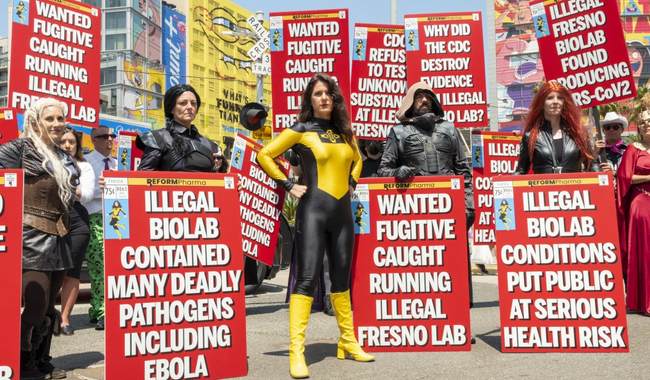
The long-running Reedley biolab case reached another turning point this week when a federal jury found Jia Bei Zhu guilty on a dozen felony counts tied to an illegal laboratory and a scheme selling faulty COVID tests, exposing a tangled operation that mixed illicit lab practices, misleading marketing, and alleged ties to foreign suppliers.
The jury convicted Jia Bei Zhu on 12 felony counts, including conspiracy to commit wire fraud, multiple counts of wire fraud, distribution of adulterated and misbranded medical devices, and making false statements to the FDA. Prosecutors say Zhu, through his Fresno-based business Universal Meditech Inc., moved more than a million COVID test kits and took in nearly $4 million while misrepresenting the products as FDA-approved and American-made. The verdict caps years of local scrutiny that began after code enforcement discovered a makeshift lab in a vacant building in Reedley.
The initial discovery came when Reedley Code Enforcement Officer Jessalyn Harper noticed a garden hose shoved through a wall of a building that was supposed to be empty. When Harper entered, she found live animals, biological materials stored inappropriately, and supplies that raised immediate red flags about safety and legal compliance. Testimony at trial painted a picture of an operation cobbled together in warehouses rather than a legitimate, regulated medical facility.
Prosecutors presented evidence that Zhu imported COVID tests from China between 2020 and 2023 and then repackaged or marketed them with false claims of FDA authorization and U.S. manufacture. Screenshots and marketing materials introduced at trial showed phrases like “FDA EUA APPROVED” and “MADE IN THE U.S.A.” next to products whose shipping paperwork listed origins in China. The evidence linked revenue from those sales to a business strategy built on deception during a public health emergency.
Federal officials described the scheme bluntly, with U.S. Attorney Eric Grant saying, “This verdict holds the defendant accountable for actions that exploited a public health crisis for his own gain. He flouted the lawful authority of the FDA and deliberately deceived the public by repackaging low-quality, foreign-made test kits at a time when accuracy and reliability were critical.” That statement featured prominently in the government’s portrayal of the case at trial.
Employee testimony added human detail to the charges, as several workers said Zhu intentionally hired people without laboratory experience so they would not question procedures or safety problems. Those workers included former retail and service employees and stay-at-home parents who, according to the trial record, were often paid to perform tasks they were not trained for. Some testified they were instructed to present misleading product claims to customers and feared repercussions if they resisted.
Victims who purchased the kits described missing components and tests that failed to detect COVID when they should have. The civil and criminal investigation uncovered court-ordered inspections showing the Fresno facility lacked the infrastructure to manufacture medical-grade tests and resembled an unsanitary warehouse. Inspectors reported a vivarium that was not sealed from the rest of the building and storage of biological materials in beverage containers, a detail prosecutors emphasized to show unsafe handling and storage.
A mid-2022 civil lawsuit helped bring the operation into the open before the Reedley discovery, with a court-ordered inspection revealing that the facility could not produce reliable tests and that many standard quality controls were missing. After a fire connected to electrical work allegedly performed under Zhu’s direction, his operation reportedly shifted to the Reedley warehouse where the code enforcement discovery later occurred. That sequence of events underscores how local enforcement and litigation intersected with federal investigation.
Items recovered at the facilities included fridges holding biological samples in unconventional containers, which investigators described as evidence of poor practices and unregulated storage. Federal filings noted that the pathogens and toxins in those containers were tied to a failed attempt to manufacture COVID tests and, according to prosecutors, “did not pose any risk to humans.” Still, the visuals and the descriptions used in court contributed to public concern about the operation’s safety.
Zhu faces a lengthy prison term if sentenced to the statutory maximums tied to the convictions, with sentencing set for August 24 before U.S. District Judge Dale Drozd. The criminal case follows years of overlapping scrutiny: civil suits, local code enforcement actions, and now a federal criminal verdict that ties the warehouse operations to intentional fraud during a health crisis. For the community and the workers involved, the trial provided answers about how the operation ran and who profited from it.
The Reedley case highlights how fraud, unsafe lab practices, and misleading marketing can intersect when oversight is lacking and bad actors exploit gaps during emergencies. As sentencing approaches, authorities and locals alike will be watching the consequences for Zhu and the broader implications for preventing similar schemes in the future.


Add comment