
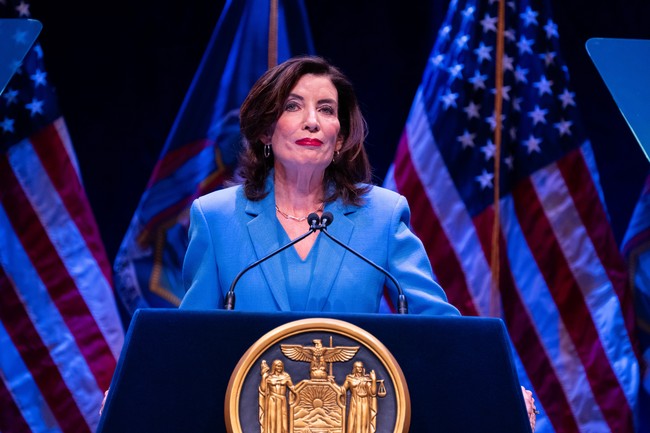
Kathy Hochul tried to mock former President Donald Trump over his support for the New York Knicks, but a mistaken historical claim and a clumsy cleanup turned the jibe into a political own-goal that left critics and commentators laughing at her instead of at Trump. The episode shows how a quick attempt at partisan shade can backfire when facts are wrong and spin teams overreach to fix the damage.
Governor Kathy Hochul took a cheap shot when a reporter told her President Trump might attend a Knicks game during the NBA Finals and asked her to comment. She replied, “I’d ask him to name the starting lineup from the 1993 Championship team and see how he does,” aiming to question his credibility as a fan. That put her squarely in the lane of partisan taunting rather than a substantive response to the news.
The problem is simple and public: the Knicks did not win the 1993 championship; the Chicago Bulls did. The last Knicks title came in 1973, a fact any long-time New York fan would know. That factual error turned Hochul’s zinger into a glaring mistake and made her look uninformed about the very team she was using to mock someone else.
Rather than letting the gaffe stand or offering a brief correction, Hochul’s team doubled down. Her press office posted on X claiming she was merely trying to “bait” Trump and had been playing “4D chess.” That explanation felt defensive and performed like an attempt to rebrand an obvious slip as strategic political theater. People saw the cleanup attempt as more awkward than clever.
Critics seized on the misstep right away, and social media amplified it quickly. Opponents highlighted footage and posts showing Trump’s history of attending games and engaging with the Knicks, undercutting Hochul’s implication that he wasn’t a genuine fan. When a politician relies on a cheap jab, they should be ready for the spotlight—and Hochul wasn’t.
When the cleanup came across as contrived, the reaction hardened. Commentators and everyday observers alike treated the “4D chess” line as an overcooked attempt to rewrite a blunt moment into something strategic. That kind of spin rarely convinces anyone outside a firmly loyal base, and it alienates swing audiences who expect basic accuracy from public officials.
https://x.com/AlecLace/status/2059662730886250635
President Trump confirmed he would likely attend one of the Finals games, saying he’d been invited and praising the team’s players, which only made Hochul’s original remark look more tone-deaf. The optics of a governor taking a cheap shot at a political rival while flubbing a basic sports fact are hard to defend. In this case, the intended political jab ricocheted back and hit Hochul’s credibility instead.
Outside voices piled on with examples meant to show Trump’s long-standing interest in the Knicks, including archival clips of him at past Finals games. One White House official even shared a video from 1994 showing Trump attending a Finals contest, underlining the point that Trump has a documented history as a fan. Those records made Hochul’s challenge feel less like a fact-based critique and more like partisan theater gone wrong.
For Republicans and critics observing the exchange, the episode reinforced a familiar theme: political elites who try to score points without bothering to get their facts straight look weak and unserious. A short, accurate response would have avoided the embarrassment; instead, Hochul opted for a turn of phrase that invited correction and mockery. In politics, small errors often become the story.
This kind of misfire has consequences beyond a single news cycle. It becomes fodder for opponents, fuels social media ridicule, and distracts from governance topics where voters expect competence. When a governor publicly aims to embarrass a rival and ends up embarrassed herself, it underscores the risk of choosing snark over substance.
Moving forward, the episode will likely be cited by critics as an example of tone-deaf political messaging that backfires. Voters notice mistakes that seem avoidable, and opposition teams keep a sharp eye for any moment they can use to question judgment. For now, the moment remains a small, politically damaging stumble that landed squarely on Hochul.

Add comment