
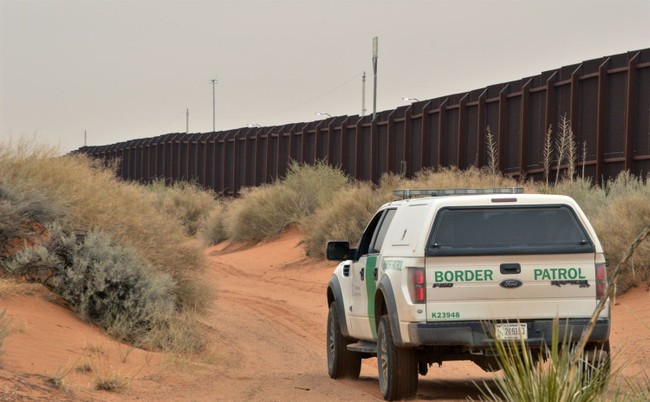
A father-and-son team was arrested at a southern border crossing near Laredo, Texas, after agents found nearly 400 firearms hidden inside false compartments in trailers; the discovery raises questions about what was being moved, who it was for, and how porous trafficking routes remain amid political gridlock on border policy and a government funding fight.
Federal agents stopped two southbound vehicles towing box trailers at the Laredo Bridge 2 Port of Entry and noticed irregularities in the trailer walls that warranted a closer look. A secondary inspection revealed concealed spaces filled with a large cache of weapons, magazines and ammunition packed into fabricated compartments. The seizure was substantial and immediate, and agents moved to detain the drivers for federal charges.
ICE Homeland Security Investigations (HSI) agents in Laredo, Texas, arrested a father and son accused of smuggling hundreds of firearms, including rifles, magazines and ammunition into Mexico after Customs and Border Protection (CBP) officers discovered hidden compartments in two trailers at the U.S.-Mexico border.
On Oct. 23, CBP officers working at the Laredo Bridge 2 Port of Entry stopped two southbound vehicles towing box trailers for inspection.
Agents said they noticed irregularities in the trailer walls.
“Irregularities” in this case meant false walls concealing a planned cargo of firearms. Agents cataloged roughly 400 weapons of varying types alongside high-capacity magazines and thousands of rounds of ammunition. Officials stated those arms were en route into Mexico, where criminal groups continue to fuel violence with a steady flow of weapons.
A secondary inspection revealed false compartments packed with an arsenal: roughly 400 firearms of various calibers, high-capacity magazines and thousands of rounds of ammunition.
HSI officials said the guns were headed into Mexico, where cartels fuel ongoing violence.
The photos released alongside the report show rows of firearms arranged on tables, but a closer look at the visible guns prompts some curiosity about the cargo’s intended use. Many of the rifles nearest the camera appear to be Ruger 10-22 models, small .22 rimfire guns commonly used for target practice, small-game hunting and training. There are also a few long-barreled shotguns that look unmodified, which suggests several of the weapons are basic hunting or recreational arms rather than obvious combat-style firearms.
That odd mix does not excuse the crime. Moving firearms with hidden walls in trailers is deliberate and illegal, regardless of caliber or intended purpose. Smuggling any weaponry across the border feeds black markets, and once a gun crosses hands it is no longer predictable where it will end up or how it will be altered.
Authorities identified the drivers as Emilio Ramirez-Cortez, a lawful permanent resident, and his son Edgar Ramirez-Diaz, a U.S. citizen, and charged both with federal firearms smuggling before turning them over to the U.S. Marshals Service for an initial court appearance. They will face prosecution within the U.S. justice system, which must now sort through motive, destination and culpability as evidence is processed. Legal presence does not shield anyone from prosecution when federal crimes are involved.
Questions linger about why these particular types of guns were being shipped and whether the stash was for personal resale, cartel supply, or some other market. Without an official inventory released by ICE-HSI or Border Patrol, observers and reporters are left to interpret images and statements, making every detail a clue and every omission a point of debate. Law enforcement will piece together manifests, ownership histories and trafficking links as the case moves forward.
All of this plays out against a backdrop of political tension, with elected leaders trading blame instead of fixing glaring vulnerabilities at the border. Agents on the ground executed an effective interdiction, but the systemic problem remains: until Washington writes sensible, enforceable law and resources follow, smugglers will keep innovating around enforcement. The stakes are not abstract; firearms flowing south empower criminal networks that terrorize communities on both sides of the border.



Add comment