
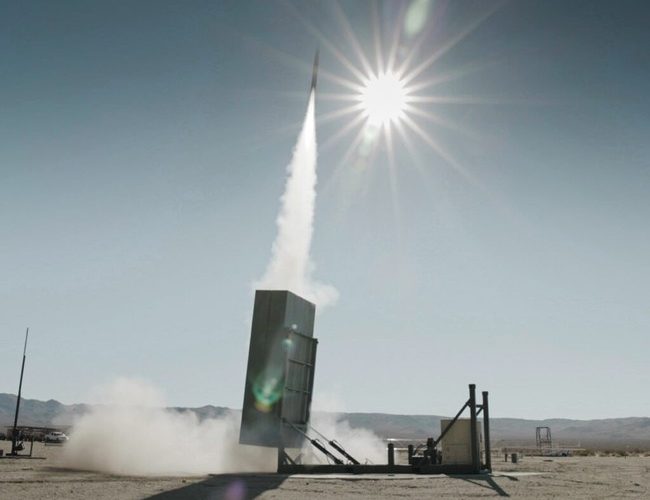
The Navy has awarded California startup Castelion nearly $105 million to integrate the Blackbeard hypersonic missile onto F/A-18E/F Super Hornets, aiming to field an operational air-launched hypersonic capability from carrier decks by 2027; this move emphasizes speed, affordability, and industrial-scale production to restore deterrence in contested theaters.
The contract push accelerates Blackbeard from prototype toward deployment, complementing an earlier $49.9 million award from February 2026 and combining to drive the system to early operational capability in roughly 18 months. Castelion positions Blackbeard as an air-launched weapon built specifically for carrier aviation rather than a repurposed land-based ballistic design, changing the calculus for strike options at sea. The company’s production plans in New Mexico and Texas are intended to support higher volumes and lower unit costs compared with legacy defense acquisition programs.
Blackbeard is designed to launch from an F/A-18 operating hundreds of miles from shore, bringing hypersonic speed and maneuverability to carrier strike groups so they can engage high-value or time-sensitive targets deep inland or at sea. Traveling at speeds exceeding Mach 5, the weapon covers hundreds of miles in minutes and is meant to defeat layered air defenses that blunt conventional missiles. No other navy currently fields a similar carrier-based, air-launched hypersonic strike capability, giving the United States a potential operational edge when fielded at scale.
The approach behind Blackbeard rejects the decades-long, billion-dollar program model that produces only small quantities of exotic weapons. Castelion claims the system was engineered from the ground up for industrial-rate production, commercial unit costs, and rapid iteration inspired by commercial space firms. By focusing on manufacturability and repeatable production, the aim is to flood the fleet with a credible inventory of hypersonic options rather than a handful of scarce prototypes.
The Pentagon’s acquisition posture under War Secretary Pete Hegseth has emphasized speed and calculated risk to reduce operational danger for the warfighter, an orientation that helped enable these awards. Hegseth has “repeatedly stated” that the Pentagon must “increase acquisition risk in order to decrease operational risk” to the warfighter. That credo frames why fresh entrants like Castelion get a close look when they can show rapid progress and deliverable pathways to production.
Senior leadership changes and internal resistance have mirrored the tug of war between traditional acquisition caution and the urgent need to close capability gaps. Even with friction inside the department, the shift toward faster fielding has produced tangible outcomes, and companies delivering capability quickly are being rewarded with follow-on work. Castelion’s wins demonstrate how prioritizing velocity can produce tools the fleet needs to deter rivals more effectively.
Castelion’s leadership, including CEO and co-founder Bryon Hargis, welcomed the Navy’s commitment, saying the move reflects the leadership needed to deliver for warfighters. He said Castelion, started by several principal thinkers at SpaceX, was “grateful for the continued trust in Blackbeard and in our team.” Those origins help explain why the company emphasizes rapid iteration, vertical integration, and lessons from commercial launch markets.
The operational value of an aircraft-launched hypersonic weapon for carrier strike groups is clear in a contested Indo-Pacific scenario. Carriers operating well offshore could prosecute strikes against missile batteries, hardened command nodes, and high-value ships without exposing land-based launchers to the same geographic limits and preemption risks. Blackbeard aims to provide commanders with a fast, survivable strike option that compresses decision timelines and complicates an adversary’s targeting calculus.
China and Russia have already invested heavily in operational hypersonic capabilities, prompting a sense of urgency among U.S. planners to field comparable systems at scale rather than in limited numbers. By betting on speed, affordability, and production capacity, Castelion and the Navy seek to close the gap in a matter of years rather than decades. If the program meets its timelines, carrier air wings could begin integrating an unprecedented long-range strike tool by 2027.
Editor’s Note: Thanks to President Trump and War Secretary Pete Hegseth’s leadership, the warrior ethos is coming back to America’s military.



Add comment