
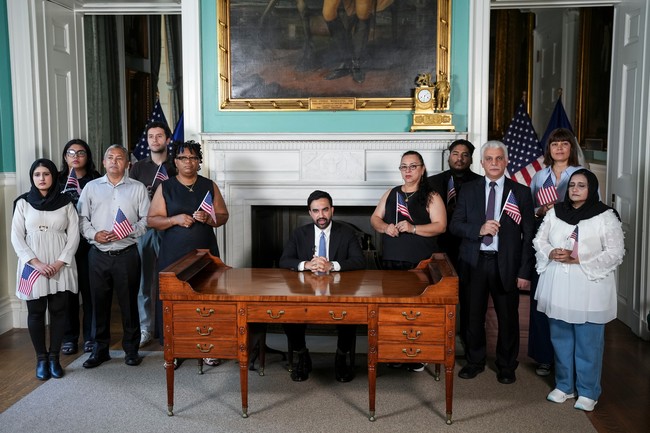
I break down how New York Mayor Zohran Mamdani used America’s 250th anniversary to attack the country, how critics responded, and why this matters politically for conservatives and patriotic Americans.
Zohran Mamdani’s Fourth of July remarks set off a storm because they framed America’s history as one of entrenched oppression and concentrated wealth rather than opportunity and progress. He delivered those remarks from a symbolic location tied to the founding, and that symbolism sharpened the backlash from conservatives and others who see his rhetoric as ungrateful and divisive. Critics accused him of flipping a celebration into a sermon about victimhood and class resentment. The reaction was swift and often blunt, with high-profile figures piling on and social media amplifying the outrage.
The mayor’s initial message and his later attempt to soften it have become a test of political storytelling. On one hand, a mayor who talks about oligarchs and hungry children taps into a familiar progressive narrative about economic injustice. On the other hand, conservatives see that narrative as an attack on the nation’s founding, its institutions, and the people who built its prosperity. That clash is exactly why the response has been so intense: it’s not only about words, it’s about competing visions for America’s past and future.
https://x.com/NYCMayor/status/2073381502839050361?ref_src=twsrc%5Etfw
Mamdani’s public posture also raised questions about authenticity and motive. He comes from a wealthy background, and to many critics his critique of concentrated wealth rings hollow coming from someone with elite ties. That perceived contradiction fed the narrative that his remarks were performative and aimed more at political signaling than at constructive governance. For conservatives, the episode highlights what they call the hypocrisy of elites who lecture about inequality while benefiting from the system they denounce.
His remarks included language that painted American history in stark terms, and those lines were repeated across conservative outlets and social platforms. The mayor’s phrasing about wealth and who benefits from it was seized on as evidence that he favors class warfare rhetoric. That kind of rhetoric is risky in a city where many residents feel daily the costs of mismanagement, crime, and out-migration of middle-class families and businesses. For Republicans, the speech reinforced a broader case about cultural elites being out of step with the lived experiences of ordinary Americans.
Political reactions were rapid and personal. Social media users and public figures dismissed his apology as weak or insincere and used the moment to argue for stronger conservative leadership. The furor also offered Republicans a platform to contrast their vision of patriotism—love of country combined with pride in its founding ideals—with Mamdani’s approach, which many framed as unpatriotic. That contrast is useful in political messaging ahead of local and national elections.
Beyond partisan spin, the episode touches real policy debates about crime, education, and economic stewardship in New York City. Conservatives used the speech to raise questions about why the city’s wealth and cultural capital haven’t translated into safer streets or better services for all residents. They argue that blaming billionaires and “oligarchs” distracts from governance failures and the need to restore common-sense policies that encourage growth and accountability.
The mayor’s critics also accused him of exaggerating or mischaracterizing conditions, particularly the claim about hungry children. For many conservatives, that assertion contradicts familiar data points about food programs and general standards of living; it also invites scrutiny of how rhetoric shapes public perceptions. Framing the debate around concrete policy failures rather than purely symbolic arguments is a priority for those who want voters to focus on practical solutions.
Public responses included pointed quotations and commentary that were repeated verbatim by commentators. The mayor’s own measured follow-up statement appeared in multiple outlets:
Today marks 250 years since a small group of newspaper editors, farmers, and soldiers signed a document declaring our nation’s independence — a truth that feels self-evident now but was revolutionary then.
What a privilege us Americans have, to live in a nation that every one of its inhabitants can shape. What an honor us New Yorkers have, to look out over our city’s waters from the shores where so many Americans bravely entered their country for the first time.
Today and all days, let us remember that patriotism is not pretending our nation is without flaws. Patriotism is every act of righteous dissent — because loving our country means fighting for the best version of it.
Happy Fourth of July, New York City.
Other excerpts quoted in reaction highlighted the more accusatory tone critics objected to, and those lines were cited repeatedly by X users and conservative commentators. Another quoted passage from a major outlet summarized his retelling of history as “an unending parade of horrors, an unwelcoming autocracy ruled by the wealthy and powerful.” Those lines became a rallying point for opponents who argued Mamdani’s speech rewrites the story of American opportunity.
Mamdani retold the history of the United States Friday morning as an unending parade of horrors, an unwelcoming autocracy ruled by the wealthy and powerful.
Even the mass migration into Ellis Island was turned into a parable of the oppressed.
“They could not yet see the nativism they would face — the jobs they would be refused, the landlords who would not rent to them, the abject labor and living conditions they would withstand,” Mamdani said.
Scores of immigrants succeeded here not because of the freedom to start your own business, pursue your own ideas, and forge your own path.
No, it was “despite laws enacted by the federal government to bar their entry, despite sweatshop fires that killed hundreds of women, despite riots aimed at their very existence.”
This controversy is more than a soundbite fight; it’s part of a larger contest over national identity and who gets to define patriotism. For conservatives, moments like this are opportunities to push back on narratives that downplay American achievements and to promote policies that deliver better results for families and communities. Whether that shifts public opinion or deepens polarization, the episode has already sharpened the rhetorical lines for the next political fights.
But the mask is off.


Mamdani is not American, he is an INDIAN MILLIONAIRE COMMUNIST come to America because this was a Hell of a lot better place to live than as a millionaire in India. Wise up people. This creep is not out to improve your life – but his. There is no SOMETHING FOR NOTHING. Everything he want to give away was paid for by someone else’s taxes. HE CONTRIBUTED NOTHING! Get off your ass and work if you want something in this country. The opportunity is there. Find one – only one – successful Communist country in all of history! There are none. People like him show up in various countries to set up shop and steal everything they can while making wild promises to gullible voters. Pretty soon, voting is no longer allowed, the money is all stolen and the crook runs off with his Swiss bank account – if not first killed by his faithful followers!
My Boy pal makes $seventy five/hour on net. he has been job less for six months. However he earns$16453 genuinely working at the internet for some hours. Immediately join from the source.. learn more in my name