
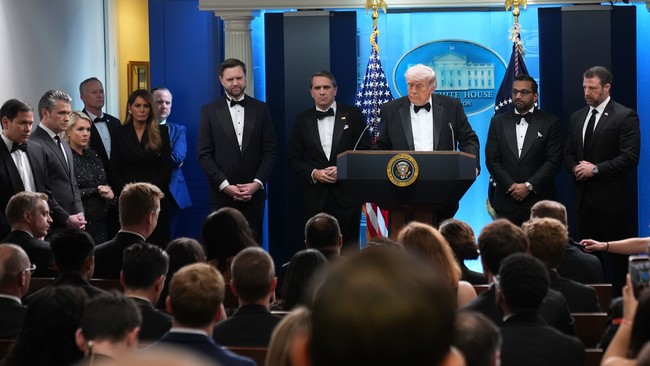
President Trump used the aftermath of the White House Correspondents Dinner attack to press his long-running argument for a new, secure White House ballroom, stressing safety, design by the military and Secret Service, and the practical need to move large events onto White House grounds to avoid vulnerabilities posed by hotels and nearby crowds.
The scene from Saturday night has become one of those “Where were you when” moments, and Republicans are right to lean into the security conversation it sparked. President Trump appeared on Fox News to explain why a purpose-built ballroom on secure grounds matters, especially after a narrowly averted assassination scenario. He framed the proposal as a commonsense fix to a clear vulnerability.
On Sunday, the president laid out the basic security logic plainly: large hotel ballrooms with rooms and elevators above them create an avoidable risk. He emphasized that moving events onto White House property would limit those exposures because the grounds are already heavily secured. That kind of practical thinking, focused on protecting people and institutions, is exactly what the public should expect from leadership after an attack.
Trump also described technical measures planned for the new facility, highlighting features meant to blunt modern threats. He mentioned bulletproof glass nearly four inches thick and the need for drone-proofing among other protections. Those details signal that this is not a cosmetic upgrade but a serious security project developed with experts in mind.
President Trump said:
Well, it’s always tough when you have a thousand rooms. It’s a large hotel right on top, and so people come down in elevators, and they’re right over the top of where you’re speaking. They are not very far away, and it’s pretty tough. As we know, we’re building a big, beautiful, very, very secure ballroom everywhere, with massive bulletproof glass. It’s almost four inches thick. Pretty amazing stuff.
[Jacqui Heinrich:] When do you think that will be ready?
All different elements. You need like drone-proofing… drone-proofing, everything. We need everything. But we also need a location. And the location’s on the White House grounds, which is the most secure ground probably in the world, including the fencing, including everything else. The president doesn’t have to leave the premises. It’s really very scary. This is mostly for future presidents.
He didn’t stop at security theater; Trump underscored project management and budget discipline, sounding like a real estate developer who understands timelines. He claimed the project was on time and on budget, originally scheduled to open in 2028, and described collaboration with the military and Secret Service. From a Republican perspective, promising a secure, cost-conscious project designed by professionals checks the boxes voters care about.
President Trump said:
We’re actually ahead of schedule, and we’re right on budget and ahead of schedule. It was always scheduled to open in ’28, and probably I would have five or six months of use, but other people have many years, hopefully hundreds of years, of use. But it’s going to be a magnificent building. It was also designed in conjunction with the military and in conjunction with Secret Service. It’s got every single bell and whistle you can possibly have for security and safety. We’ll have that done very much on time, even ahead of schedule. It’s ahead of schedule now.
It’s really what you need. I mean, you can’t have a thousand rooms, or whatever it is, a very big hotel on top of the ballroom, and people come down in an elevator right next to the ballroom. And nobody is blaming them. They are good people, they’re very good people. I know the people well. I’ve been in that room many times. But you know, it’s had difficulty in the past, and a new one is set not to have that kind of thing. All of the traps are knocked out.
Those arguments tap into a preexisting policy fight that Republicans have been pushing for years: use secure federal property where possible to reduce avoidable risks at major events. It’s not about shutting down tradition so much as protecting the people who attend and the office itself. The president framed the addition as a legacy project that will benefit presidents of both parties, stressing practicality over politics.
Legal questions and courtroom battles are a separate matter, and they won’t be erased by an incident. Still, public perception matters, and this episode will strengthen the case among voters who want common-sense security upgrades. For conservatives who prioritize national safety, Trump’s pitch now has the emotional weight of a near-miss behind it, which can change how the public evaluates trade-offs.
Beyond the technical pitch, the president used the interview to reinforce resilience: institutions should not bow to fear after an attack. He praised the role of the press and the traditions surrounding the dinner even while arguing that logistics must change to keep attendees safe. That balance—defending American institutions while adapting to new threats—is a core conservative position in responding to violence.
President Trump notes:
This was designed at the highest level by top military and Secret Service. It was really… It’s a joint venture.
Presidents have wanted it for 150 years, just because they wanted a big space. But military and Secret Service have wanted it for many years. I’m getting it built. The one good thing is that now everybody knows how badly needed it is.
Whether this incident shifts legal outcomes is uncertain, but politically it gives Republicans a strong, relatable talking point: protect gatherings by removing unnecessary risks and investing in hardened, well-designed federal facilities. For now, the pitch is simple and persuasive—build what you need to keep people safe and do it with experts. The president’s message was clear and practical, delivered in a way that connects with voters worried about security.
In closing, the president and Jacqui Heinrich :
Here’s how that went:
Jacqui Heinrich: I want to thank you, Mr. President, for joining us today, and I also want to say how grateful we were last night, as a member of the Board of the White House Correspondent’s Association, and the incoming president of that association, we were very grateful to have you there, taking part in a tradition that recognizes the role of the free press in our democracy, and we’re all sad that it went the way that it did. We’re all grateful that we get to come home to our loved ones, and be together afterwards, and thank for your leadership in the moments afterward, and for coming on and giving the country the strength to not let those who would wish to harm us stop us from our pursuit of our liberties.
President Trump: Well, Jacqui, thank you very much, it’s very nice, very nice. Let’s do it again. Let’s not let people like this change the course of our country. We’re not going to let that happen. So, hopefully you guys can get it on and get it together, and I’ll be there, I promise.


Add comment