
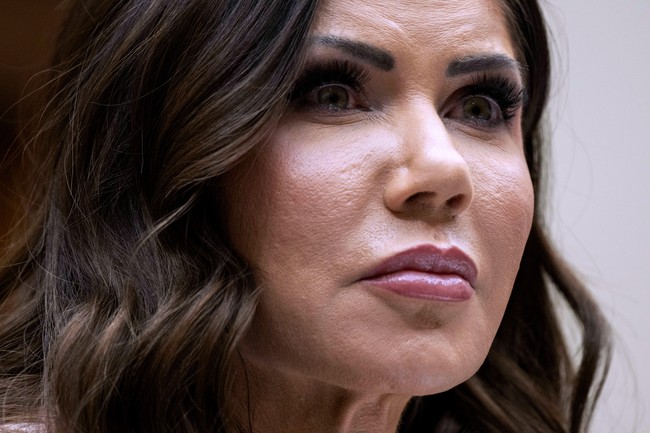
President Trump moved quickly to replace Homeland Security Secretary Kristi Noem after a tense Senate exchange about a $220 million ad campaign, and questions about whether she told the truth under oath appear to have been central to the fallout; this piece lays out the hearing moment that likely mattered most, the reactions from key players, and why the episode matters for trust and leadership in the administration.
The headline moment came during Noem’s Senate testimony when she said the president had approved a controversial, taxpayer-funded ad campaign in which she appeared. She testified repeatedly that the $220 million effort had Trump’s sign-off, and she answered directly when pressed by Senator John Kennedy. That claim, if wrong, cut to the heart of a basic question: did the Secretary accurately represent the president under oath?
Sen. John Kennedy challenged her plainly: “The president approved ahead of time you spending $220 million running TV ads across the country in which you are featured prominently?” Noem replied, “Yes, sir, we went through the legal processes …” Kennedy pursued it: “Did the president know you were gonna do this?” and she answered, “Yes.”
Kennedy made it clear he found the claim hard to accept based on his knowledge of the president’s habits and instincts. He told colleagues he followed up and later said his conversation with the president suggested a different recollection from Noem’s. That divergence — the president’s memory versus the Secretary’s sworn testimony — is what drove immediate distrust within conservative ranks.
After the hearing, the president himself pushed back publicly, saying, “I never knew anything about it.” His repudiation of Noem’s claim made the issue more than a routine policy dispute; it became a credibility crisis. For an administration that relies on tight message discipline and loyalty, a Cabinet member contradicting the president on such a precise matter is a serious breach.
Reports from within the White House described private frustration, noting anger over testimony that seemed to place the president at the center of a decision he says he did not approve. Sources close to the situation indicated that the remarks set in motion swift personnel change, and the subsequent move to replace Noem with Sen. Markwayne Mullin looked like a direct response. In Washington terms, this was less about policy than trust.
Republican observers will see two lessons here: first, optics matter as much as strategy when a Cabinet member’s public statements can be read as putting the president on the hook. Second, the president’s willingness to act fast when trust frays signals how seriously he treats alignment from his senior team. Those are practical realities for anyone serving in a high-profile role.
There are also structural questions about how such a large ad buy was authorized and communicated. Regardless of who signed off, the episode highlights weak points in internal coordination and the need for clear, documented approvals on high-dollar initiatives. When millions in taxpayer money and a senior official’s public profile are involved, paperwork and chain-of-command clarity aren’t optional.
Beyond internal mechanics, this episode carries political consequences for the party heading into an important election cycle. It matters when a figure with national prominence testifies in a way that prompts the president to respond publicly and immediately. Campaign messaging, staffing, and trust among conservative leaders all shift when such a public rupture occurs.
Some will argue the firing was long brewing and that this moment merely accelerated an inevitable decision. Others will see it as proof that the president prioritizes loyalty and straightforwardness over extended debate. Either way, the swift replacement signals a low tolerance for anything that looks like a disconnect between Cabinet actions and the president’s account of events.
One practical outcome is the elevation of a new Senate ally to run Homeland Security, a choice meant to restore discipline and close ranks. The administration’s next moves will aim to move past the controversy, but the episode itself is a cautionary tale about how a single courtroom-style exchange can change careers. For Republicans, it serves as a reminder that public testimony must be precise, because consequences can be immediate and irreversible.



Add comment