
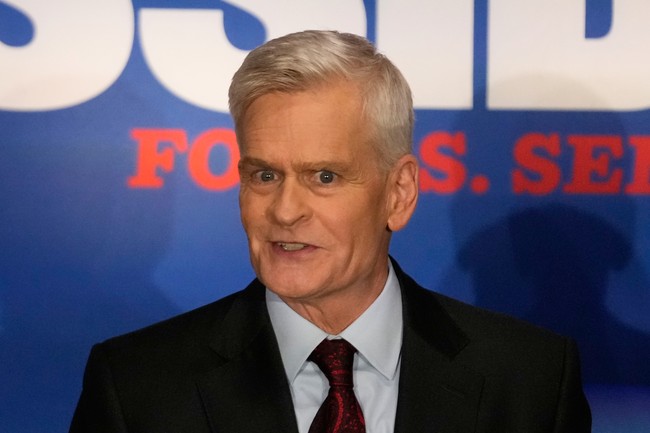
At a recent Senate Republican luncheon, a routine push for the SAVE America voter ID bill turned into a shouting match between President Donald Trump and Sen. Bill Cassidy, R-La., over Iran policy and presidential war powers; the confrontation highlighted widening tensions inside the GOP as Trump presses for bold action while some senators privately push back. What began as a policy meeting morphed into a public clash that left colleagues scrambling to calm things down and prompted sharp exchanges captured in direct quotes from Cassidy and witnesses.
The meeting was meant to focus on the Safeguarding American Voter Eligibility (SAVE) America Act, a top priority for President Trump. Instead, attention shifted quickly to Iran and a recent symbolic war powers resolution that several Republicans supported. That resolution asked the president to seek congressional authorization before further military steps in Iran, a stance that angered Trump and set the stage for a heated back-and-forth.
Sen. Bill Cassidy, who lost his primary earlier this year and faces a runoff on June 27, became the focal point of the dispute after pressing the president about the status of negotiations with Iran. Cassidy and three other GOP senators — Rand Paul, Susan Collins, and Lisa Murkowski — had joined Democrats on the resolution, a move that did not sit well with the president. Personal frictions were already present after Trump publicly supported Cassidy’s primary opponent, so the lunch amplified an existing strain.
What started as a push to pass Safeguarding American Voter Eligibility (SAVE) America Act transformed into Trump railing against Republicans for allowing a war powers resolution handcuffing his authorities in Iran to pass on Tuesday.
And that spurred a confrontation with Sen. Bill Cassidy, R-La., who Trump campaigned against and defeated earlier this year.
“He asked, ‘why would anybody vote for the War Powers Act?’,” Cassidy said afterward. “As he continued, I said, ‘is that a rhetorical question, or would you like to really know?’ He said, ‘I’d like to know.’”
Cassidy recounted how the conversation escalated when he demanded more transparency about the administration’s Iran strategy. “I stood and said, ‘you have not told the American people what’s going on. It was supposed to last four weeks, it’s lasted four months,’” he said, insisting that original objectives had not been met and that accountability was overdue. Colleagues reported voices were raised and that Cassidy lost his temper until other senators asked him to sit down.
https://x.com/mychaelschnell/status/2069905959368212604
The senator described his own behavior with a wry nod to his temperament, saying the shouting match owed something to “the Irish in me.” He made clear he wasn’t backing down when constituents want answers, calling out a need for clarity on national security decisions. That insistence on oversight clashed directly with Trump’s demand for unified party support and deference on foreign policy moves.
Sen. Bill Cassidy (R-La.) on his spat with President Trump at Senate GOP lunch:
“I’m not going to be bullied when I’m trying to get answers for the American people.”
On Trump calling him a lunatic: “Can I imagine that the president called me things that would be said on a school on a playground? Yeah, I can imagine that.”
Witnesses described an exchange in which Trump called Cassidy a “lunatic” and the two traded barbed remarks about whether they were “brothers,” with Cassidy referring to Trump as “brother” and the president rejecting that label. The moment underlined an ongoing split between the president’s demand for loyalty and a subset of senators who believe independent oversight is part of their duty. For many rank-and-file Republicans, loyalty to principle and ensuring constitutional checks still matter, even when the party is under strong presidential leadership.
After the luncheon, Trump said the party was mostly united while admitting he “doesn’t like a few people,” a line that signaled he is willing to call out internal critics publicly. That approach plays well with a base that respects toughness, but it risks deepening divides in the Senate at a time when Republican votes are critical for passing priority measures like voter ID legislation. The tension between aggressive executive action and congressional oversight will likely surface again as the Iran situation evolves.
The clash is a reminder that policy fights can turn personal quickly, especially when national security and presidential authority are on the table. Some senators are willing to join Democrats on limited measures they see as checks on unilateral military action, while the president expects full-throated GOP backing for his approach. Those competing instincts are pushing the party into awkward, high-attention theater as it tries to balance boldness with constitutional restraint.
In the days after the lunch, the fallout included public statements, terse reactions, and renewed scrutiny of where individual senators stand on war powers. With Cassidy leaving the Senate next January, voices in both camps are already positioning for how to handle future battles over foreign policy and party unity. For Republican voters who prize strength and accountability, the episode highlights the fault lines inside the party over how to lead and how to govern.
Add comment