
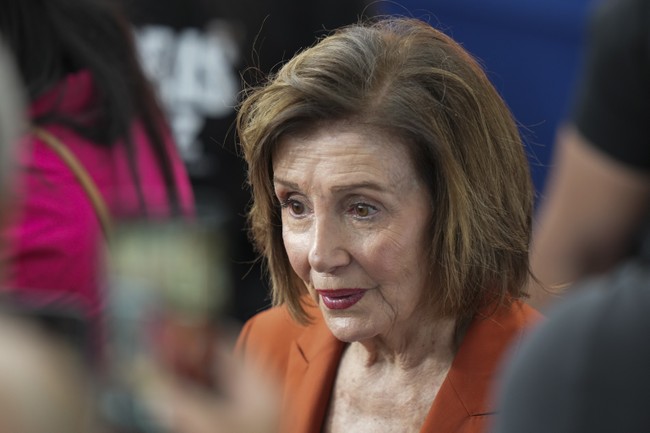
Nancy Pelosi, at 85 and still in the spotlight, delivered an interview that mixed grandstanding, confusing moments, and a political attack that flips responsibility for a funding standoff onto others. The clip shows her reacting to footage of Donald Trump and then making blunt claims about SNAP, taxes, and feeding children, while critics argue the facts show a different story about who controls funding decisions and who is working to find missing migrant children.
Watching Pelosi in the clip is jarringly out of sync with the seriousness of the topic she invoked. She waved at a screen showing Donald Trump as if he could see her, and that gesture distracted from the policy points she tried to make. Observers on the right say the performance undercuts the credibility of her argument and highlights why some believe it’s time for new leadership in her seat.
Pelosi repeated a familiar line about entering politics “for the children,” yet her remarks quickly turned accusatory. She charged that Trump was “taking food out of the mouths of babies with the SNAP, taking that money away, and giving tax breaks to the richest people in America.” Those words were delivered with the theatrical outrage she often uses, but critics point out the political reality behind program funding decisions is more complicated.
Republican critics note that votes to keep the government open and to fund programs like SNAP require cooperation and action from congressional Democrats as well as the White House. In this standoff, the claim that Trump alone is to blame ignores the legislative choices made by Pelosi’s party. The accusation that he is personally responsible for SNAP cuts doesn’t square with who has blocked funding bills and who has used spending fights as leverage.
Context matters when evaluating claims about “not feeding the children.” The right frames the situation as Democrats weaponizing social programs to score political points, while Republicans argue they are the ones pushing actual solutions. That includes efforts to secure the border and locate missing migrant children who vanished amid chaotic processing under the current administration, an issue conservatives have repeatedly raised as evidence of mismanagement by Democratic leaders.
Supporters of the Republican approach emphasize action over rhetoric, pointing to teams working to track down thousands of missing migrant children as proof of practical priorities. They say dealing with illegal immigration, restoring order at the border, and promoting job growth are tangible ways to protect families and children, while partisan speechifying does little to solve real problems. This contrast is central to the criticism leveled at Pelosi’s remarks.
Pelosi’s reference to tax breaks for the wealthy as part of her critique reflects a wider partisan narrative, but the critique often omits how budget battles unfold in Congress. Republicans argue that accusing opponents without acknowledging legislative dynamics is disingenuous. That, they say, is precisely why voters grow weary of recycled lines and why the GOP pushes for accountability on both policy outcomes and political tactics.
The emotional language about children is a potent political tool, and Republicans contend Democrats have used it selectively. Conservatives stress that invoking children in budget fights should not be a cover for refusing to negotiate or for prioritizing partisan leverage over basic governance. The right accuses Democratic leadership of using humanitarian language while simultaneously blocking measures that would keep services funded or address root causes of crises at the border.
Pelosi’s age and prolonged tenure draw commentary beyond policy differences, with critics arguing her continued presence symbolizes a disconnect between political elites and everyday Americans. For many on the right, her performance reinforced the narrative that long-serving party leaders cling to power and speaking points instead of delivering results. That perception fuels calls for fresh faces who will focus on concrete outcomes rather than theatrical denunciations.
When the conversation turns to missing children in immigration processing and the broader humanitarian fallout, Republicans highlight operational progress as proof of priorities. They point to efforts that reportedly located thousands of missing migrant children by September as evidence that action is happening behind the scenes. In their telling, that kind of work matters more than accusations and sound bites during interviews.
Ultimately, the episode reinforced partisan divides: Democrats using moral language to criticize opponents, and Republicans responding with a focus on tangible work and responsibility. Conservatives see Pelosi’s comments as emblematic of a political class that prefers headlines to problem solving, while urging voters to evaluate who is actually delivering for families and children through policy, border security, and economic growth.

Pelosi your a worn out rubber hole nobody cares about or listens to anymore. Your like a fart you hear it and run before the stink gets to you. You’re nothing anymore but an old hack that should’ve retired decades ago. Save face and resign immediately