
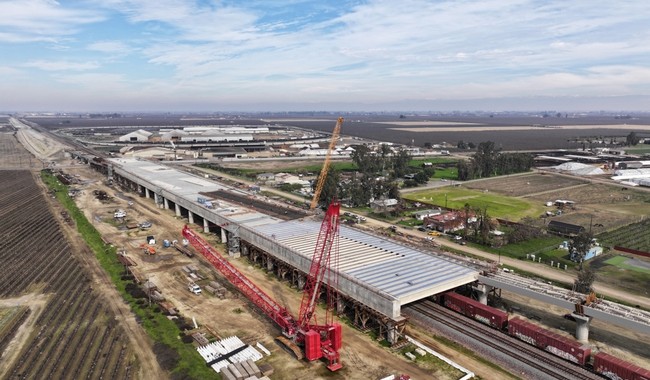
This piece examines the collapse of California’s high-speed rail project under Governor Gavin Newsom: what the project promised, how billions were spent with no tracks to show, why oversight and planning failed, and what the political stakes are for taxpayers and leadership accountability.
California’s high-speed rail was sold as a bold vision to connect Los Angeles and San Francisco, but after years and billions it still has no operational route. Voters approved the idea in 2008, yet the facts now on public view make it clear the plan has become an expensive mess. The story matters because this is public money and public trust being eroded by poor execution and shifting goals.
60 Minutes on Sunday profiled the “Ghost train” in California — the high-speed rail project that was approved by voters in 2008 and supposed to connect Los Angeles and San Francisco. Instead, the project has turned into an estimated $125 billion stain on the state, with Californians still waiting for the first tracks to be laid down, years after the train was expected to starting running.
Correspondent Jon Wertheim wanted to get an answer on why the train is so far behind schedule — and over budget.
He pointed to a few reasons, including “California’s exacting environmental regulations, which triggered all manner of reviews, lawsuits, and delays.”
The list of failures is long: ballooning costs, missed deadlines, and a route whittled down from a major interstate connection to a short Central Valley shuttle. People rightly ask where the money actually went, because the visible result is negligible compared to the sums spent. That question is not academic—it’s about accountability for public leaders who pushed and defended this project for years.
Where did the funds end up, and why did oversight allow so many mismatches between promises and results? Construction costs, regulatory delays, and litigation all played roles, but those are symptoms rather than the full explanation. The deeper issue looks like poor initial planning and an optimism bias that turned into a funding gap too big to ignore.
The narrative given by project defenders has shifted repeatedly, from a grand statewide rail spine to a scaled-back Central Valley corridor. That shrinkage highlights a core problem: the initial pitch was theoretical and lacked the grounded specifics needed for a multibillion-dollar build. When plans are vague, costs explode and timelines slip, and voters and taxpayers get left holding the bill.
Political leaders who touted the project have been reluctant to own the choices that produced this outcome. Federal funding was reduced, and critics rightly point out that if a project this large can’t be managed in a blue state with deep pockets, it should worry anyone who cares about taxpayer stewardship. Fiscal responsibility needs to be more than a slogan; it has to be enforced when plans go off the rails.
“As anyone whose renovated a home knows, delay adds to price,” [correspondent Jon] Wertheim quipped.
He said the high cost of U.S. labor and construction relative to other countries hasn’t helped, either.
Another problem: terrible planning. Rep. Vince Fong (R-CA) told CBS the 2008 plan that was approved by voters was “very theoretical,” but that it has become “very clear they didn’t have the specifics worked out.”
“We’re now in 2026. There are no trains, there’s no track laid,” Fong added. “It’s a complete bait and switch.”
— Steve Guest (@SteveGuest)
The financial math is brutal: even with further spending, analysts say there will remain a multibillion-dollar shortfall. That detail alone should trigger a full accounting and hard questions about how future infrastructure dollars are prioritized. Leaders must explain how a project went from a voter-approved plan to an unfinished promise with mounting costs and shrinking benefits.
“The entire amount of money we need is not there…”
And now they want more money than Amtrak has EVER received in their history.
CBS notes: “That’s more funding than Amtrak has received in its history, and still leaves a shortfall of roughly $90 billion.”
INSANE.
Federal decisions have already reflected concern: in 2025, a significant portion of federal funding was pulled from the project, signaling that Washington was not ready to keep underwriting a program with so many open questions. Political leaders who supported the rail need to answer whether they will fix the governance failures that created this outcome. Without such changes, handing more money to the same structure would be reckless.
The project’s downsizing is emblematic of a broader pattern where big government promises meet the reality of execution and cost. Voters deserve infrastructure that delivers value and transparency, not indefinite spending with little to show for it. Responsible leadership means stopping wasteful projects or reforming them before asking taxpayers to cover new gaps.
Editor’s Note: Gavin Newsom wants to turn America into one big version of California – a failed, overtaxed, dystopian nightmare.


Surprising! I’ve been making 100 Dollars an hour since I started freelance on the Internet six months ago. I work long hours a day from home and do the basic work that I get from the business I met online. share this work for you opportunity This is definitely the best job I have ever done…
just use the info on this page .====> PayAtHome1.Com
Without a shadow of a doubt Newsom serves Satan; he is a most vile and egregious man of sin!
These scammers do too, they are cut from that same evil cloth!
The Truth only hurts those who are denying it or trying to escape it!