
Checklist: Maintain focus on Giorgia Meloni’s stance, preserve original quotes and numbers, remove external links and credits, keep embeds intact, and rewrite the article in clear, punchy prose. The article covers Meloni’s balancing act between the U.S. and the EU over Greenland tensions, her private comments on tariffs and military posturing, and the broader diplomatic context. I will keep quoted passages exactly as provided and retain the token in its original place. The rewrite will avoid repeating the checklist items in the article itself.
Giorgia Meloni’s Greenland Gamble: U.S. Ties Over EU Tensions
President Trump has set his sights on Greenland, and that single decision has roiled European capitals. Most of Europe is opposed to any American flag flying over the island, yet not every leader in Brussels is falling in line with that rejection. Italy’s Giorgia Meloni has chosen a different path: she’s keeping a steady relationship with the United States, even when it draws pushback at home.
Meloni’s approach is pragmatic rather than ideological. She understands the hard reality of power: Europe will not come out ahead in a trade war or military standoff with the United States. That realism shapes her refusal to cut ties, and it explains why she publicly and privately counsels restraint on actions that might escalate the crisis.
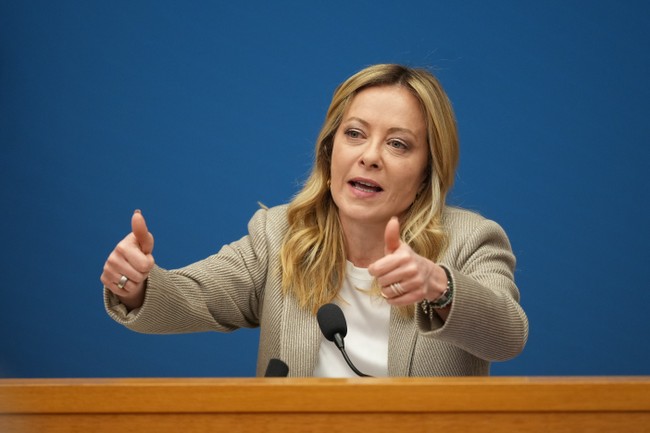
Within the European Union, Giorgia Meloni has always taken a pro-Atlantic stance, accentuated by the Italian prime minister’s close relationship with Donald Trump. Since the Greenland crisis erupted, Meloni has insisted on the need not to sever ties with the American president, which has angered the Italian opposition, who accuse her of betraying Italy and Europe.
On Thursday, January 22nd, the European Council is set to examine the activation of the anti-coercion instrument requested by French President Emmanuel Macron.
In this highly tense context, Meloni is striving at all costs to maintain balance.
Political opponents in Italy have branded her stance as betrayal, but Meloni is betting on stability and strategic calculation. She sees the potential losses if Europe tries to confront the United States head-on over Greenland, and she’s positioning Italy to avoid needlessly escalating a dispute. Walking that line invites criticism, yet it also positions Rome as a potential mediator.
In private, Meloni has been frank about the tactics she dislikes while still supporting core ties. She told President Trump that punishing European countries with tariffs is a mistake, but she also made clear she will not abandon relations with Washington. That mixture of criticism and commitment is exactly the kind of posture you expect from a leader who values influence over symbolic purity.
In a private exchange with the U.S. president, Meloni described the current U.S. strategy of punishing European countries with customs duties as a “mistake.”
However, the Italian prime minister has no intention of severing ties with the United States. This is a very realistic position: the balance of power is currently very much against Europe, which will always lose out in a trade war or military engagement with the United States. Meloni believes that Trump will not go so far as to take Greenland by force—something the U.S. president verified in his Davos speech on Wednesday—and that an armed confrontation must be avoided at all costs: this is why she did not want Italian soldiers to take part in the reconnaissance mission to Greenland. Her defence minister was also very sceptical about this manoeuvre: “Imagine fifteen Italians, fifteen French and fifteen Germans in Greenland. It sounds like the beginning of a joke,” he said at the time.
Her defense minister’s quip about fifteen Italians, French, and Germans in Greenland lands as a sharp jab at symbolic gestures that could be more theater than strategy. Meloni didn’t want Italian troops sent on a reconnaissance trip that would have only raised tensions. She’s trying to avoid actions that could be photographed as provocation without delivering any real advantage.
On the larger point, Meloni’s aim seems to be maintaining dialogue and preventing a wedge between Italy and the United States. If the dispute over Greenland becomes a test case for whether Europe can stand up to America economically and militarily, Meloni is betting that restraint and negotiation will serve Italy better than grandstanding. That kind of pragmatic diplomacy can be unpopular with opponents who prefer louder posturing, but it can also yield real leverage behind the scenes.
Observers who expected a sweeping European line against the U.S. may be surprised by Meloni’s posture, but international relations are full of surprises. Leaders who choose negotiation and targeted pressure often keep more options on the table than those who burn bridges for the applause of the moment. That logic is at the heart of Meloni’s tilt toward keeping ties with Washington intact while urging caution on punitive measures.
Practical gains matter here: increased basing rights, mineral access, and shared security arrangements could be more valuable than headlines about ownership. Meloni appears open to playing broker if it helps produce a solution that limits escalation and protects Italian and European interests. Whether she’ll be the one to broker a deal remains to be seen, but her willingness to engage keeps a path to compromise open.
Editor’s Note: Thanks to President Trump and his administration’s bold leadership, we are respected on the world stage, and our enemies are being put on notice.



Add comment