
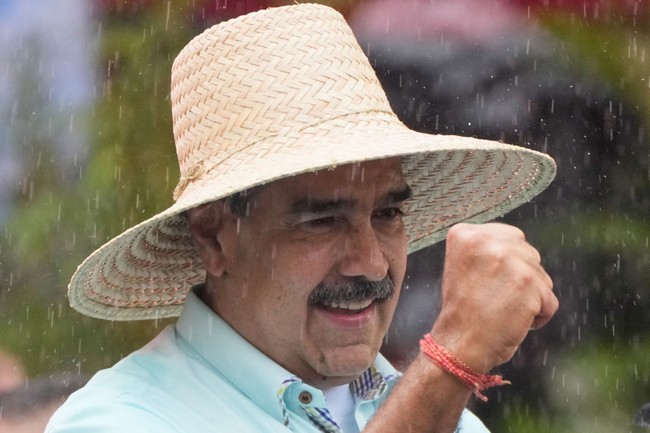
President Nicolás Maduro says he is open to a deal with President Trump if the United States backs off military pressure, offering cooperation on drug trafficking and U.S. investment in oil; the offer faces steep obstacles, including U.S. demands for Maduro to leave, his indictment on narcotics charges, China’s deep influence in Venezuela, and longstanding U.S. demands for restitution of nationalized American assets.
Maduro publicly declared willingness to negotiate in an interview with Ignacio Ramonet, pitching what he framed as pragmatic terms: help on drugs and foreign investment in Venezuela’s oil sector. From a conservative perspective, any negotiations must square with U.S. strategic interests in the hemisphere and the administration’s explicit objectives, which have focused on removing Maduro from power. The president has repeatedly signaled he wants Maduro gone, making a political bargain that leaves Maduro in charge a hard sell back home.
“The U.S. government knows, because we’ve told many of their spokespeople, that if they want to seriously discuss an agreement to combat drug trafficking, we’re ready,” he said. “If they want oil, Venezuela is ready for U.S. investment, like with Chevron, whenever they want it, wherever they want it and however they want it.”
President Trump has publicly stated that pushing Maduro from power would be a desirable outcome and warned Maduro against playing tough, remarks that have been interpreted as both rhetorical and strategic pressure. Those statements underscore a core dilemma: accepting a deal that leaves Maduro in place risks the appearance of weakness and could revive political attacks that the administration backed down. For Republicans who prioritize strength and deterrence, any agreement must not reward authoritarian behavior or let strategic rivals consolidate influence.
Trump, taking reporter questions at his Mar-a-Lago club in Florida on Monday evening, was directly asked if his administration’s ultimate goal in Venezuela is to force Maduro from power.
“Well, I think it probably would. I can’t tell him. That’s up to him what he wants to do. I think it would be smart for him to do that. But again, we’re going to find out,” Trump said.
At the same time, Trump issued a warning to Maduro.
“He can do whatever he wants, it’s alright, whatever he wants to do. If he wants to do something, if he plays tough, it’ll be the last time he’s ever able to play tough,” Trump said.
Beyond the politics, there are real strategic threats to account for. Venezuela has deepened ties with China, accepting major loans and infrastructure deals while expanding military cooperation, a pattern that undercuts U.S. influence in a critical maritime area. For a Republican view that emphasizes the Monroe Doctrine and hemispheric security, allowing a Russia- and China-aligned regime to entrench itself at a chokepoint is unacceptable without major concessions that reverse that influence.
Nearly 600,000 Chinese nationals reside in Venezuela; probably less than 10 percent of that number are citizens. Most are relatively new arrivals. The Chinese population of Venezuela, as of their 2011 census, was 15,358. In 14 years, over 500,000 Chinese have appeared in Venezuela. That is a lot of laundries and restaurants. Down at the FBI office, that is what is known as a clue.
Venezuela is also an active participant in China’s Belt and Road Initiative, which aims to secure China’s dominance in raw materials and trade routes. Venezuela has received over $60 billion in Chinese infrastructure and energy loans (GDP of Venezuela = $82.77 billion). China provides most of Venezuela’s military equipment.
And, not to put too fine a point on it, China is not a “strategic competitor,” it is an enemy nation with which warfare has not yet entered the kinetic stage; see There’s No Hiding It; China’s Actions Say It’s Planning a Preemptive Attack on the US – RedState.
There is also the legal and moral problem of dealing with a leader charged in U.S. courts with narcotics trafficking and related crimes. Maduro has been sanctioned and is the subject of federal indictments alleging he leads a narco-terrorist enterprise, which makes any publicized cooperation on drug interdiction politically fraught. Republicans who insist on rule of law and accountability will demand clarity on how a deal addresses those charges before endorsing any meaningful concessions.
Another sticking point is restitution for U.S. companies and property seized during nationalizations over the past two decades. The Trump administration has been explicit about recovering land and oil rights taken from American firms, a demand that conflicts with Maduro’s framing of foreign investment as a favor he grants. Any credible agreement must include a clear mechanism for returning or compensating U.S. assets before the United States accepts substantial concessions.
President Donald Trump on Wednesday assailed his White House predecessors for not pushing back against Venezuela earlier and stated that his intention is “getting land, oil rights, whatever we had” returned by the government in Caracas.
Speaking to reporters at Joint Base Andrews, Trump said: “They took it away because we had a president that maybe wasn’t watching. But they’re not going to do that again.”
“We want it back,” he added. “They took our oil rights — we had a lot of oil there. As you know they threw our companies out, and we want it back.”
The long list of nationalized U.S. interests — in oil, manufacturing, food processing, and consumer goods — is a reminder that any arrangement must reckon with restitution and economic restoration. Simply signing an agreement on drug interdiction or energy investment without restoring property rights would be politically toxic and strategically hollow. For conservatives who view strength as credibility, accepting less than a full account would be portrayed as a capitulation.
Finally, Maduro’s territorial claims on neighboring Guyana and continued ambitions in contested oil-rich regions complicate any détente. A deal that fails to curb expansionist behavior or reverse external alignments would leave the United States and its partners exposed in a way that weakens regional security. For policymakers, the central question is whether a negotiated settlement can deliver both accountability and strategic realignment, not merely temporary calm.

Add comment