
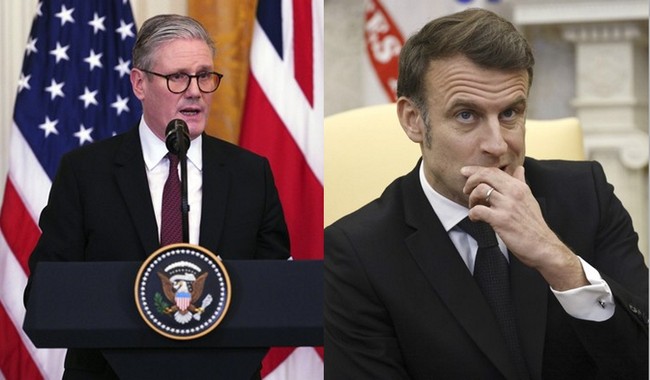
I’ll walk through why European leaders’ applause for the Strait of Hormuz reopening feels hollow, note how the U.S. and Iran actually made the corridor passable during a ceasefire window, point out Macron and Starmer’s public statements calling for permanent navigation, highlight President Trump’s blunt response to allied behavior, and underline the broader lesson about relying on American power for security.
Headlines celebrating “Hormuz reopening” are popping up everywhere, and you can see why capitals are eager to claim credit. Paris and London issued statements welcoming the announcement and calling for lasting freedom of navigation, while signaling plans for an international maritime effort to secure the route. Those public pronouncements sound reassuring, but the timing and reality tell a different story about who actually forced the change on the ground.
The irony is plain: European leaders are applauding a development their policies didn’t produce. Macron and Keir Starmer are right to press for permanent maritime security in words, but words do not swing the balance when nations face an immediate threat. Planning meetings and military planners assembling in London matter for future coordination, yet they came after the decisive actions that reopened the strait.
The leaders of France and the U.K. on Friday welcomed the announcement by Iran and the U.S. that the Strait of Hormuz is open, but said freedom of navigation must be permanently restored to the key oil route choked by the U.S.-Israeli war on Iran.
President Emmanuel Macron and Prime Minister Keir Starmer said they would keep planning an international mission to restore maritime security, which Starmer said will be deployed “as soon as conditions allow.” They said military planners will meet in London next week.
That quote lays out the familiar script: welcome the result, call for permanence, promise collaboration. It also uses language that shifts blame around, describing the route as “choked by the U.S.-Israeli war on Iran,” which sidesteps who actually acted to clear the obstruction. For many Americans watching, the frustration is that allies talk about missions and meetings while the security teeth belong to the United States.
Meanwhile, the action that mattered happened in real time. As the diplomatic meeting unfolded, public statements and diplomatic moves by Tehran and Washington led to immediate commercial passage. Markets reacted accordingly, with oil prices dropping when Iran signaled commercial vessels would be allowed through. Those are the kinds of practical outcomes that matter to global trade and energy security.
As the meeting was underway, President Donald Trump and Iran’s foreign minister declared the strait open to commercial vessels. Oil prices plunged after Iranian Foreign Minister Abbas Araghchi posted on X that passage for commercial vessels would remain “completely open” for the duration of a 10-day ceasefire in Lebanon.
President Trump framed the episode bluntly, reminding Americans and partners that U.S. resolve is the difference-maker. His public messages were sharp and undiplomatic, but they reflect a straightforward view: allies who dither in crisis lose leverage, and the Americans who deliver results won’t forget that. That tone rubbed some European capitals the wrong way, but it also communicated a clear lesson about the cost of inaction.
I TOLD THEM TO STAY AWAY, UNLESS THEY JUST WANT TO LOAD UP THEIR SHIPS WITH OIL. They were useless when needed, a Paper Tiger! President DJT
Those words are combative, and they were meant to be. They also capture a broader sentiment: when allies decline to offer bases, access, or timely support in early, decisive days, the U.S. ends up carrying the operational burden. That reality fuels skepticism about European defense commitments and keeps American policymakers focused on hard power rather than endless diplomacy.
Criticism aimed at specific countries for denying basing or logistical access is not new, and this episode revived those complaints. When immediate access and cooperation matter, delays and refusals have strategic consequences: missions become harder, risk grows, and operational flexibility shrinks. Public planning sessions after the fact do not substitute for early, tangible allied support when it matters most.
Still, European leaders will keep talking about missions, commissions, and long-term maritime security frameworks. Those initiatives can matter eventually if they translate into shared capabilities and burdens. For now, though, the short window of commercial passage was opened by the combination of U.S. pressure and Iranian signaling, not by triumphant European maneuvering.
The practical takeaway is straightforward: nations that want reliable security guarantees should invest in capable militaries and credible deterrence, and allies should show up early when the stakes are highest. Otherwise, applause for reopening a strait looks like political theater after the hard work has already been done. The politics of praise won’t secure shipping lanes; hard power will.
Observers should watch whether the planned international maritime effort becomes a real burden-sharing mechanism or just another round of diplomatic theater. If European governments move from rhetoric to capability—stationing ships, sharing intelligence, and offering basing support—that will change the conversation. Until then, the United States remains the actor that opens chokepoints and keeps them open when it’s necessary to do so.
Way to step up once America secures safe passage!!!! We Americans expect that from France but now Germany!!