
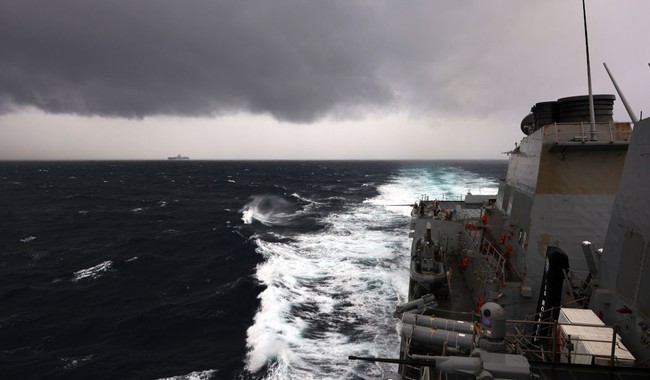
This piece examines recent Iranian claims that the Strait of Hormuz has been closed, the U.S. response about continuing interdiction operations, and what the exchange means for American policy and credibility under the Trump administration.
Mohammad Bagher Ghalibaf, the Speaker of Iran’s Parliament, announced on X that the opening of the Strait of Hormuz is nullified because President Trump violated an agreement. That declaration landed as a jab at U.S. policy and as a signal to domestic audiences that Tehran is taking a hard line. The claim is provocative, but it demands verification from actions at sea, not social media pronouncements.
Ghalibaf claimed:
1- The President of the United States made seven claims in one hour, all seven of which were false.
2- They did not win the war with these lies, and they will certainly not get anywhere in negotiations either.
3- With the continuation of the blockade, the Strait of Hormuz will not remain open.
Those comments came after U.S. Central Command announced that the blockade is ongoing and released guidance on contraband interdiction. The U.S. notice to mariners set out categories of banned and conditionally banned cargo that could be subject to inspection, and the Central Command warned it would pursue suspected blockade runners.
The notice spelled out types of contraband and conditional contraband in blunt terms. It listed weapons, ammunition, explosives and military equipment as forbidden items and included crude oil, nuclear material, metals and machinery as conditional contraband if they aid Iran’s military operations. Chief of the Joint Staff Gen. Dan Caine also said U.S. forces would pursue ships beyond the immediate Central Command area when necessary.
The U.S. reserves the right to search any Iranian vessels, sanctioned vessels and ships suspected of carrying a list of contraband items, according to a Thursday notice to mariners from U.S. Central Command.
Contraband items include weapons, ammunition, explosives and military equipment, the notice reads. Conditional contraband –meaning contraband for aiding Iran’s military operations – includes crude oil, nuclear material, metals and machinery. A full list is included in the blockade update.
To that end, the U.S. will pursue ships outside of the U.S. Central Command area of response, Chief of the Joint Staff Gen. Dan Caine told reporters Thursday.
We should judge words by deeds. Ghalibaf has a large social media platform inside Iran, but Tehran’s internal churn makes it hard to know how authoritative his statements really are. Iranian officials often play to domestic political audiences, announcing strong positions while diplomats quietly manage back channels.
The Trump administration has made reopening the Strait of Hormuz a signature foreign policy achievement, and it will be politically painful for that to be undone by Tehran’s posturing. Republicans in Washington will expect a firm response if Iran truly attempts to reimpose a blockade that threatens global shipping and U.S. interests. The credibility of deterrence rests on consistent follow-through, not verbal concessions.
Operationally, the CENTCOM guidance gives U.S. commanders room to act against vessels suspected of carrying contraband, and the public nature of the notice is a deliberate signal. Making the rules visible to international shipping and to Iran increases the cost of any attempt to obstruct freedom of navigation. That transparency also helps allies coordinate responses and reduces ambiguity about U.S. intentions.
Expect this to play out on two tracks: tactical actions at sea and strategic messaging onshore. On the water, U.S. and coalition ships will monitor traffic and, when necessary, board or intercept vessels that meet the contraband criteria. On land, American officials will build a legal and diplomatic record so that any use of force, if required, is clearly justified to partners and the public.
While Tehran sends defiant statements, U.S. military posture and policy announcements so far show a willingness to enforce the rules governing the strait. That posture matters to regional allies and to the shipping industry, which relies on predictable open sea lanes. If Washington demonstrates resolve, Tehran will have to weigh the domestic showpiece value of tough words against the real costs of escalating a naval confrontation.
Back-channel diplomacy may still be happening, but the administration has positioned itself to respond to any attempt to interfere with maritime traffic. For Republican policymakers, the imperative is simple: maintain American power and ensure maritime security without telegraphing weakness. The actions that follow will reveal whether Tehran’s declaration is rhetoric or a precursor to tangible disruption in the strait.

Add comment