
Quick take: I’ll recap how U.S. pressure has squeezed Iran’s finances, note Pentagon estimates on lost oil revenue, highlight Sen. John Kennedy’s blunt assessment on the situation, include his exact quotes, and place the original clip embed where it appeared.
The United States has tightened the screws on Tehran, and the results are visible on the balance sheet. Recent naval and financial moves have severely limited Iran’s ability to sell oil and move money the way it used to. That squeeze is playing out as a strategic tool to force Tehran into a weaker position without launching a full-scale kinetic campaign.
Military interdiction in the Gulf of Oman and diplomatic work on the banking front have combined to make selling crude much harder for the Iranian regime. U.S. actions redirected shipping and made buyers wary, which hit export volumes and revenue streams. For policymakers who prefer pressure over costly entanglement, this kind of leverage is the preferred path right now.
Officials now estimate the regime has lost on the order of billions in revenue since the blockade began. The Pentagon’s current figure is nearly $5 billion in denied oil income, and that number carries real consequences for funding and logistics inside Iran. When the cash flow dries up, decision-makers in Tehran start feeling a lot more urgent pressure.
The military reported specific disruptions: 31 tankers carrying 53 million barrels are effectively stalled in the Gulf, valued at roughly $4.8 billion, and a couple of ships have been seized outright. Iran has begun using older tankers as floating storage because onshore capacity is full, and some shipments are rerouting via longer, costlier paths to avoid interdiction. Those are not minor operational inconveniences; they change how the regime can sustain itself day to day.
That economic reality feeds into political tension inside Iran. When oil revenue collapses, the Revolutionary Guard and Tehran’s leadership face increased strain maintaining domestic control and funding regional proxies. The combination of financial pressure and visible interdiction raises the cost of continued aggression for Iran’s rulers.
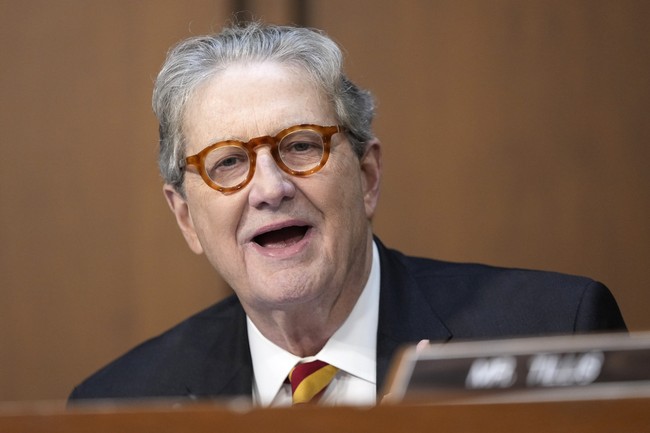
On television, Sen. John Kennedy framed the situation in plain, unmistakable terms and offered a confident Republican read on where this is headed. In his characteristic way, he summarized the effect of the blockade and what it means for Iran’s options. His remarks are notable because they boil down a complex campaign into a clear, actionable judgment.
Sen. Kennedy said, “We ‘have Iran by the ying-yang,'” and he followed up with a stark snapshot of their situation. He pointed to the absence of both imports and exports, stressing that oil is Iran’s single reliable source of hard currency and that source has been effectively turned off. Those words capture the strategy: cut revenue, compress capability, and force a political reckoning.
He expanded on the mechanics: “There’s nothing going in, and there’s nothing coming out. The only source of revenue that Iran has is the sale of oil, and they can’t sell a drop.” Sen. Kennedy then described the risk to Iran’s oil infrastructure itself if production falters, warning that wells shut down for low pressure may never be restarted. The quote conveys both economic and technical peril for Tehran.
The senator predicted a timeline: “another two to three weeks” of blockade pressure could push Iran’s leadership to a turning point. He suggested that sustained disruption would produce an internal “epiphany” among Iran’s rulers and force behavior change without direct regime overthrow. That view frames the blockade as a finite, effective instrument rather than a permanent state of affairs.
Sen. Kennedy also dismissed media voices insisting that the U.S. must gain custody of Iran’s fissile materials or instigate regime change before claiming strategic success. He argued those criteria are the wrong way to measure victory and maintained that the United States “has [already] won” based on the current outcomes. That assertion reflects a Republican confidence in targeted pressure and clear-eyed metrics.
For conservatives watching foreign policy, the push to choke off Iran’s funding fits a classic playbook: apply economic and military pressure until political cost becomes unbearable, then negotiate from strength. This course reduces the need for large-scale ground commitments while still delivering meaningful effects on an adversary’s capacity. It’s a strategy that puts the burden on Tehran to alter its calculations.
Where things go next depends on a few variables: continuation of interdiction, responsiveness from global buyers, and Tehran’s willingness to accept new terms. If pressure persists and the operational constraints remain tight, the regime will face hard choices about funding its security forces and regional operations. Republicans will see any sign of concession or recalibration from Tehran as proof the pressure campaign is working.


Add comment