
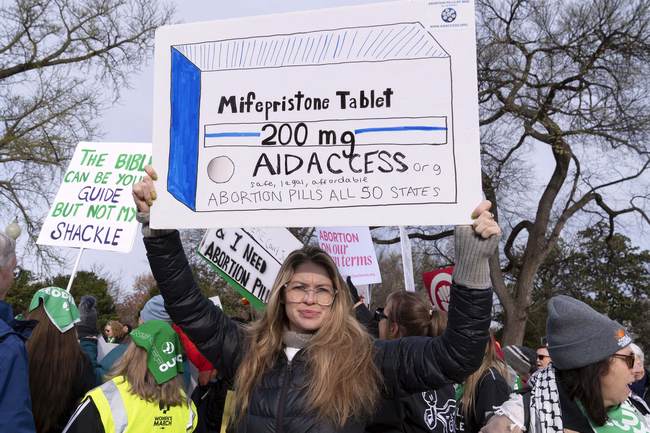
The Fifth Circuit’s temporary block of the FDA’s 2023 mifepristone mailing policy has reopened a major legal fight over chemical abortion, with Louisiana leading the charge and the pharmaceutical manufacturer rushing to the Supreme Court for emergency relief. This decision narrows access nation‑wide in practice, raises state sovereignty issues, and sets up a likely high court showdown over federal regulatory power and the limits of mail‑order abortion access.
On Friday the Fifth Circuit stepped in and temporarily halted the FDA’s change to the REMS rule that had allowed mifepristone to be dispensed by mail and through telehealth channels. That move undercuts the distribution model many pro‑abortion groups used to route pills into states that restrict abortion. For Republicans and state officials who pushed back, the order is a vindication of state authority and of efforts to protect unborn life.
Louisiana Attorney General Liz Murrill framed the ruling as a clear win for life and for state law enforcement, calling out what she described as a federal scheme that had enabled widespread mail‑order abortions. Her office and allied legal groups argued the REMS change effectively sidestepped state prohibitions by allowing pills to be shipped across state lines without in‑person screening. The Fifth Circuit found that Louisiana had a credible path to success in challenging the administration’s rule.
BREAKING: Victory for Life! U.S. Fifth Circuit blocks Biden abortion regime that facilitated the death of thousands of Louisiana babies through mail-order abortion pills.
The Biden abortion cartel facilitated the deaths of thousands of Louisiana babies (and millions in other states) through illegal mail-order abortion pills. Today, that nightmare is over, thanks to the hard work of my office and our friends at @ADFLegal. I look forward to continuing to defend women and babies as this case continues.
The panel’s order emphasized the public interest in not perpetuating a medical practice the agency itself admitted was inadequately studied. The lower court had already signaled that plaintiffs like Louisiana and Rosalie Markezich, described as an abortion drug coercion survivor, had strong claims, but the appeals panel granted the tighter relief states sought. The practical effect is a curtailment of mail‑order access pending further litigation.
A federal appeals court in New Orleans Friday temporarily blocked a federal rule allowing the abortion drug mifepristone to be dispensed through the mail.
A panel of the 5th U.S. Circuit Court of Appeals ruled that Louisiana would likely succeed in its challenge to the federal rule that was adopted under the Biden administration, according to Reuters.
The order also adds to a lower court’s ruling that found Louisiana and the abortion drug coercion survivor Rosalie Markezich would likely win the case, but said the lower court erred in denying immediate relief and the Food & Drug Administration can still complete its safety review of mifepristone.
“The public interest is not served by perpetuating a medical practice whose safety the agency admits was inadequately studied,” the ruling reads. “Indeed, the public interest demands the opposite.”
The ruling, although temporary, significantly curtails access to the drug nationwide and particularly in states that have banned abortion. A previous rule required the drug to be dispensed in person.
The FDA’s 2023 REMS update removed the in‑person dispensing requirement and set up a pharmacy certification pathway that effectively authorized retail pharmacies to distribute mifepristone to patients with prescriptions from certified prescribers. That regulatory change came after the Dobbs decision returned abortion policy to the states, and it directly confronted state laws that had limited in‑person distribution. For many conservatives, the FDA’s action looked like a federal workaround to override state limits on abortion access.
Litigation has been moving through several procedural channels for years. Doctors and pro‑life groups previously sued to roll the REMS change back but ran into standing problems at the Supreme Court. The case returned with a different set of plaintiffs, and Louisiana’s participation provided the court with the state‑sovereignty angle the Fifth Circuit emphasized. That shift in plaintiffs is what allowed this latest appellate ruling to reach the relief sought.
Lawyers for Danco Laboratories, the manufacturer of Mifeprex, responded by filing an emergency motion asking the Supreme Court to stay the Fifth Circuit’s order. The company argued the ruling creates immediate confusion for providers, pharmacies, and patients and disrupts time‑sensitive medical decisions. That filing signals the dispute will likely reach the high court again, where justices may be asked to resolve regulatory authority questions and to decide how much deference the FDA may receive when its actions clash with state law.
A pharmaceutical company that manufactures and distributes the abortion pill Mifepristone asked the Supreme Court on Saturday to block a federal appeals court ruling prohibiting doctors from prescribing the medication through telehealth services or dispensing it through the mail.
Delaware-based Danco Laboratories, LLC, filed an emergency motion with the high court seeking an “immediate administrative stay” on the 5th U.S. Circuit Court of Appeals ruling while the court considers the appeal.
“The panel’s ruling injects immediate confusion and upheaval into highly time-sensitive medical decisions — and it forces Danco, [Food and Drug Administration] FDA, certified Mifeprex providers, patients, and pharmacies all to guess at what is allowed and what is not,” lawyers wrote in the filing.
Advocates on the pro‑life side stressed the human cost they attribute to mail distribution, citing monthly shipments into Louisiana and safety concerns tied to emergency room visits. Those arguments informed both the legal strategy and the political messaging of state officials who framed the case as protecting women and unborn children. For Republicans and state leaders, the clash is as much about restoring local democratic choices as it is about the immediate access issue.
With a plaintiff the courts accept as having standing and a manufacturer urgently seeking a stay, the legal conflict over mifepristone distribution will almost certainly continue to the Supreme Court unless settled earlier. That makes Louisiana v. FDA a major test of federal regulatory reach, state sovereignty, and how abortion‑related medical policies are implemented after Dobbs.
Don’t miss this critical state sovereignty discussion from today’s 5th Circuit ruling in Louisiana v. FDA. ⬇️
When federal policy is designed to undermine a state’s legal code, that’s not just policy disagreement. That’s sovereign injury.
Every state should take note: if the feds craft a regulation with the express purpose of circumventing your laws, you’re not powerless. You have standing to fight back.



Add comment