
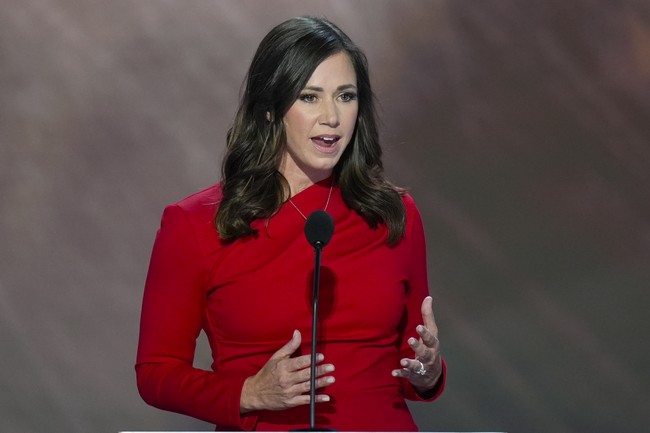
Sen. Katie Britt stepped into the senior senator role and fired a clear warning at Senate Democrats for stalling Department of Homeland Security funding while many of them flew to the Munich Security Conference. She argued that this political theater leaves frontline workers like TSA agents and FEMA personnel bearing the cost, and she called out colleagues who preach national security abroad but neglect it at home. Britt accused Democrats of slow-walking negotiations, prioritizing optics over workers, and weaponizing ICE policy in a way that doesn’t address the agencies actually affected by the funding lapse. Her remarks emphasize Republican commitment to law enforcement, public safety, and continuing talks to resolve the partial shutdown without surrendering enforcement priorities.
On Fox News Sunday and on the Senate floor, Britt made it clear that Republicans wanted more time to negotiate and were willing to engage in good-faith discussions. She said Democrats asked for two weeks but then took too long to present concrete proposals, relying on press conferences and tweets instead of direct negotiation. That delay, she argued, undermined the shortened process designed to avert gaps in funding for critical agencies. Britt framed the situation as political posturing that harms rank-and-file workers more than it advances policy goals.
Look, I’m going to say it one more time: We wanted more time. Democrats asked for two weeks. Our concern was that two weeks wasn’t long enough.
It took the Democrats a week to articulate what it is they wanted. They articulated it via press conference and via tweet, not by conversation. Let’s be clear: Not by conversation.
Then it took them a number of more days, from Wednesday to Saturday to come up with legislative text.
Britt criticized the decision by some Democrats to make ICE reforms a bargaining chip, even though ICE and Border Patrol are not the DHS components affected by this particular stopgap funding issue. She stressed that Republicans will not allow enforcement to be traded away, saying plainly that the party will continue enforcing the law. The larger complaint was hypocrisy: traveling to Europe to lecture about global security while leaving American security functions and workers in limbo back home. That contrast was the core of Britt’s rebuke.
She pointed to several Democrats who attended the Munich Security Conference and argued their presence there made the disconnect especially obvious. Britt contrasted speeches about alliance-building with the reality of TSA agents and FEMA staff facing missed paychecks and operational uncertainty. Her message was about priorities: if national security matters, fund and protect the people who deliver it in the United States first. The practical consequences, she insisted, are being felt by everyday federal employees.
And when we talk about these different things, and they’re looking at it, they know that… it’s kind of rich to be honest with you, to watch so many of them having flown off to Munich, to talk about national security on the world stage, but yet failing to fund our own here at home. They know that ICE and CBP will continue to be funded throughout this, but they know that the other things that keep Americans safe will not. And that actual American workers, TSA agents, will be the ones paying the price.
One example Britt highlighted was Sen. Elissa Slotkin, who attended the Munich conference and warned about alienating allies, saying, “I think it takes a long time to build trust and an instant to lose it.” Britt used that remark to underscore what she sees as mixed messaging: lecturing allies on trust while leaving domestic frontline workers with pay and safety worries. The point was not personal; it was about demonstrating consistent leadership on both foreign and domestic fronts. Britt argued that real leadership shows up at home first.
She also painted a grim picture of the human cost when funding stalls. Britt described reports of TSA agents sleeping in their cars, selling plasma to pay bills, and families scrambling after months without guaranteed pay. She named FEMA workers who already endured lengthy unpaid periods during earlier funding gaps, arguing that repeated policy brinkmanship hurts the public servants who keep communities safe. That testimony framed the debate as more than abstract policy fights and focused it on real consequences for American workers.
There is no way that you can’t say we’re working in good faith. We want to continue this conversation, but yet you’re penalizing a TSA agent? A TSA agent is gonna go without a paycheck. Why? So that you can posture politically. I’m over it! Everybody on that side of the aisle knows that ICE and CBP will continue to be funded. They are going to continue to enforce the law just as they should. Who’s gonna pay the price? It’s the TSA agent. It’s the person working at FEMA, who already went FORTY-THREE days without a paycheck. Who’s trying to figure out how to make things work. I have reports of TSA agents sleeping in their cars because they can’t afford gas. Selling plasma to make their bills. Guys, come on. We’re asking to continue a conversation.
Britt reiterated Republican positions that local and state law enforcement should cooperate with federal partners and that sanctuary policies undercut public safety. She made clear Republicans will hold firm on enforcement priorities while continuing to negotiate funding measures. The tone she struck blended toughness on policy with concern for workers who are directly affected by the stalemate. Those remarks set the terms Republicans are offering as they push for a resolution.
Lawmakers on both sides will continue debating funding and policy language, but Britt’s message is straightforward: don’t lecture the world about security while leaving critical domestic functions unfunded. She framed the dispute as a test of priorities and responsibility, insisting that protecting Americans and supporting federal workers must come before political theater. The negotiations will determine whether that perspective carries the day or whether political posturing continues to dictate outcomes.


Add comment