
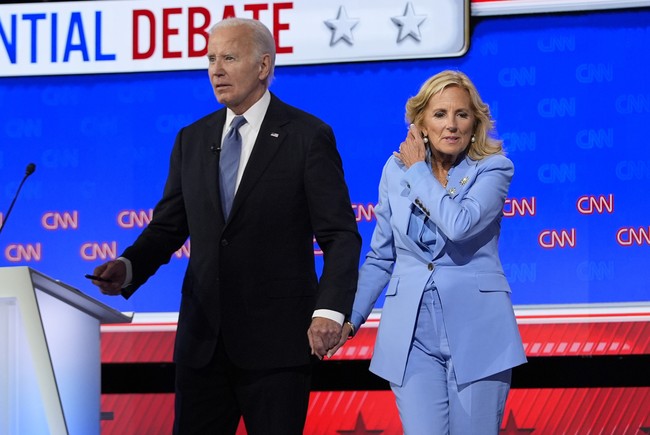
I’ll lay out the facts about Jill Biden’s new book and the fallout from her comments after the 2024 debate, review conflicting passages and reporting, examine reactions from aides and reporters, and show how the narrative undercuts her stated purpose without adding new sources or links.
Jill Biden released a memoir and gave interviews to promote it, and some passages have triggered steady criticism. She described fearing that Joe Biden might have suffered a medical event during the 2024 debate with Donald Trump, saying she was worried he had a stroke or something similar. That admission alone carried weight because it directly addressed what many voters had already seen onstage.
But the book also contains a blunt exchange immediately after the debate, quoted in reporting: “I really f**ked up, didn’t I?” he said, and she replied, “‘Yes, you did,’ I whispered back.” Those exact words raise a contradiction when paired with her earlier claim that she thought a medical issue was to blame. Saying both creates a credibility gap that critics have been quick to point out.
Shortly after the debate, Jill joined her husband at campaign events and told supporters he had “answered every question” while claiming the opponent lied. That public posture looks sharply at odds with whispering that he had botched the debate because of some kind of medical problem. The sequence of private alarm followed by public praise fuels accusations that she misled supporters or was smoothing over an obvious collapse.
The memoir itself, according to reporting, shows that Jill worried the debate would make viewers think Joe was always that way, writing, “Oh God—will people watching assume this is how he is all the time?” That line signals awareness of how damaging the performance could be and suggests a motive for trying to control the narrative. Critics say the book reads like an attempt to reshape her role from protector to corrective by insisting she was not hiding his condition.
Former aides and campaign insiders have pushed back, calling parts of the new story “revisionist history” and saying that staff were repeatedly told the debate was just a “bad night.” One quoted former senior advisor said, “She and a handful of other close advisors around President Biden kept gaslighting us, telling those of us on the campaign we were the ones who were wrong, and that he just had a ‘bad night.’ I think she saw the reputational harm this caused her and is therefore taking a new position.” That kind of internal dissent undermines a tidy defense that she was simply reacting as any spouse would.
Reporters with direct access to campaign operations added their observations, noting that aides had seen similar off-script moments before and after the debate. Writers stated that those moments “became more difficult to predict and conceal” and pointed out Jill’s continued presence with Biden at public events following the incident. Those details reinforce the argument that the campaign was aware of a pattern, contradicting claims the debate was an isolated problem.
The sequence — concern about a medical event, private bluntness, immediate public praise, and later attempts to write a clarifying memoir — creates a messy picture. To many onlookers, it reads less like a straightforward confession and more like damage control. That perception has driven the backlash and keeps the story alive in conservative and mainstream commentary alike.
What complicates the conversation is the emotional mix of a spouse’s instinct to protect and a political team’s instinct to preserve a campaign. Jill’s lines about fearing people would assume Joe was always incoherent suggest genuine anxiety, while the public messaging suggests strategic management. When those instincts pull in different directions, the result is confusion and suspicion rather than clarity.
The book’s stated aim — to dispel accusations that she covered up cognitive decline — has not landed as intended for many readers and critics. Instead of closing the debate, the memoir has reopened questions about when and why aides and family talked down concerns. Opponents and some former insiders say the new narrative shifts responsibility and recasts earlier messages in a more self-serving light.
Whatever one thinks of the Bidens personally, the episode highlights a broader political reality: mixed messages from those closest to a candidate can be as damaging as the original public misstep. When private doubts and public defenses do not line up, the result is a credibility problem that sticks long after campaign speeches end.
A former senior Biden campaign advisor tells me Jill Biden’s comments are “revisionist history.”
“She and a handful of other close advisors around President Biden kept gaslighting us, telling those of us on the campaign we were the ones who were wrong, and that he just had a ‘bad night.’ I think she saw the reputational harm this caused her and is therefore taking a new position.”
Biden aides had told Jake Tapper and me they had seen him act that way before and after. Those moments became more difficult to predict and conceal. And Jill joined Biden for several campaign events after the debate including a rally the next day.
https://x.com/DashaBurns/status/2059996674605383773
Add comment