
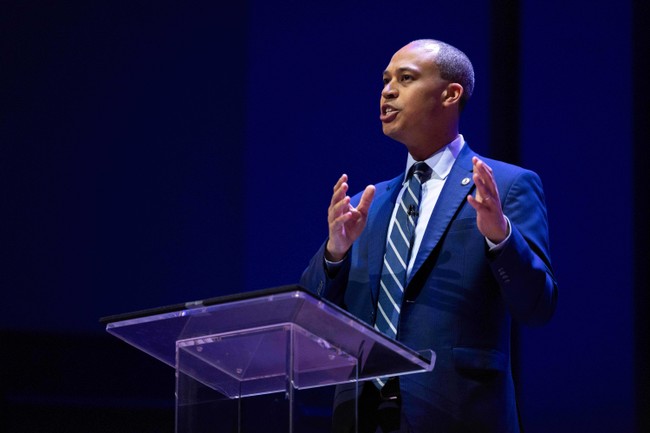
Decision Desk HQ has called the Virginia attorney general race for Democrat Jay Jones over incumbent Republican Jason Miyares, a surprising result after a campaign rocked by speed and text messaging controversies and intense national attention in the closing weeks.
The race tightened after damaging stories about Jay Jones emerged in October, turning what had been a quiet contest into a high-profile battle. One revelation showed Jones was ticketed for driving 116 MPH in a 70 MPH zone and charged with reckless driving, a record that raised questions about judgment for someone seeking the state’s top law enforcement job. Voters saw a candidate who, unlike ordinary Virginians, avoided jail time and allegedly performed community service in a way that looked like a sweetheart arrangement tied to his own political fundraising. That sequence of events fed a narrative that many on the right used to argue Jones lacked the temperament and respect for law enforcement expected of an attorney general.
A later scandal made the campaign even more combustible: text messages in which Jones allegedly fantasized about violence against a GOP leader and his family. Those messages, which included envisioning putting “two bullets” in the head of then-Speaker Todd Gilbert and watching his sons die in their mother’s arms, became the focal point for critics who said Democrats failed to hold their nominee accountable. The shock value of those messages put the national spotlight on Virginia and forced voters to confront whether character concerns outweighed party loyalty in a down-ballot race. For many Republicans and independents, the texts were disqualifying; for Democratic leaders, it became a test of whether party unity trumped basic decency.
Despite the controversies, high-profile Democrats continued to support Jones, and at least some voters in the state stuck by him. The headline-grabbing moments did not translate into an automatic disqualification at the ballot box, showing how polarized modern politics has become. Some Virginia Democrats even signaled they might cross the aisle in individual races, acknowledging the discomfort with Jones while still aligning with the party elsewhere. That fractured reaction reflected a party grappling with the trade-off between winning seats and policing candidate behavior.
Polls leading into Election Day showed a tight contest, with incumbent Jason Miyares making gains after the October revelations. One roundup noted Miyares had pulled into the lead in the RealClearPolitics average, fueled by what some conservative outlets labeled effective October surprises. Miyares, who rode a Republican wave into office in 2021 alongside Governor Glenn Youngkin and Lieutenant Governor Winsome Earle-Sears, campaigned on law-and-order themes and parental rights, themes that resonated with voters upset by the lockdowns and school board controversies of the pandemic era. That 2021 sweep proved the state could pivot quickly when voters felt their concerns were finally being heard.
The contrast between Miyares and Jones became a referendum on competence and character, at least among swing voters who might be persuaded by an opponent’s missteps. Miyares emphasized his record and the promises Republicans made when they returned to office three years earlier, positioning himself as a steady hand who would defend victims, uphold the law, and push back against what his supporters call overreach from the left. For conservatives, the campaign was about holding onto the gains made in 2021 and proving that accountability and public safety matter to Virginia voters.
Election night clearly showed how volatile down-ballot politics can be when national narratives and scandal collide with local issues. While Democrats managed to carry two top-ticket races, the attorney general outcome underscored that negative headlines can shift momentum, but they do not always determine the final result. Turnout patterns, local organizing, and targeted messaging by both parties factored heavily into the narrow margins that decided the race. Virginia’s electorate, diverse and often unpredictable, responded in ways that reflected both national polarization and local priorities.
Jason Miyares’ 2021 victory was part of a larger GOP resurgence in Virginia tied to parental anger over pandemic-era policies and concerns about educational content in schools. That coalition helped elect a Republican governor, lieutenant governor, and attorney general that year, and party strategists viewed the 2025 cycle as a test of whether those gains would stick. The attorney general contest became a measuring stick for the Republican message on public safety and accountability, even as Democrats fought to defend their nominees amid swirling controversies.
https://x.com/JasonMiyaresVA/status/1985726238967669043
Inauguration Day in Virginia is set for Saturday, January 17, 2026, when the incoming officials will be sworn in and the political consequences of these races will begin to play out in policy and enforcement decisions. The results will matter for questions about criminal justice, election law, and state oversight, areas where an attorney general’s priorities can have an immediate impact. Both parties will use the outcome to refine their strategies heading into future statewide and national contests.
Editor’s Note: The Schumer Shutdown is here. Rather than put the American people first, Chuck Schumer and the radical Democrats forced a government shutdown for healthcare for illegals. They own this.
Political observers on both sides will be parsing the vote for weeks, trying to understand which messages landed and which candidates managed to overcome or succumb to controversy. Virginia once again proved to be a political laboratory where character, policy, and party strategy collide in ways that send signals far beyond the Commonwealth’s borders. The attorney general race was another reminder that down-ballot contests can carry national significance and that voters will weigh both personal conduct and political promises when casting their ballots.

Add comment