
Checklist: I’ll explain the collapse of Rep. Al Green’s latest impeachment push, note how many Democrats abandoned him, include verbatim quoted vote details, describe the effect of the new Texas map on his future, and place the original embed token back where it belonged.
Al Green’s latest effort to impeach President Biden — yes, the 47th president as the piece calls him — ended with even Democrats walking away. What was billed as a privileged resolution to force a quick vote instead collapsed when a coalition of House Republicans and 23 Democrats voted to table the measure. The spectacle left Green isolated and exposed how isolated extreme tactics can become when party leaders and moderates refuse to play along.
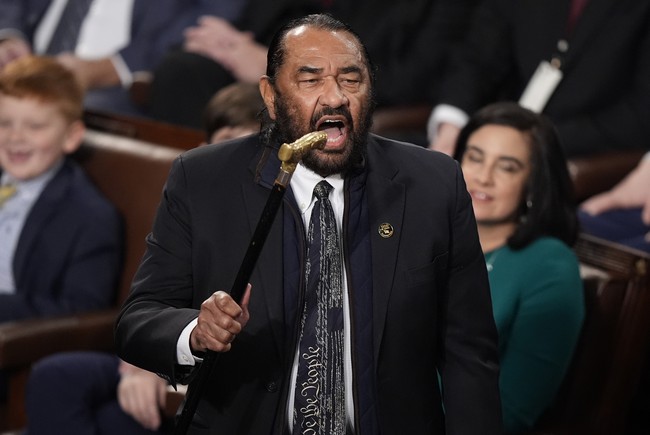
The public moment that set the tone for how many view Green is already part of his reputation: an angry outburst at a presidential appearance that drew attention for all the wrong reasons. That incident reinforced a perception of someone more interested in theatrical confrontation than legislative strategy. Whether motivated by principle or performative politics, the end result was the same — his colleagues opted not to back his escalation.
Rep. Al Green, D-Texas, moved to get a vote on two articles of impeachment Wednesday night via a privileged resolution, a mechanism allowing lawmakers to force action on a bill within two legislative days.
Republicans called for a vote to table the measure on Thursday, a move that effectively kills consideration of the bill itself when a privileged resolution is called for.
Twenty-three Democrats joined Republicans in pushing the impeachment aside. A significant number of Democrats also voted “present,” including all three senior leaders — House Minority Leader Hakeem Jeffries, D-N.Y., Minority Whip Katherine Clark, D-Mass., and Democratic Caucus Chairman Pete Aguilar, D-Calif.
The vote tally and the number of members choosing to register as “present” made the point starkly. A later summary reported, “The final vote fell 237 to 140, with 47 “present” votes.” That rolling refusal to support Green came from across the Democratic spectrum, with notable names declining to endorse the effort. When party leadership takes a neutral stance, it’s a clear sign the motion was never going to gain traction.
The final vote fell 237 to 140, with 47 “present” votes.
Among the Democrats who voted to table the measure are Reps. Tom Suozzi, D-N.Y., Josh Riley, D-N.Y., Jared Golden, D-Maine, Jimmy Panetta, D-Calif., Chrissy Houlahan, D-Pa., Maggie Goodlander, D-N.H., Sharice Davids, D-Kan., Don Davis, D-N.C., Shomari Figures, D-Ala., and others.
That list of Democratic defections reads like an instruction manual on how not to build a majority for a dramatic political gambit. Members who are mindful of electoral math and local optics shied away rather than join a headline-seeking push. The outcome is predictable: if the idea was to rally public outrage or force a spectacle, the vote showed real politics still matters in the House.
Compounding Green’s isolation is the new Texas redistricting map recently cleared by the Supreme Court, which reshapes his political prospects. The map makes his path back to Congress in 2026 significantly harder, and many observers now treat his continued impeachment motions as largely symbolic. With his political future uncertain, Green’s options narrow to continued theatrical bids or an exit from the scene in 2027.
There’s also a cultural angle at work: Green’s theatrics have become shorthand for a segment of Washington that prizes spectacle over legislation. That kind of posturing can pay off in media attention, but it rarely convinces colleagues who hold the levers of power. In this case, the reaction from both parties made it clear his gambit was a dead end.
For conservatives watching, the episode underscores a simple point: political theater without a path to votes collapses under its own weight. Green’s motion was an attempt to manufacture momentum that never existed in the chamber, and the result was predictable. When even members of your own party step back, it’s time to reassess the strategy rather than double down on empty gestures.
The longer-term effect is straightforward: Rep. Green will have limited opportunities to continue similar tactics if he is no longer in office after 2026. Meanwhile, his remaining months, should he choose to keep pursuing these resolutions, will likely play out as political theater with little impact on governance or accountability. The House moved on, and Green was left doing the shouting while the work continued elsewhere.



I just came across this amazing way to earn $6,000-$8,000 a m0nth 0nline! No selling, no struggle—just a simple system that anyone can follow. Kelly Richards did it, and so can you! Don’t miss out on this life-changing 0pportunity.
Here is I started_______ EarnApp1.Com