
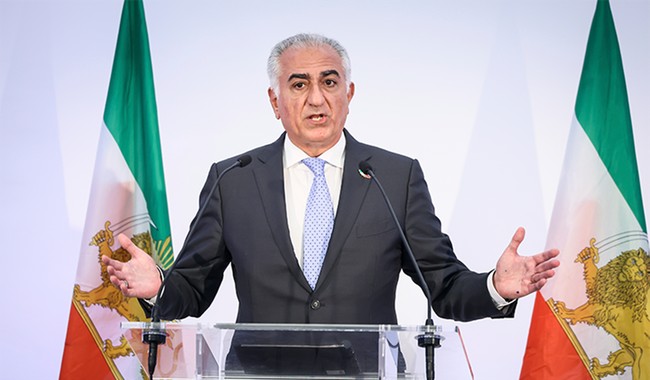
The U.S. and Israel launched strikes that an exiled Iranian royal called a humanitarian intervention, and his reaction has reopened the question of what comes after the Islamic Republic. This article walks through Reza Pahlavi’s statement, the reality facing Iran’s security forces, and the debate over a transitional government while keeping the focus on how these events could shape Iran’s immediate future.
Reza Pahlavi, the exiled son of the last Shah, stepped into the moment with a clear message to the Iranian people and those who enforce the regime. As missiles and strikes reportedly hit targets tied to Iran’s clerical leadership, Pahlavi framed the action as targeted assistance to those suffering under the regime’s rule. He made an appeal for mass civic action and urged security forces to reconsider their loyalty, arguing that the people should reclaim the country from its theocratic rulers.
Reza Pahlavi, the exiled crown prince of Iran, described the joint U.S.-Israeli attack on the country as promised “aid” and an act of “humanitarian intervention” by President Donald Trump.
Following the reported strikes, Pahlavi urged Iranians to abandon the regime and called on security forces to defect.
“Moments of destiny lie ahead of us,” Pahlavi in a statement on social media. “Even with the arrival of this aid, the final victory will still be forged by our hands. It is we, the people of Iran, who will finish the job in this final battle. The time to return to the streets is near.”
From a Republican perspective, offering support that weakens an oppressive clerical regime while minimizing civilian harm is a defensible use of American power. Pahlavi’s framing matters: he insists the strikes are directed at the regime and not at Iran as a nation. That distinction aims to reassure ordinary Iranians while isolating the ruling apparatus that has exported violence and repression for decades.
https://x.com/PahlaviReza/status/2027648281577132145
The practical question is how much those words matter to rank-and-file members of Iran’s security services. When a government falters, survival instincts kick in fast. Many officers and paramilitary members will weigh threats to their families and livelihoods, and defections often hinge on whether there’s a believable path to safety and a guarantee against revenge. Pahlavi’s call for defection is courageous, but it also expects that those he addresses see a credible future without the clerical rulers.
Pahlavi declared that the Islamic Republic is collapsing.
He framed the reported strikes as assistance directed not at Iran itself, but at its ruling clerical establishment and urged the U.S. to “exercise the utmost caution” to preserve civilian lives.
“The aid that the President of the United States promised to the brave people of Iran has now arrived,” Pahlavi wrote. “This is a humanitarian intervention; and its target is the Islamic Republic, its repressive apparatus, and its machinery of slaughter — not the country and great nation of Iran.”
Pahlavi issued a blunt warning to Iran’s military, police and security services, urging them to break ranks with Supreme Leader Ayatollah Ali Khamenei.
“Now that the Islamic Republic is collapsing, my message to the country’s military, police, and security forces is clear: You have sworn an oath to protect Iran and the Iranian people — not the Islamic Republic and its leaders,” he wrote.
History shows regime change rarely occurs without chaos and cycles of revenge. After nearly half a century of clerical rule, wounds run deep and many Iranians will demand accountability. That makes the role of any interim authority critical: they must offer security for ordinary citizens and a clear process for justice that does not become a decades-long vendetta.
Realistically, a transitional period will be messy. Some senior figures might flee to allied capitals and attempt to regroup, while others could be detained or face violent reprisals. The priority for those who back a representative future for Iran should be to protect civilians and create the conditions for transparent, competitive elections. Any figure who can rally a broad cross-section of Iranians without promising a return to monarchy could be useful in that window.
Reza Pahlavi has positioned himself as a possible focal point, but he’s made clear there will be no restoration of the old monarchy. That stance is designed to neutralize a key criticism that would alienate reform-minded Iranians. His message stresses popular sovereignty and democratic institutions as the aim, not nostalgia for past regimes.
From the U.S. viewpoint, the balance is delicate: support those who want freedom without becoming occupier or patron of one faction. If American action can help tip the scales away from a brutal regime while allowing Iranians to determine their own future, it fits within a conservative view of promoting liberty and stability. The coming days will test whether words translate into defections, demonstrations, and an organized transition away from theocratic rule.



Add comment