
Checklist: explain how the Nancy Guthrie disappearance put Pima County in the national spotlight; outline Sheriff Chris Nanos’ controversial handling of evidence and investigations; describe recent raids, detentions, and federal involvement; report on the newly filed recall effort and the signature threshold required; preserve key quotes and embeds.
Pima County in Arizona suddenly became a national talking point after the disappearance of Nancy Guthrie, a case that drew dramatic public attention and intense scrutiny of local law enforcement. What began as a missing persons report has evolved into allegations of kidnapping, contested evidence handling, and a political fallout now centered on the county sheriff. The story has layers: the human tragedy, investigative friction between local and federal agencies, and a growing movement to hold an elected official accountable. That mix has pushed otherwise local news onto a national stage.
The disappearance itself prompted immediate alarm when family and community members noticed something was very wrong. Investigators said Mrs. Guthrie “did not leave on her own. We know that,” a remark that underscored the seriousness of the situation and raised fears of foul play. Later, the sheriff described an even more chilling scenario, saying investigators believed she was taken while in bed. “You have an 84 year old lady who is home in bed, asleep in the middle of night (and) disappears,” he said, adding, “That’s not Tucson and that’s not who we are here.”
Public interest surged as details emerged and reports multiplied. Authorities executed a coordinated operation that included searches of a Tucson residence and the seizure of a vehicle for forensic examination. Local reporters on scene noted a blend of federal and local personnel working the perimeter, and at least four people were detained while detectives and a SWAT team conducted the search. News crews were limited in what they could observe, but the visible police activity signaled serious investigative steps.
Questions later arose about how evidence was handled and which agencies should control forensic processing. Critics accused the sheriff of refusing to allow federal facilities to process key items, a move that sparked tension and public debate over investigative best practices. Those concerns extended to the sheriff’s own background, with observers pointing to inconsistencies in his resume and earlier career roles that prompted scrutiny. The combination of procedural controversy and unanswered questions about the disappearance increased public impatience and suspicion.
Despite the intense search activity and publicity, Pima County officials reported no arrests immediately following the raids, which only fueled speculation and frustration among family, friends, and the broader community. Authorities continued to insist the investigation remained active and that cooperation between agencies was ongoing, yet the optics of evidence control and public statements complicated the narrative. For many, especially those seeking assurance that the case was being handled with maximum resources and transparency, the situation felt unsatisfactory. The lack of quick answers deepened the political stakes.
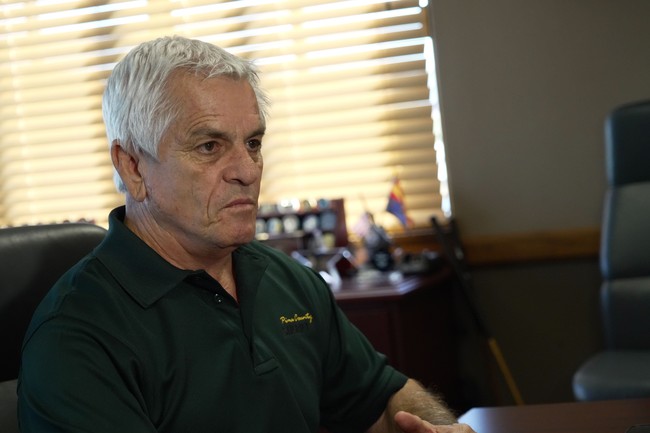
Political consequences began to take shape as the sheriff found himself the focus of a recall effort filed in mid-March. Local election officials confirmed a petition to remove Pima County Sheriff Chris Nanos was filed on March 12th, starting a process that requires a substantial number of valid signatures to proceed. The threshold set by county rules demands 120,000 signatures collected within 120 days to trigger a recall election, a steep bar that reflects how difficult it is to remove an elected official through this mechanism.
The recall filing explicitly ties the effort to “scrutiny over the handling of the Nancy Guthrie investigation,” framing the petition as a response to perceived missteps and public dissatisfaction. When asked about the effort, Sheriff Nanos stated, “We’re aware of the recall and it’s the right of the people. We’ll always honor the will of the people and that’s what makes democracy.” The statement acknowledged the legal avenue for citizens to voice discontent while stopping short of addressing the specific operational critics had raised.
The effort to collect a large number of signatures in a limited timeframe will test the capacity and resolve of recall organizers. If proponents can mobilize support and evidence of public concern, the recall could force a high-profile electoral test for the sheriff. If they fail to meet the threshold, the political backlash may still shape local conversations about law enforcement oversight, transparency, and cooperation with federal partners. Either outcome will leave a mark on county politics.
Meanwhile, the search for Nancy Guthrie continues and the community remains focused on answers and accountability. Family members, neighbors, and investigators press on, driven by basic questions about where she is and how this could have happened. As the case unfolds, the interplay between investigative choices and political reaction will remain a central thread, with each development feeding public debate and shaping perceptions of law enforcement leadership.
Reporting on the case has kept certain direct quotes and on-the-record comments prominent because they highlight how officials framed the incident and how the public reacted. The situation remains fluid, with law enforcement promising ongoing work and recall organizers moving forward under strict procedural rules. For residents and observers alike, the investigation, and the political consequences tied to it, will be watched closely in the weeks ahead.

Add comment