
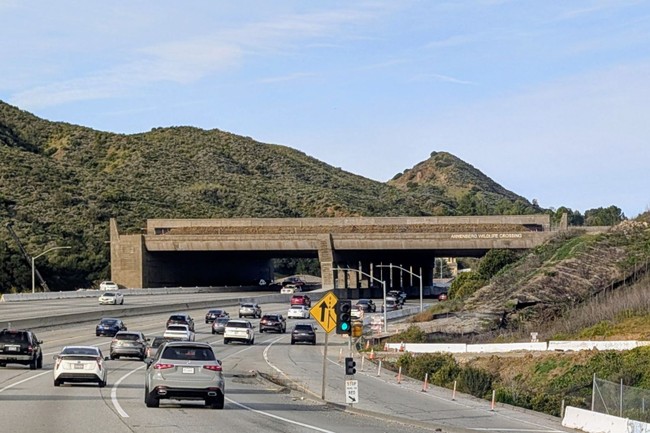
The proposed Wallis Annenberg Wildlife Crossing in Southern California is a costly, controversial project designed to connect fragmented habitat for mountain lions and other wildlife, but critics warn the crossing could worsen wildfire risk, repeat past land-management mistakes, and prioritize symbolism over public safety and sensible fire prevention.
The bridge has become a lightning rod because its price tag ballooned to roughly $114 million and its schedule slipped well past the original 2025 goal, all to help a very small population of mountain lions avoid inbreeding. Planners insist the structure will reconnect isolated habitat, but neighbors and longtime residents see a different risk: a constructed corridor of vegetation that could act as an accelerant during Santa Ana wind events. That worry is not theoretical—the area has burned before, and embers have jumped the 101 in past megafires.
Project backers frame the crossing as a way to fix fragmentation that threatens regional wildlife. Official materials emphasize that roads and development “have created islands of habitat that can genetically isolate all wildlife—from bobcats to birds to lizards. The species most immediately at risk, the mountain lion, could vanish from the area within our lifetime.” That line captures the conservation argument in stark terms and explains why the crossing is championed by agencies and nonprofits.
“More than two decades of study by the National Park Service in the Los Angeles area has shown roads and development are not only proving deadly for animals trying to cross, but have also created islands of habitat that can genetically isolate all wildlife—from bobcats to birds to lizards. The species most immediately at risk, the mountain lion, could vanish from the area within our lifetime.”
Still, the debate goes beyond wildlife genetics. Residents in communities near the 101 fear the bridge will be landscaped with drought-prone shrubs and trees that dry each summer, effectively creating a tinder-lined span over a busy freeway. The Santa Monica Mountains are no stranger to extreme fire behavior, and locals point out the area’s unique combination of heavy fuels and seasonal offshore winds that can turn a small flame into a fast-moving catastrophe.
Government land managers and certain environmental groups are at the center of the controversy because of past decisions that limited aggressive fuels management. Critics say the same agencies that supported the crossing also restricted prescribed burns and mechanical clearing on public lands, citing protections for rare plants. That stance, opponents argue, hamstrung firefighters and allowed brush to accumulate in strategic places.
“The freeway (US 101) is a formidable and virtually impenetrable barrier for many wildlife species, including mountain lions, bobcats, gray foxes, coyotes, and mule deer that inhabit and travel between these two mountain ranges. For mountain lions in particular, the consequences of this restriction results in increased inbreeding and territorial fighting, and very low genetic diversity, within the Santa Monica Mountains.”
Local memory of the Woolsey Fire and the Palisades Fire fuels skepticism about any plan that plants additional vegetation across the 101 corridor. Residents recall embers crossing the highway near the exact spot where the crossing is slated to sit, a reminder that fire does not respect design drawings or good intentions. Those experiences make the idea of a planted bridge feel less like a conservation triumph and more like a potential pathway for flames.
Some project supporters celebrate the optics of reconnecting people and nature, imagining commuters stuck in traffic who might glimpse a mountain lion strolling above them. One advocate said, “Someone could be in rush-hour traffic, and there could be a mountain lion right above them. I think that’s such a hopeful image, and one that inspires me that we can right some of these great wrongs.” That line plays well in advocacy pieces, but it does not answer questions about fuel loads, landscape maintenance, and fire suppression tactics under extreme conditions.
Complicating the picture is the role of public-private partnerships and nonprofit funding in driving the project forward. Money from philanthropic sources has helped finance planning and design, while public agencies own large tracts of surrounding land and set the rules for how it is managed. Critics want clearer accountability: who controls ongoing vegetation choices on the bridge, what firewise practices will be enforced, and how maintenance will be funded long-term?
Neighbors and firefighters call for rigorous, enforceable assurances that the crossing will not become a seasonal hazard, including fuel breaks, low-flammability plant palettes, and regular clearing. They argue that conservation objectives and community safety should be balanced, not traded off. Until those operational guarantees are nailed down, skepticism will persist among those who remember how quickly past blazes spread in this same landscape.
The conversation around the crossing is about more than wildlife and symbolism; it is about how government agencies, nonprofits, and communities manage shared landscapes in a fire-prone region. Decisions made now will shape how the Santa Monica Mountains respond to the next severe wind event, and critics say the project needs to be rethought if it increases danger to people and property while aiming to help a handful of big cats.


Add comment