
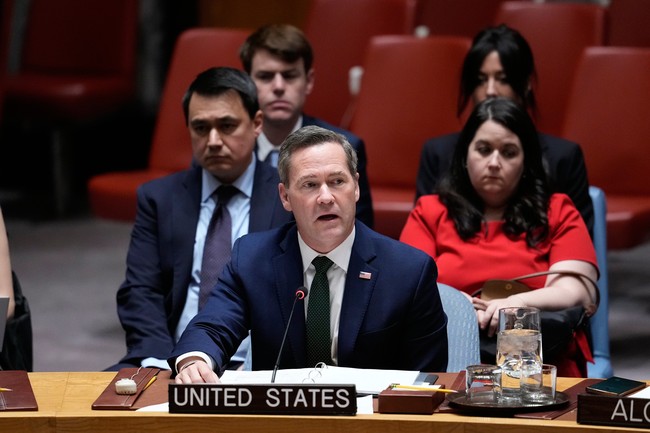
This piece examines U.S. strategy toward Iran as described by U.S. Ambassador to the United Nations Mike Waltz, focusing on verification, military posture in the Strait of Hormuz, stepped-up economic pressure, and how fractured Iranian authority complicates any nuclear deal.
The familiar Reagan line “Trust, but verify” is front and center in the debate over Iran, but here the phrase gets a sharper Republican edge: “Don’t trust and verify.” That shift captures the urgency in Washington to ensure any agreement with Tehran is not built on promises that can be ignored. Ambassador Waltz laid that out clearly during his appearance on ABC News’ “This Week” with Jon Karl, and his message is being backed up by actions at sea and in the financial arena.
Iran’s internal chaos is a running theme. Waltz told Karl the Iranian government “is in absolute dissaray,” and he pointed to conflicting statements between the foreign ministry and the IRGC as proof that Tehran does not have a single, coherent voice. When officials contradict one another about control of the Strait of Hormuz, the credibility of any Iranian pledge crumbles before talks even begin.
That lack of coherent command matters because the U.S. is not negotiating with an orderly, centralized partner. Our Navy and legal authorities are actively shaping what Tehran can do, and Waltz emphasized that the United States “ultimately deciding what gets in and out” of the Strait is part of the leverage at play. That posture sends a clear signal: promises alone won’t protect global commerce or stop weapons proliferation.
Waltz went on to say the U.S. will rely on enforceable, verifiable mechanisms for any nuclear agreement. “I promise you, I assure you the United States doesn’t trust anything; any agreement that comes out will have to be verifiiable and enforceable.” He named the IAEA and its inspectors as central to that verification, underscoring the need for international monitoring tied to clear consequences.
Militarily, the administration is not shy about preserving options. Waltz made the point that President Trump has more tools he can employ in the Strait to sustain the blockade and to deter attempts to flout international rules. In practice that means naval interdictions and rules of engagement crafted to protect commercial traffic while making it costly for the IRGC to press its agenda.
Economic measures are being used alongside military pressure. Treasury Secretary Scott Bessent announced an initiative dubbed “Operation Economic Fury” to freeze assets and squeeze financial lifelines to top Iranian and IRGC figures. That campaign aims to cut off revenue streams and to coordinate financial actions with Gulf neighbors who share an interest in preventing Tehran from profiting while threatening the region.
“So, we have pushed out to them the request that we want to freeze more funds of the leadership of the IRGC, and any members of Iranian leadership.”
The administration is also working to make sure oil revenues do not flow back to Iran through third parties, complicating Tehran’s ability to finance its military and proxy activities. Cutting access to funds and blocking asset movement is meant to create real, measurable pain that can be verified and tracked by allies and enforcement agencies.
There is another practical question at play: if commercial cruise ships and cargo vessels can transit the Strait without seeking permission from Tehran, how much real control does Iran have? The answer matters not just for politics but for the credibility of any diplomatic arrangement. A regime that cannot control shipping lanes cannot credibly assert the authority needed to enforce or honor an agreement.
That reality feeds into a larger negotiating posture of skepticism and rigor. The U.S. position, as articulated by Waltz, is not to hand the regime the benefit of the doubt. Agreements will be constructed so inspectors can see what they need to see, sanctions can be quickly reimposed, and military measures can be applied if violations occur. This is a deliberate move away from wishful thinking toward hard enforcement.
Waltz also contrasted the current administration’s approach with that of the previous president, criticizing the habit of telegraphing options in public and thereby reducing leverage. He argued that not announcing every intention preserves options and keeps adversaries guessing, which is a key part of exerting pressure without conceding momentum. In short, ambiguity in posture can be a strategic advantage when paired with concrete, verifiable steps.
As the U.S. delegation returns to talks in the region, the mix of naval operations, IAEA oversight, and financial pressure forms a single strategy: deny Iran the ability to clandestinely expand its nuclear or military reach, and make any compliance easy to verify. That approach aims to replace hollow promises with enforceable reality, and it reflects a willingness to pair diplomacy with decisive measures where necessary.
Waltz’s message is straightforward and uncompromising: the United States will not accept unverifiable commitments, and it will use every lawful tool to ensure compliance. The lines between diplomacy, economic coercion, and military deterrence are being drawn in real time, and Washington intends to hold Tehran accountable on all of them.
When asked what would happen if Iran refuses to agree, Waltz was clear that “all options are on the table” and that the administration will keep its cards close to the vest. That posture is meant to maximize leverage while leaving room for verification mechanisms to do their work without being undermined by premature disclosures.
Add comment