
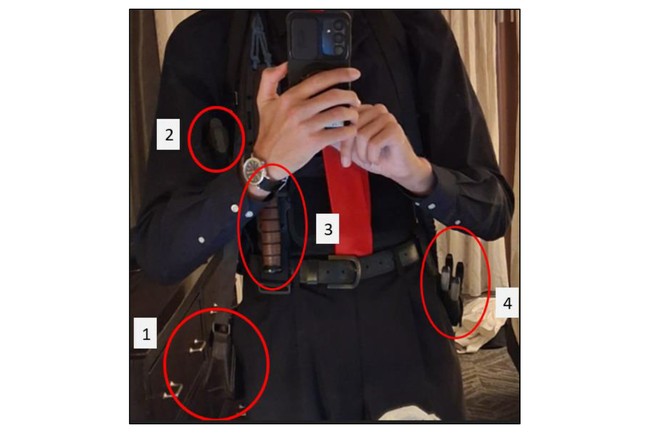
The newly released surveillance images and court filings paint a stark picture: on April 25 a man armed with a shotgun rushed a checkpoint outside the White House Correspondents’ Association dinner at the Washington Hilton, Secret Service officers engaged, one agent was struck in his vest, and the suspect was taken into custody after a rapid, chaotic confrontation that prosecutors say was planned and targeted.
Surveillance photos show the seconds after Cole Tomas Allen burst through a doorway and sprinted toward the screening line outside the ballroom where President Donald Trump, Vice President JD Vance, and senior cabinet officials were gathered. At least eight Secret Service and security officers are visible reacting as Allen moved forward with a shotgun held in both hands. One agent drew his weapon and fired as Allen charged the checkpoint with the firearm raised.
Secret Service Director Sean Curran confirmed that the 31-year-old Allen fired first and that an agent was struck in his bulletproof vest. The agent returned fire with five shots at close range, and none of those rounds struck the suspect. The wounded agent was treated at a hospital and released, while Allen was captured near a staircase leading to the ballroom.
“The agent did not shoot himself,” U.S. Attorney for D.C. Jeanine Pirro said at a press conference Thursday, pushing back on speculation about the source of the injury.
Acting Attorney General Todd Blanche had earlier said investigators were still examining the surveillance for a clear muzzle flash, and he declined to confirm specifics while footage was reviewed. “We’re still looking at that,” Blanche said when asked about who fired the shot that struck the agent. Director Curran’s later statement provided clarity for investigators and the public.
“We’re still looking at that,” Blanche said when asked about who fired the shot that struck the agent. Director Curran’s confirmation settled it.
New court filings outline preparations Allen made before the attack, including photographing himself in a hotel room with multiple weapons and watching live coverage of the event to confirm the president’s attendance. Prosecutors say he sent an email to family members shortly before the encounter that listed administration officials as “targets, prioritized from highest-ranking to lowest,” and that he signed the message using a self-styled label identifying himself as a “friendly federal assassin.” Those items form part of the prosecutors’ case for motive and intent.
“Shortly thereafter, the defendant rushed the screening checkpoint on the Terrace Level of the Washington Hilton with a raised shotgun,” the government’s filing states.
Prosecutors also describe Allen’s travel and surveillance of the venue as evidence of premeditation: he boarded a train in Torrance, California, and arrived in Washington four days later. Authorities say he conducted reconnaissance at the hotel and prepared for a targeted strike at one of the capital’s most secured events. That planning underpins the most serious charge he faces: attempting to assassinate the president, which carries a potential life sentence.
The weapon used was a Mossberg Maverick 88 pump-action shotgun loaded with buckshot, according to filings. Prosecutors argue the choice of buckshot rather than slugs reflected a deliberate intention to inflict lethal harm on those in the room while limiting overpenetration. Allen also faces federal counts for transporting firearms across state lines and discharging a firearm during a crime of violence, each carrying up to 10 years in prison on top of the life-eligible charge.
Despite the agent firing five rounds at close range, the suspect was not struck by gunfire and was subdued without further shots. He fell near a stairwell and was taken into custody, and investigators recovered the shotgun and other evidence described in the affidavit. The exchange and the quick medical care for the wounded agent underscore the dangers law enforcement faces while protecting high-profile events.
Images from surveillance and details in court documents give a sobering look at how a planned attack on an event with the president present can unfold in seconds. The evidence prosecutors cite — the travel from California, the weapons photographs, the monitoring of live coverage, and the emailed manifesto — form a narrative the government says shows a calculated effort to reach senior officials at a well-secured gathering.
Law enforcement officials continue to review footage and forensic evidence as the case proceeds, and federal prosecutors have laid out charges that reflect the gravity of an attempted political assassination. The episode has renewed focus on event security, shooter intent, and the legal consequences for anyone who attempts violence against elected officials and their protectors.
Add comment