
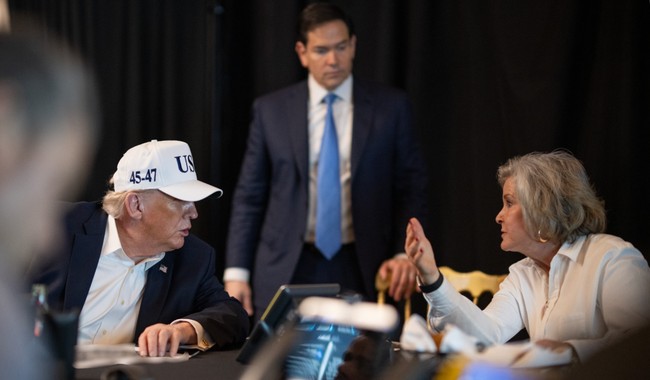
President Trump spoke about the ongoing U.S.-Israeli strikes on Iran, suggesting the operation might run roughly a month and offering commentary on leadership losses, naval strikes, regional reactions, and possible future talks with Tehran. He expressed confidence in how the campaign has unfolded so far, noted conversations with regional leaders, and reflected on the toll of U.S. service-member casualties while signaling continued U.S. resolve.
The president told a national outlet that the joint operation could “ultimately last a month,” noting mission plans that indicated a roughly four-week timeline. He addressed the nation following the deaths of three U.S. service members and extended gratitude to their families, describing a somber moment that framed the broader military action. The strikes are being carried out as part of a campaign labeled Operation Epic Fury, involving coordinated U.S. and allied strikes. That context has set the tone for a sustained and intense military phase against Iranian targets.
POTUS described planning that expected a multiweek effort and said, “It’s always been a four-week process. We figured it will be four weeks or so. It’s always been about a four-week process so – as strong as it is, it’s a big country, it’ll take four weeks – or less.” He added that the campaign so far has matched expectations and that the operation’s results have been significant. The president claimed substantial impacts on Iran’s leadership, a point he repeated when discussing the scale of losses suffered by the adversary.
“No, I think it’s going as per planned. You know, other than we took out their entire leadership – far, far more than what we thought. Looks like 48,” he answered.
In the same interview the president left open the possibility of talks, but he did not commit to an immediate diplomatic opening. “The President remained open to more talks with the Iranians, but couldn’t say if they would happen ‘soon.'”
‘I don’t know,’ he answered. ‘They want to, they want to talk, but I said you should have talked last week not this week.’
The administration has been public about damage inflicted on Iranian naval assets, and the president announced that a series of ships were taken out in recent strikes. He posted an assessment of the naval losses and described a separate attack that heavily damaged Iran’s naval command facilities. The announcement about ships was accompanied in the original report by an embed with footage and commentary measuring the scope of the strikes.
They will soon be floating at the bottom of the sea, also! In a different attack, we largely destroyed their Naval Headquarters. Other than that, their Navy is doing very well! PRESIDENT DONALD J. TRUMP
Regionally, Iran’s remaining commanders have been launching missiles across the Middle East, provoking alarm among neighboring states and raising the risk of wider conflict. The president said he has been in touch with leaders from Bahrain, Saudi Arabia, the United Arab Emirates, Qatar, Jordan, and “a couple of others.” Those conversations reflected shared concerns about escalation and the need to protect regional partners amid ongoing strikes.
Asked about Saudi Arabia’s posture, he noted their willingness to act if attacks persisted, and summed up a hardening of regional resolve by saying, “they’re fighting, they’re fighting too.” That blunt phrasing underscored a broader shift among Gulf partners toward more assertive measures in response to Iranian provocations. The development has complicated diplomatic calculations while reinforcing the administration’s claims that the coalition is serious about stopping further aggression.
Back in Washington, the president planned to return to the White House to prepare for another intense news cycle and to oversee next steps in the campaign. He expressed cautious optimism about Iran’s future potential, saying, “I do,’ he said. ‘It’ll be very interesting to watch, but a lot of things could happen and a lot of very positive things could happen.” The comment reflected a dual posture of pressure and the possibility of eventual positive change if conditions allow it.
The president’s remarks combined a clear operational timeline, claims of decisive leadership losses, and an openness to diplomacy conditioned on behavior. At the same time, the human cost of conflict was highlighted by the recent U.S. casualties, shaping both public messaging and policy calculations. The unfolding campaign will continue to be judged by its results on the ground, the reactions of regional allies, and whether it steers Iran toward meaningful negotiations or deeper escalation.


Add comment