
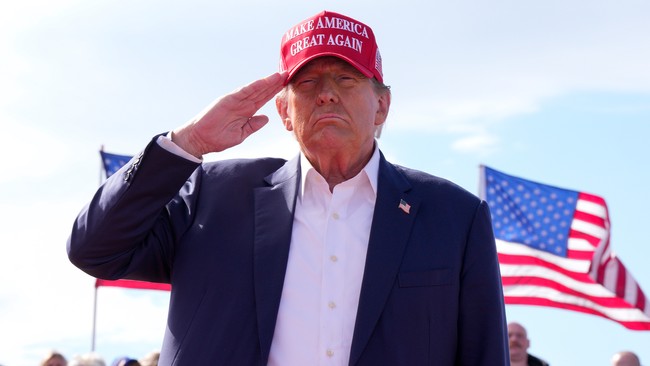
President Donald Trump spent a day along the Ohio River corridor, touring a Thermo Fisher Scientific facility in Reading, Ohio, and then speaking to a large rally in Northern Kentucky where he emphasized manufacturing, jobs, drug pricing reforms, and energy policy designed to bring relief to American families and revive industry at home.
Trump opened the day inside a major manufacturing plant, engaging with workers and reporters about domestic production and investment. He framed the visit as part of a deliberate push to expand U.S. manufacturing and reward companies that build and hire here. His message was direct: policy moves under his watch are intended to make onshore investment more attractive and to create tangible jobs for communities along the river.
“Well, it’s a great company. We’re just talking about how the expansion’s going, and a lot of expansion because of Trump, I have to say. I think the one-year depreciation is great when you’re expensing. Everyone loves it.”
After the plant tour, Trump discussed prescription drug pricing and touted measures aimed at lowering costs for American patients. He presented his administration’s “Most Favored Nation” approach as a tool to reduce what Americans pay for medications by tying U.S. prices to better international benchmarks. The argument appealed to voters tired of paying more than their counterparts in other countries for the same drugs.
Energy policy was another central theme during the visit, with Trump pointing to the Strategic Petroleum Reserve as a lever to ease fuel prices when consumers need relief. He described coordinated releases and strategic moves as temporary stabilizers while domestic production grows. The approach he described links short-term market action with a longer-term goal: keep energy affordable while promoting American energy independence.
Crossing the river to Northern Kentucky, Trump stepped into a congressional district represented by a Republican known for independent streaks, yet the president focused squarely on local economic wins. He referenced the Thermo Fisher expansion and pointed to a cluster of manufacturing investments in the region. The rally crowd heard a consistent theme: policies that favor reshoring and investment are translating into jobs and visible economic activity.
The president highlighted construction and manufacturing hiring as key indicators of renewed industrial strength. He argued that when factories expand and build, communities along industrial corridors reap the benefits through higher employment and new supply chains. That was the throughline of a straightforward economic message aimed at voters who measure success by paychecks and local projects, not by abstract statistics.
Trump also made the case that smart use of national tools can protect consumers from price shocks. He described coordinated international oil actions and domestic reserve releases as pragmatic steps to lower pump prices. For him, energy policy is not purely ideological; it is practical and tied to everyday costs faced by families and businesses.
“We have to get rid of the evil. Somebody had to do it. Forty-seven years of horror.”
Throughout both stops, Trump emphasized accountability and results, framing policy changes—like accelerated depreciation and drug pricing adjustments—as concrete incentives for private-sector expansion. He portrayed these moves as clear contrasts with previous administrations that, in his view, failed to produce similar on-the-ground outcomes. The tone at each venue blended optimism about regained industrial strength with tangible claims about the benefits of his policy toolkit.
The day’s events carried a political undertone without overtly targeting local leaders. By visiting a major plant and then speaking inside a nearby congressional district, Trump underscored his connection to the economic life of working communities along the Ohio River. He used the itinerary to stitch together a message that manufacturing, energy, and drug pricing reform are not abstract campaign promises but parts of a plan to restore American competitiveness.
That plan, as presented, pairs short-term actions like strategic reserve use with longer-term incentives to bring production home. The emphasis on construction jobs, factory expansions, and lower consumer costs was designed to resonate with voters focused on jobs and family budgets. For supporters, the day offered a narrative of industrial revival tied to concrete policy tools and visible local investments.
Readers can view the president’s remarks and the factory tour via the embeds above to see the full context of his comments and the exchanges with workers and supporters. The appearances were pitched as a full-throttle economic day, aimed at proving that policy decisions lead to measurable results in the communities they affect.


Add comment