
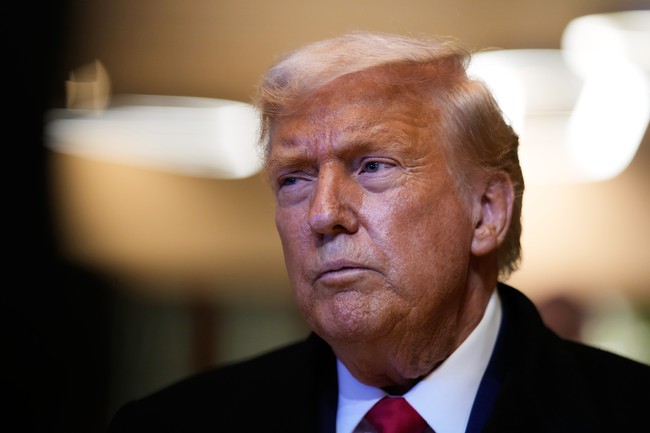
President Trump has put the brakes on a recently passed housing bill until the Senate acts on the SAVE America Act, making a high-stakes trade: housing legislation on pause until election integrity measures get top billing in Congress.
The SAVE America Act is being pitched as a major reform to tighten voter registration and voting rules, including proof of citizenship for registration and photo identification at the polls. Supporters argue these steps are common-sense safeguards to protect lawful ballots and restore public confidence. Opponents call it partisan and unnecessary, but the debate now has concrete consequences for other legislation.
Trump has used clear leverage by refusing to sign the housing bill until the SAVE America Act is passed, a move aimed squarely at Senate Republicans who have been slow to act. That leverage is political theater and pressure all at once: it forces a choice between moving housing assistance forward and prioritizing election integrity. For his supporters, this is the kind of hardline negotiation necessary to get long-stalled priorities done.
https://x.com/JakeSherman/status/2069789920986550546
Reportedly, the president delivered his stance with public statements and social posts that leave no doubt about his aims, and he framed the SAVE America Act as a national emergency. The administration’s messaging makes clear that voter ID and citizenship verification are nonnegotiable items for the moment. This tactic is meant to rally the base and push wavering senators to pick a side.
In the meantime, the housing bill sits in limbo, subject to the Constitution’s timing on presidential action. Article I, Section 7, Clause 2 explains the procedure for a president’s signature, veto, or inaction that could turn a bill into law after ten days. That technical detail shapes the bargaining posture: the president can sign, veto, or let the clock run and potentially allow the bill to become law automatically.
What follows is a set of direct presidential remarks that are being circulated exactly as issued and that underscore his impatience with Senate delay. The president wrote:
Today’s Housing News Conference and Signing is hereby cancelled until such time as we pass the desperately needed SAVE AMERICA ACT, which I consider to be a National Emergency. Thank you for your attention to this matter! President DJT
Beyond that declaration, the president’s broader critique of the housing bill and the Senate’s priorities has been blunt and colorful, reflecting his usual cadence. He argued that other measures pale in importance when compared to the SAVE America Act and urged Republicans to act first or risk seeing Democrats eliminate procedural guards like the filibuster. Those comments are part incentive and part challenge to his own party.
He went further in a subsequent message, repeating themes about the filibuster and congressional priorities with tongue-in-cheek hyperbole and sharp language. The president said the nation should not let marginal bills take precedence over what he called essential election safeguards. The tone is intended to force a political reckoning among Republican senators.
The Elizabeth “Pocahontas” Warren centric housing bill, which is of minor importance compared to lower interest rates, and even FISA, pales in comparison to passing THE SAVE AMERICA ACT. That is what Americans, both Dumocrats, Republicans, and everyone else, care about. Get the bad Republicans to approve it or, better yet, Terminate the Filibuster and approve it, AND EVERYTHING ELSE REPUBLICANS HAVE EVER DREAMED OF. The Dumocrats will do it in hour one, 100%. Republicans will feel very stupid if they don’t do it first. I’ll be watching with tears in my eyes!!! President DJT
The strategic calculus is clear: press the Senate into action by holding other priorities hostage. That is a risky but sometimes effective negotiating tactic in Washington where timing and headlines matter. There is also a practical calculation about public opinion, since polls typically show strong support across many demographics for voter ID measures.
Senate Republicans now face a choice with real consequences, both for the housing bill’s recipients and for the party’s broader agenda. They can push the SAVE America Act forward and accept the political cost, or they can let the housing bill advance on its own timetable and risk alienating a segment of the GOP base demanding tougher election rules. Either way, the dispute exposes fault lines about legislative priorities and tactics.
Constitutional timing means the president can use a veto threat as another lever, but vetoes carry their own political and legislative costs. Overriding a veto would require a supermajority that Democrats and Republicans rarely achieve together, so the threat itself can be persuasive. That reality is part of why these high-stakes maneuvers play out publicly: votes matter and votes are scarce.
For conservatives pushing election integrity, this moment is framed as do-or-die: either muster the votes or see the issue delayed indefinitely. The president’s approach is unapologetically forceful, aimed at forcing a resolution rather than accepting incrementalism. With significant consequences for both policy and party unity, the fight over the SAVE America Act will shape perceptions of Republican resolve.
While Congress navigates procedure and politics, the public will watch for outcomes that affect both elections and everyday needs like housing. The interplay of pressure, timing, and constitutional mechanics makes this a test of political will. Lawmakers must decide whether they will yield to the timetable the White House has set or chart a different course.

Add comment