
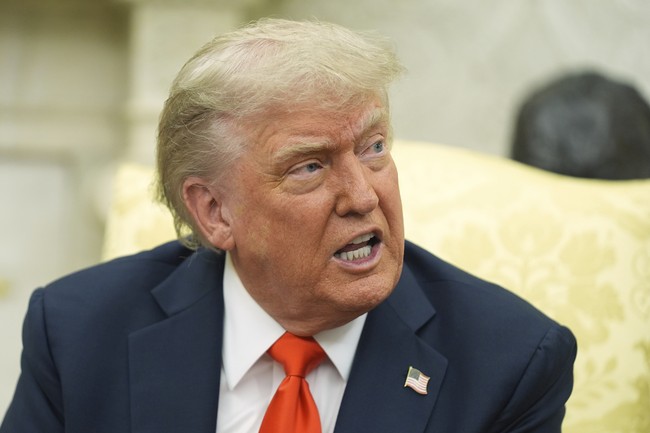
President Trump announced he will halt trade with Spain over Madrid’s refusal to meet NATO spending commitments and for denying U.S. forces access to its bases related to operations concerning Iran. Germany’s Chancellor Friedrich Merz stood with Trump on the need for Spain to meet agreed defense spending, and markets reacted sharply to the news. Tensions over NATO obligations, base access, and broader strategic trust are driving a tough U.S. response that aims to enforce allied responsibilities. The controversy highlights how defense commitments, base rights, and diplomatic friction can quickly affect trade and markets.
New: Trump Slams Door on Trade With Spain Over NATO, Iran
At a White House meeting with German Chancellor Friedrich Merz, President Trump made clear he will cut off trade with Spain because Madrid refuses to comply with NATO spending requirements. Chancellor Merz agreed publicly that Spain must “catch up with the three percent, or 3.5 percent which we agreed on in NATO,” and insisted the commitments are part of “our common security.” That public alignment between the U.S. and Germany signals higher stakes for any NATO member that fails to meet its obligations. The issue is now both a security complaint and an economic lever.
Speaking to the media, Chancellor Merz says:
The answer on that is quite simple, we are trying to convince Spain to catch up with the three percent, or 3.5 percent which we agreed on in NATO. And, as the president said, it’s correct, Spain is the only one who’s not willing to accept that. And we are trying to convince them that this is a part of our common security, that we all have to comply with these numbers, and that it is 3.5 for military and another 1.5 for our military infrastructure. So, Spain has to comply with that.
The immediate trigger for Trump’s announcement was Spain’s refusal to allow U.S. operations tied to a strike on Iran to use Spanish bases, which led to key refueling tankers leaving Rota and Morón. Reports said KC-135T and KC-135R aircraft departed after Madrid objected to using its facilities for that operation. Spain’s foreign minister emphasized that Spanish bases would not be used for actions “that fall outside the agreement with the United States and the United Nations Charter.” That diplomatic stance cut direct military support to operations some in Washington consider vital.
Markets did not shrug this off. One report noted a significant midday drop for the iShares MSCI Spain ETF after the announcement, reflecting how quickly political moves translate into investor reactions. When trade is threatened between allies, companies and funds with exposure to the affected country suffer immediate losses. The economic fallout is a practical lever that the U.S. can use to press partners to change course, and the market impact underscores the seriousness of the policy shift.
Spain’s modern troubles are now mixing with long-standing historical themes. Once a dominant global power with significant maritime and colonial reach, Spain today faces demographic, social, and security challenges that complicate its ability to meet NATO targets. The current leadership’s choices on immigration, defense spending, and foreign policy have provoked sharp criticism from those who see a decline from Spain’s earlier global role. For American policymakers and many conservatives, that decline is a failure of political will and strategic prioritization.
The decision to press Spain on spending and base access is part of a broader pattern under the Trump administration of insisting allies carry their fair share. This approach ties military cooperation to concrete obligations and holds partners accountable through diplomatic and economic pressure. Supporters argue that enforced compliance protects U.S. taxpayers and strengthens deterrence by ensuring NATO members maintain credible capabilities. Critics worry about the diplomatic costs, but the administration frames the move as necessary to restore responsibility among allies.
Spain’s refusal to accommodate U.S. operational needs has introduced a trust issue that goes beyond numbers on a budget spreadsheet. Access to bases is a practical detail with strategic consequences: denying facilities can limit rapid power projection, constrain logistics, and complicate coalition planning. For the U.S., reliable basing rights near hotspots are a non-negotiable element of forward defense. When an ally withdraws that support, Washington views it as a breach that justifies proportionate responses.
The unfolding dispute will test NATO unity and the willingness of European capitals to meet agreed commitments when confronted with direct pressure. With Germany publicly backing stricter enforcement of NATO spending rules, Spain is facing diplomatic isolation on this issue within the alliance. That isolation could force Madrid to choose between adjusting its policies or facing sustained economic and political consequences. The outcome will matter both for NATO cohesion and for how the U.S. manages relations with allies who balk at shared responsibilities.



Add comment