
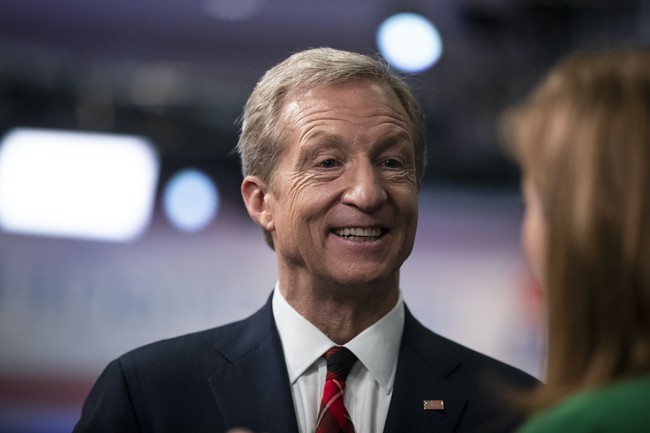
The California governor’s race produced an eyebrow-raising moment when billionaire candidate Tom Steyer fumbled a simple question about Gov. Gavin Newsom’s performance, refusing to assign a grade and saying he hadn’t followed Newsom closely enough to evaluate him; that exchange, captured on a Sacramento show, raises questions about credibility, priorities, and what voters should expect from a candidate who has poured huge sums into politics.
Tom Steyer is no stranger to political spending and influence in California, but money does not substitute for familiarity with the job he wants. He has injected massive funds into state politics and is self-funding a campaign, yet when pressed about Gov. Gavin Newsom’s record over two terms he struggled to answer plainly. A short, direct question exposed a longer problem: a wealthy candidate who talks big but failed to offer even a basic assessment of the incumbent he wants to replace.
On Sacramento journalist Ashley Zavala’s show, the crucial exchange was simple and revealing. Zavala asked, “What grade would you give Gavin Newsom for the last two terms?” Steyer’s reaction was halting and evasive: “I don’t know. Look, I think…” The inability to state a position or a grade on the job performance of a popular and controversial governor speaks to either political caution or a lack of engagement with the very issues voters expect gubernatorial hopefuls to master.
Zavala pressed for clarity with a blunt “A through F?” and Steyer tried to pivot into praise without providing an assessment. He said, “I don’t know. I think that people have come to really appreciate how Gavin has stood up for the State of California.” When Zavala asked again, “You won’t give us a grade?” Steyer confirmed, “No, I’m not going to,” and then added, “I haven’t — I haven’t followed it closely enough to give him a grade.” That admission is the most damning part of the exchange for a serious candidate.
A candidate who can spend $80 million of his own money and bankroll ballot measures should at minimum be conversant with eight years of a governor’s record. Saying you haven’t followed the incumbent “closely enough” undermines any claim to grasp policy, budgeting, housing, public safety, or the range of administrative decisions that affect Californians every day. Voters aren’t buying a hobbyist stepping into governance, and this kind of answer does nothing to reassure skeptics.
Steyer’s policy history complicates his credibility on the cost-of-living argument he uses to court voters. He has championed aggressive environmental initiatives and tax changes while funding causes that many view as anti-business, then pivoting to say housing and utilities are too expensive. That contrast makes it easy to question whether his proposals are grounded in practical governance or in activist impulses financed by personal fortune.
For Republicans and conservatives watching the primary field, this moment is an opportunity to highlight differences in experience and priorities. A candidate claiming ignorance about the current governor’s record invites scrutiny over readiness and seriousness. When politics becomes a spectacle of big checks and soft answers, the practical responsibilities of running a large, complex state risk being overshadowed by fundraising and publicity.
The exchange also raises the question of how candidates should handle loyalty and critique within their own party. Steyer’s reluctance to critique Gov. Newsom could be read as deference, strategic avoidance, or ideological alignment; whatever the motive, it leaves voters with little to evaluate on comparative performance. Effective campaigning requires not just money and messaging but the ability to articulate clear judgments about the current state of affairs and a plan to move forward.
Refusing to grade an incumbent after nearly eight years in office suggests that Steyer either lacks the detailed engagement necessary for the job or is unwilling to alienate potential allies. Both are troubling for an office that demands decisive positions and accountability. The people of California deserve candidates who can point to concrete disagreements and policy alternatives, not evasions that sound like talking points rather than serious appraisal.
Ultimately, the clip is a useful snapshot for voters deciding who should lead the state. It shows a candidate with resources but not necessarily the readiness to be judged on practical governance or the courage to stake out a clear position against an incumbent. For those evaluating competency, that moment will likely matter more than any ad buy or late-night soundbite.


Add comment