
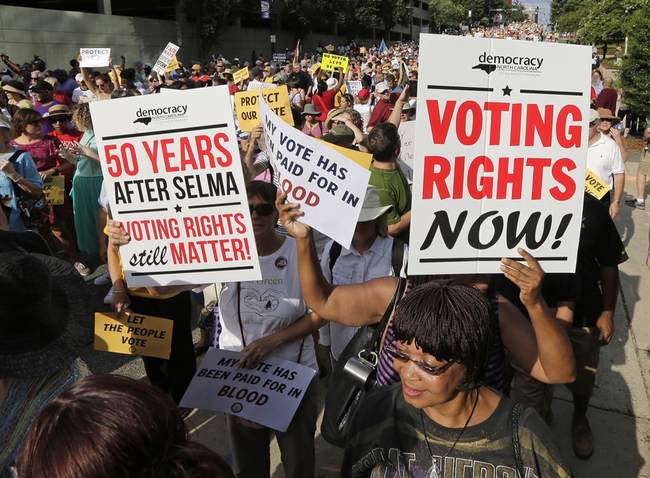
The Supreme Court’s ruling in Louisiana v. Callais is reshaping how courts and state legislatures will handle redistricting disputes under Section 2 of the Voting Rights Act, and its ripples are already forcing urgent moves in places like Alabama where court-drawn districts and race-based map challenges hang in the balance.
The decision in Louisiana unmoored a significant legal tool that had been used to challenge state maps for decades, and that shift promises a cascade of changes across Southern states that relied on federal court mandates to create majority-minority districts. Practically speaking, a number of districts created or preserved by race-conscious remedies may now face fresh scrutiny, prompting litigation, rapid legal filings, and political recalculations. That reality is already prompting state officials and challengers to jockey for position ahead of the 2026 election cycle.
Alabama represents the first clear example of the domino effect the Court’s ruling set off. The state’s post-2020 congressional maps were previously found to violate Section 2, producing a June 2023 ruling that forced a new Black-majority district and led to a special election outcome that shifted a seat to Democrat Shomari Figures. With Louisiana now overturned on race-based districting grounds, Alabama’s earlier disputes have renewed urgency and could be revisited by the courts. That potential reversal has legal teams, state leaders, and national groups all watching closely.
The State of Alabama is still defending its congressional map, which legislators approved in 2023. A special master hired by a three-judge panel in Birmingham redrew the map for the 2024 congressional elections after Democrats and liberal groups were successful in their initial legal challenge.
National Republican strategists have been explicit that the stakes extend beyond any single state. The director of the National Republican Redistricting Trust took the Callais outcome as a signal that longstanding court-created districts could be undone, altering the political arithmetic in competitive House races. That perspective frames this as more than a legal nuance: it is a potential structural change to the map of congressional power across multiple Southern states that had relied on remedial remedies under Section 2.
Adam Kincaid, executive director of the National Republican Redistricting Trust, told 1819 News on Wednesday he was waiting to see what the Supreme Court does with Alabama redistricting cases.
“We are just waiting to see what the Supreme Court does to the Alabama cases and we should expect to see an order as early as Monday,” Kincaid said. “Everything is in front of them so I’m curious to see what they do. It could go in a couple of different directions. Like I said, before we know what happens in Alabama, we need to know what the Supreme Court does with these cases on Monday when they release their orders.”
Not everyone is content to wait out routine court timelines. Appellees in the Louisiana matter have petitioned the Court to issue its judgment without the usual delay, arguing that an immediate outcome is necessary to avoid shoehorning a remedial plan into the 2026 cycle. That push for speed underscores how consequential the ruling could be for when and how states redraw maps—especially in jurisdictions where remedial maps were promptly implemented after court orders.
Alabama’s Attorney General has publicly pledged to apply the new precedent quickly, signaling that state officials are ready to press for map changes consistent with the Supreme Court’s guidance. That intent to move fast demonstrates how state-level legal and political actors view Callais not as a single-case holding but as a blueprint for revisiting prior race-conscious redistricting remedies. The prospect of new litigation and quick adjustments at the state capitol has both parties preparing for a series of legal fights.
“The Supreme Court has spoken. States cannot be forced to gerrymander by race. Louisiana v. Callais is a watershed moment. The Court has shut the door on vote-dilution claims that use racial data to disguise what are really partisan disputes. Alabama has been fighting this battle for many years, and today the Supreme Court confirmed our long-held argument that States must not use race, either to help or to harm particular voters, when drawing voting districts. The Court rightly acknowledged that the South has made extraordinary progress, and that laws designed for a different era do not reflect the present reality. We will act as quickly as possible to apply this ruling to Alabama’s redistricting efforts and ensure that our congressional maps reflect the will of the people, not a racial quota system the Constitution forbids.”
Public pressure is mounting in some quarters for governors and state legislatures to call special sessions or act preemptively, while other leaders prefer the courts to sort matters out. That split in approaches is creating political tension: some advocates want emergency legislative fixes, and others expect judges to impose remedial plans. Either way, the immediate legal fallout will likely play out across filings, appeals, and rapid judicial orders that could reshape districts before the next major election.
Critics of the old approach argue that Section 2 was stretched into a tool for creating partisan advantages by packaging race as the dominant factor in mapmaking, and they see the Court’s decision as restoring the constitutional line against race-based districting. Supporters of the prior remedies counter that majority-minority districts were essential to protecting minority voting power, so the coming legal fights will center on how to reconcile those competing priorities in redrawing lines.
Some Democrats in affected districts already recognize the stakes and are preparing for the political consequences if court-created districts are dissolved or redrawn. The combination of fast-moving legal challenges and high political stakes means the next year will be a test of whether legislatures or courts drive the post-Callais redistricting landscape, and how long-standing assumptions about safe seats will hold up under fresh scrutiny.
Observers who view the Court’s decision as decisive suggest a clear pathway: if race-based districts are now treated as unconstitutional, states that were forced to adopt such maps will redraw them, and those changes could alter congressional majorities that were sustained by court-ordered districts. That scenario is what fuels the sense of urgency on both sides, and it explains why the Callais ruling is being treated as a potential turning point rather than a narrow technical win.
The Voting Rights Act of 1965 originally aimed to stop racial discrimination at the ballot box, but years of litigation over remedies and mapmaking have created a layered legal landscape. The Supreme Court’s recent interpretation narrows the permissible role of race in district design, and that narrowing will be tested in courts and legislatures across the South in the months ahead as officials and litigants seek clarity and political advantage.


Add comment