
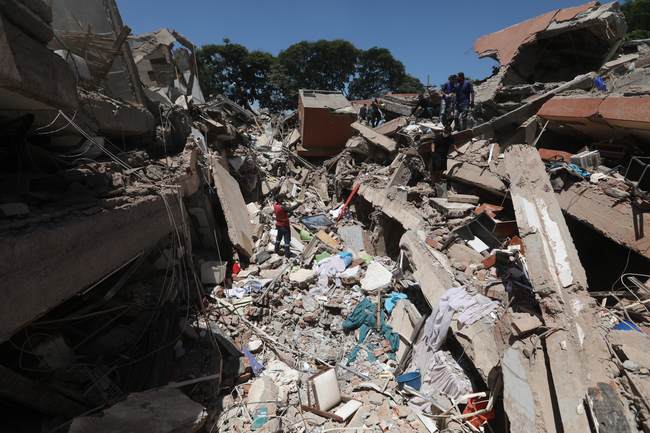
This article describes a remarkable 36-hour rescue after a powerful earthquake in Colombia, detailing how emergency teams located and freed a trapped woman, the scale of the temblor and damage, and the medical complications she faced after being pulled from the rubble.
Thirty-six hours after a catastrophic national disaster, there is usually very little hope of finding survivors, yet this story breaks that expectation. A 7.4 magnitude quake struck on the morning of August 10 and left a wide path of destruction across cities and towns. Amid the chaos, a determined rescue operation in Pereira produced a near-miracle when a trapped woman was brought out alive.
Local responders and colleagues from the capital worked long hours against the clock to find Daniela Largo Sánchez. Rescuers located her position and then spent more than ten hours executing a careful extraction. Their persistence paid off when they managed to reach and free her from deep beneath collapsed concrete.
Miracles do happen:
https://x.com/AP/status/2087504659502035289
Applause went up as rescuers pulled Daniela Largo Sánchez from the ruins of a building where she had been trapped for 36 hours.
According to Bogota firefighters the woman had been located ten hours before the rescue but had to be delicately rescued as she was buried deep under the rubble.
The quake that struck at 7:34 am killed as many as 254 people, injured nearly 4,000, and toppled hundreds of buildings. The force of the temblor reminded everyone that nature can still surprise and overwhelm human plans. Emergency services were stretched thin as they responded to collapses, fires, and people trapped in broken structures.
Rescuers refused to give in, working in shifts and using specialized teams to probe the wreckage for signs of life. A local resident heard faint cries and reported the sounds, which focused attention on one collapsed building. Teams used small cameras and listening devices to locate the victim and communicate until they could reach her.
Translation by X:
🚨❤️ 36 HOURS UNDER THE RUBBLE AND A LIFE THAT WAS REBORN
Daniela Largo Sánchez was rescued alive after remaining 36 hours under the rubble in downtown Pereira.
#FuerzasQueSalvanVidas #IncondicionalesEnLaAdversidad
The rescue itself required a precise and patient approach because four heavy concrete slabs blocked access to her position. Teams dug two separate tunnels to reach Daniela: one from above to provide oxygen and another from below to extract her safely. That tactic reduced the risk of further collapse during the hours-long operation.
Once they made contact, they stabilized her airway and delivered oxygen through the narrow opening while crews continued to carefully widen the tunnel. The extraction was slow but steady, with rescuers coordinating to avoid jostling the unstable debris. When she finally emerged, the crowd’s applause was a raw response to a hard-won success.
Survival after such an ordeal is often just the first battle, and complications can follow quickly. Daniela had a 12-year-old son, and the initial relief at her being alive turned tense when her trapped arm was liberated. Blood flow returned and she went into cardiac arrest, requiring 17 minutes of resuscitation before she stabilized.
Medical teams later discovered the trapped arm had suffered severe tissue damage, and gangrene set in as a result of prolonged entrapment and loss of circulation. Doctors indicated the arm would likely require at least partial amputation to prevent further life-threatening infection. That grim reality underlines how rescue and medical care must proceed hand in hand in disaster zones.
The broader aftermath of the quake continues to unfold, with recovery efforts focusing on search, shelter, and restoring essential services. Communities are working to support displaced families while emergency units prioritize where survivors may still be found. Aid organizations and local governments face the twin tasks of immediate relief and planning longer-term rebuilding.
Stories like Daniela’s show how fast, coordinated action and the refusal to give up can save lives even in the worst conditions. The rescuers’ decision to keep digging, to tunnel from two directions, and to maintain pressure on all fronts made the difference. Amid devastation and loss, that combination of skill and grit stands out as a human answer to disaster.

Add comment