
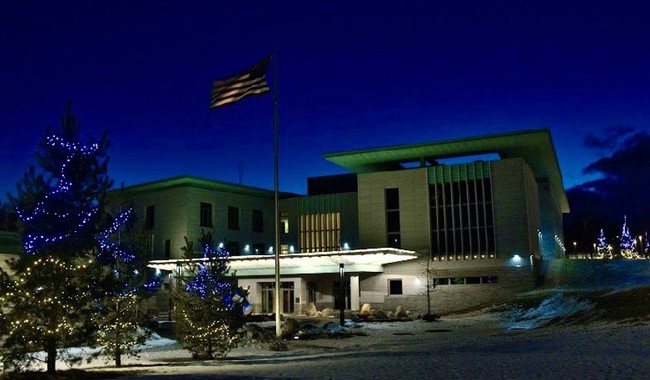
The U.S. embassy in Oslo was struck by an explosive device early Sunday, causing damage but no injuries, and Norwegian authorities have arrested three brothers of Iraqi origin on suspicion of a terrorist bombing; investigators are probing motivations, potential state links, and whether the attack connects to recent Middle East tensions.
The Bomb Brothers: 3 Siblings of ‘Iraqi Origin’ Arrested in Attack on U.S. Embassy in Oslo
A blast damaged an entrance to the U.S. embassy in Oslo during the predawn hours, thankfully leaving no casualties. Norwegian police quickly treated the event as a serious incident and opened a terrorism probe to establish what happened and who was responsible.
On Wednesday, police arrested three Norwegian citizens who are brothers and described as being of Iraqi origin, taking them into custody on suspicion of conducting a terrorist bombing. Police prosecutor Christian Hatlo announced the arrests and said authorities are still sorting out each man’s role in the incident and what might have motivated it.
Hatlo told reporters that the suspects are in their 20s and had not been previously known to police, and that a range of hypotheses is being considered. “We are still working from several hypotheses. One of them is whether this is an order from a government entity,” Hatlo said, noting the embassy as a high-value target given global tensions.
Investigators believe one man left an improvised explosive device at an embassy entrance while the other two were “complicit in the act,” according to police statements. Officials have not ruled out connections to criminal networks or organized groups, and the inquiry has broadened to examine both local ties and foreign linkages.
Police also reported a concurrent online incident that may be related: a video depicting Iran’s late Ayatollah Ali Khamenei was posted on Google Maps around the same time as the blast, and authorities said they were probing any possible connection between the two events. These parallel signals have sharpened concern that the attack could be politically or ideologically motivated rather than purely criminal.
Beyond those immediate clues, some analysts point to the wider Iran-U.S./Israel conflict as a contextual factor that could have driven the action, though motive remains unproven. Tensions following recent high-profile strikes and reprisals in the region have produced a heightened risk environment, and security services are watching for spillover effects in Europe and North America.
Oslo police released a surveillance image of a potential suspect early in the investigation to gather leads from the public, and that release appears to have helped produce arrests this week.
Authorities are explicitly exploring whether a state actor played a role, a serious line of inquiry that would elevate the case from an isolated attack to a potential act of directed aggression. Given the target and the international ramifications, police and intelligence services are coordinating to trace any cross-border orders, funding, or training that might have influenced the operation.
The blast itself was limited in scope; investigators said it was caused by an improvised explosive device left near an entrance, and the damage was described as minor. Officials were careful to note that the device was not a hand grenade and that, by luck or design, no one was injured in the explosion.
Public reaction has been intense given the symbolic weight of an attack on a diplomatic mission, with political leaders emphasizing that assaults on U.S. facilities will not be tolerated. From a policy perspective, the incident will likely sharpen debates about homeland security, embassy defenses, and the need to counter foreign malign influence and extremist radicalization at home.
Law enforcement in Norway is continuing forensic work, reviewing surveillance footage, and interviewing witnesses to establish timelines, contacts, and any links to outside groups or governments. Prosecutors will need to build a clear case showing intent, planning, and participation before moving toward charging decisions and potential trials.
Internationally, the incident has prompted renewed attention to embassy security in allied capitals and to intelligence-sharing efforts between partners. As the investigation unfolds, officials will be looking not just for who carried out the attack but also for any broader networks or directives that might suggest a coordinated campaign rather than a lone act of violence.

Add comment