
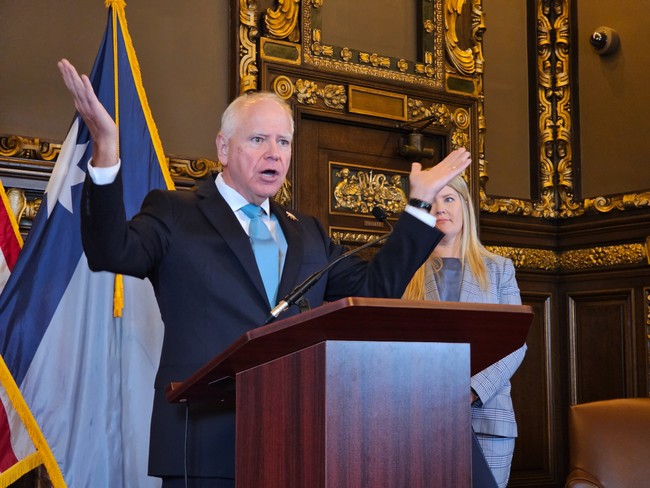
The state audit exposes widespread problems in Minnesota’s Behavioral Health Administration grants, showing more than $425 million distributed with poor oversight, possible backdated documents, and troubling conflicts of interest that lawmakers and auditors say demand accountability.
Is This Why Tim Walz Quit? New Bombshell Audit Exposes Even More Minnesota Fraud
If you thought you heard it all on the fraud in Minnesota, you would be wrong. The latest audit makes clear this is not a few isolated mistakes; it reads like system-level collapse. Gov. Tim Walz announced he would not seek reelection, and the timing only sharpens the spotlight on how state programs were run.
The nonpartisan Office of the Legislative Auditor released a report covering July 1, 2022, through Dec. 31, 2024, that shows the Department of Human Services’ Behavioral Health Administration distributed more than $425 million in grants to 830 organizations. Most of those recipients were nongovernmental, and the audit found the agency frequently failed to track how taxpayer money was spent. In many cases those funds were intended to help people struggling with addiction and mental health problems, yet oversight was chronically lacking.
Auditors flagged missing progress reports and said the BHA could not show it completed all required monitoring visits, with documentation absent for some visits entirely. The audit even found instances suggesting paperwork was created only after the fact, which raises serious questions about the integrity of the administration’s records. When oversight disappears, so does public trust, and this report paints a bleak picture of both.
One particularly troubling example detailed a $672,648 grant paid for only a month of work with no documentation of what was delivered. The employee who authorized that payment later left the Department of Human Services and went to work providing consulting services for the same company. That sequence looks like exactly the sort of revolving-door conflict that weakens government and rewards insiders at the expense of taxpayers.
Auditors also found what appeared to be backdated or newly created documentation that did not exist before the audit, suggesting an effort to retroactively manufacture paperwork to show compliance. The legislative auditor, Judy Randall, called it a “systemic effort” and stressed how rare this is in her experience. She said she had not seen anything like it in her “nearly three decades with the Office of the Legislative Auditor.”
Judy Randall is quoted saying, “We have never been able to prove it, to document it, and we did in this case.” That quote underlines the gravity of what the audit team uncovered and why lawmakers on the other side of the aisle are demanding answers. When a long-serving auditor uses language like that, it is a clear signal the findings are extraordinary and require immediate action.
Republican leaders in the state wasted little time responding. House Speaker Lisa Demuth described the report as “shocking” and said it exposed a “culture of pervasive fraud, negligence, and deception.” She urged immediate investigation into apparent backdating and potential falsification of documents and called for accountability at the top. Speaker Demuth warned that those running the programs acted as if they faced no repercussions under Governor Walz and his party.
Lisa Demuth said, “We need answers immediately about the apparent backdating and potential falsification of documents found during the audit,” House Speaker Lisa Demuth, R-Cold Spring, said. “This proves once again that those running our programs expect no repercussions or accountability from Governor Walz or the Democrats in power, even when they fabricate documents and ignore basic procedures. It’s time to clean house and restore honesty and accountability in state agencies.”
The audit’s raw numbers are hard to ignore: more than $425 million disbursed to 830 organizations over a roughly two-and-a-half-year span, with critical holes in documentation and monitoring. For conservatives focused on stewardship of public funds, the report reads like confirmation of long-held concerns about transparency and fiscal responsibility in blue-run agencies. It also raises practical questions about how many dollars went to services and how many ended up in questionable contracts.
With the Department of Human Services unable to produce required reports and monitoring records in numerous cases, lawmakers will now have to decide whether to pursue criminal referrals, tighter statutory controls, or wholesale management changes. The public deserves a clear accounting of where taxpayer dollars went, who authorized the payments, and whether any state employees or contractors profited from lax oversight. Whatever the next steps, this audit will shape the political conversation in Minnesota for months to come.


Add comment