
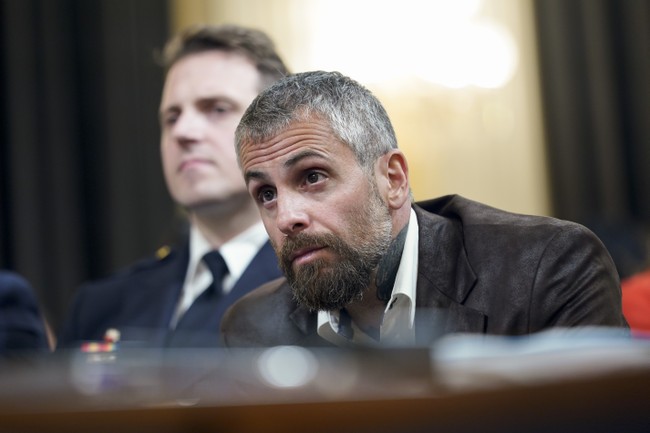
At a House Judiciary Committee hearing featuring former Special Counsel Jack Smith, attention shifted away from the witness when former Capitol Police officer Michael Fanone created a scene in the audience, reacting loudly and physically to remarks from Republican members and engaging with another attendee, producing several tense moments that interrupted proceedings.
The hearing began with sharp questioning of Jack Smith by Committee Chair Jim Jordan, but the drama in the audience soon stole part of the spotlight. Michael Fanone, who has been a prominent figure tied to Jan. 6 coverage, sat among spectators and reacted visibly to testimony and comments from representatives. His reactions drew repeated calls for order from the dais as committee members tried to proceed.
Representative Troy Nehls suggested that Capitol Police leadership had intelligence indicating a “high propensity for violence” ahead of Jan. 6, 2021, and that those warnings were not sufficiently acted upon. That line of questioning clearly upset Fanone, who responded aloud while sitting in the audience. The confrontation quickly escalated into disruptions that interrupted the flow of the hearing and required the chair to restore decorum.
Fanone’s attire was notable: his shirt displayed the words “Dropkick Murphys” on the front and “Fighting Nazis since 1996” on the back, a visible political and cultural statement. When Nehls made his point about leadership failures, Fanone coughed and shouted the exact words “F**k yourself,” which were heard in the chamber and prompted immediate admonishment from the chair. The outburst forced a pause in the proceedings and set the tone for further volatility in the audience.
After that verbal outburst, the tension did not subside. At one point Fanone gave the middle finger in the direction of members of Congress, a gesture that attracted additional attention and another warning from the chair to maintain order. The gesture was followed by an exchange with Representative Nehls, who appeared to scold Fanone for the behavior, and the committee again had to call the room to order. Those moments interrupted testimony and drew eyes away from the witness on the stand.
Fanone’s confrontation with another attendee, identified as Ivan Raiklin, escalated the situation further. Raiklin, known for protesting the 2020 election outcome, and Fanone clearly had a history of disagreement that spilled into this hearing. The interaction grew heated enough that Fanone’s companions stepped in to hold him back while security moved to intervene, creating a near-physical scene near the committee seating area.
Security ultimately escorted Fanone out of the hearing after his repeated disruptions and the tense exchange with Raiklin. Witnesses described a moment where Fanone told a female police officer not to touch him as he was being removed, which added another layer of friction to the removal. The exit marked the end of the audience disruption, but not before it had drawn coverage and complaints from multiple sides on the floor.
Despite Fanone’s confrontational conduct toward a member of Congress, several Democratic members of the committee reacted differently, applauding him as he was escorted out. That applause underscored the partisan split in how audience behavior and political symbolism are received within the chamber. Republicans argued that such conduct should not be tolerated in a congressional hearing room regardless of who is involved, while Democrats framed the reaction as support for Fanone’s history and perspective.
Representative Jamie Raskin called attention to Ivan Raiklin’s conduct, labeling him “deranged” in response to the heated exchange and urging the chair to control the situation. The back-and-forth in the audience and between members amplified the partisan tenor of the hearing, making it harder to focus solely on Smith’s testimony. What should have been an orderly oversight session instead featured a series of interruptions that became part of the story.
The hearing ultimately continued after Fanone’s removal, but the disruptions had already affected the committee’s rhythm and the attention of those watching. What began as hardline questioning of the special counsel turned into a wider conversation about decorum, accountability, and how participants in public proceedings behave under pressure. The episode left clear impressions about tensions that still exist around Jan. 6 and how those tensions play out in public settings.


Add comment