
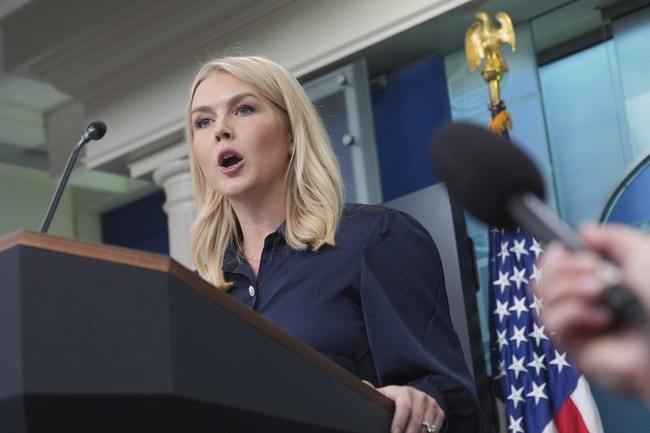
Karoline Leavitt slammed a biased question from The Hill’s Niall Stanage at a White House briefing, calling him a “left-wing hack” after he challenged her defense of ICE; the back-and-forth, captured on video, highlights a tense exchange over ICE custody deaths and immigration-related crimes and shows Leavitt aggressively pushing back on media bias while defending the agency and its officers.
The scene unfolded during a Thursday briefing where a question about Immigration and Customs Enforcement was posed in a way that immediately put Leavitt on the defensive. The reporter framed his query around statistics and allegations meant to cast ICE in a uniformly negative light, prompting Leavitt to rebut on both facts and tone. The exchange quickly moved from policy to credibility, with Leavitt openly calling out perceived partisan motives.
Before the confrontation escalated, the reporter read a series of troubling claims about deaths in custody and other incidents, setting the stage for a dramatic pushback. The original question implied systemic wrongdoing and asked Leavitt to reconcile agency statements with those fatal outcomes. Rather than accept the premise, Leavitt demanded clarity and evidence, forcing the questioner to defend his assertions.
Earlier, you were just defending ICE agents generally. And, earlier on, Secretary [of Homeland Security Kristi] Noem spoke to the media, and she said, among other things, that they are doing everything correctly. Thirty-two people died in ICE custody last year. One-hundred-and-seventy U.S. citizens were detained by ICE. And, uh, Renee Good was shot in the head and killed by an ICE agent.
How does that equate to them doing everything correctly?
Leavitt did not accept the premise that a handful of tragedies erase the broader mission or the daily work of ICE officers who remove dangerous individuals from communities. She pushed back hard, asking direct questions about motives and whether the reporter had actually examined the full set of facts or simply repeated a narrative. Her tone was confrontational and unapologetic, aimed squarely at the framing of the question rather than offering a long defense of every single case.
When the reporter insisted the killing was “unjustifiable,” Leavitt responded by attacking the bias she saw behind the question. She did not mince words, leveling a charge that the questioner was not acting as an objective journalist but as an activist. That rebuke was sharp and aimed to discredit the weight of the accusation rather than enter into a technical legal discussion in the moment.
Oh, okay, so you’re a biased reporter with a left-wing opinion. Because you’re a left-wing hack. You’re not a reporter, you’re posing in this room as a journalist, and it’s so clear by the premise of your question. And you, and the people in the media, who have such biases but fake like you’re a journalist – you shouldn’t even be sitting in that seat.
You’re pretending like you’re a journalist, but you’re a left-wing activist. And the question that you just raised and your answer proves your bias. You should be reporting on the facts. You should be reporting on the cases. Do you have the numbers of how many American citizens were killed at the hands of illegal aliens? And who ICE is trying to remove from this country? I bet you don’t. I bet you didn’t even read up on those stories. I bet you never even read about Laken Riley or Jocelyn Nungray or all the innocent Americans who were killed at the hands of illegal aliens in this country. And the brave men and women of ICE are doing everything in their power to remove those heinous individuals and make our communities safer.
And shame on people like you in the media who have a crooked view and have a biased view and pretend like you’re a real, honest journalist.
That line of argument shifted the debate from a narrow discussion of custody incidents to broader questions about public safety and media responsibility. Leavitt invoked specific victims to underline the human costs that often get lost in one-sided coverage. Her point was that reporting should weigh both crimes committed by illegal entrants and the difficult work of enforcement officers who aim to protect citizens.
The moment became a lesson in political theater as much as it was a policy debate; Leavitt used the briefing room to call out what she sees as chronic media slant against enforcement agencies. Her language was designed to rally those who already distrust mainstream outlets and to force journalists to defend their framing in public. For conservatives, moments like this are evidence that plainspoken pushback can cut through a narrative that ignores certain victims.
Video of the exchange shows the rapid shift from a procedural briefing to a pointed confrontation, with both participants sticking to their lines. The exchange felt less like an attempt to dig into facts and more like a test of credibility between a press secretary and a skeptical, adversarial press corps. Observers who favor robust immigration enforcement saw Leavitt’s tone as justified and effective.
Many viewers will focus on the rhetoric, but the exchange also invites a closer look at how statistics and anecdotes are used in political argument. Accusations thrown into a question can harden into accepted premises if not challenged, and Leavitt made it her business to challenge them. Her remarks are part of a broader push to shape the public narrative around enforcement, accountability, and the role of the media.
The back-and-forth will likely be replayed by both supporters and critics, but it does highlight an ongoing tension: who sets the terms in these public confrontations, and how often do reporters check their own framing. Leavitt’s approach was blunt and unapologetic, focused on defending ICE while accusing parts of the media of activism rather than journalism. The exchange left the question of impartiality in plain view and made the briefing room feel like a battleground over facts and interpretation.


Add comment