
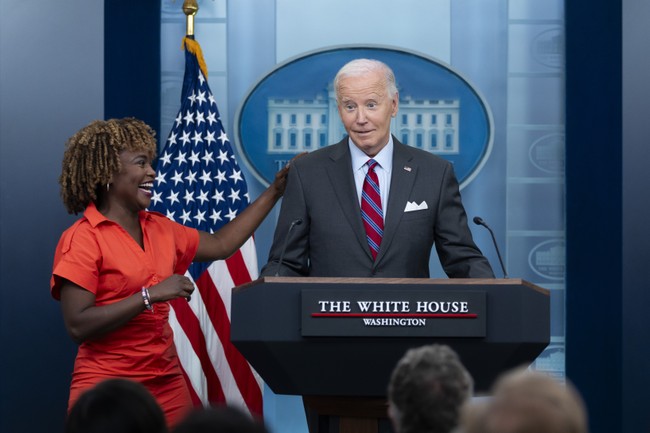
Karine Jean-Pierre’s recent MSNBC appearance turned into a tense replay of past controversies, focusing on her defense of Joe Biden’s fitness and her handling of Special Counsel Robert Hur’s findings, with the interview ending in an appeal to identity rather than accountability.
Jean-Pierre returned to cable television this weekend and found her welcome considerably cooler than in earlier years. Once a regular on the network, she was pressed hard about her role as White House press secretary and the choices she made while defending the president. The tone of the exchange shifted from factual dispute to a cultural wedge, highlighting the gap between media memory and public perception.
The central flashpoint was how the White House responded when Special Counsel Robert Hur reported on his interview with President Biden. Hur’s findings described memory lapses and cognitive issues observed during questioning, and those observations became politically explosive once the audio was released. The administration’s initial line of attack, led from the podium by Jean-Pierre, framed Hur’s commentary as gratuitous and unfair.
When the interview audio appeared under the subsequent administration, it showed discrepancies between what was said publicly and what the records revealed. Questions emerged about whether Jean-Pierre and her team had exaggerated or misrepresented exchanges, including the claim that Hur had improperly raised the death of Biden’s son. The audio suggested the memory lapse occurred in Biden’s own recounting, not as an instigated issue brought on by the special counsel.
On MSNBC, a host asked Jean-Pierre if she had ever apologized to Hur for the White House’s public pushback. She fumbled that question and shifted to describing the president through the lens of her daily interactions with him. That defense—insisting Biden was “sharp” in her view—clashed with the weight of documented incidents and viral clips that many Americans had already seen and debated for years.
HOST: Special Counsel Robert Hur, when his report came out about President Biden and the classified documents, you stood from the White House podium, February 2024, and you said that his commentary was gratuitous, that it was unacceptable, and that it didn’t live in reality, and clearly the American public saw another side of Joe Biden’s mental acuity during the summer’s debate. Robert Hur was unemployed for a period because of the attacks from the Democrats and from the White House that you were at the podium leading. Have you apologized to Robert Hur.
JEAN-PIERRE: I mean (stammers), look, what I can say to you is I saw the president every day. It wasn’t one-offs. It wasn’t once in a while. I saw him everyday.
HOST: But just in this case, have you gone back to somehow who you had pretty sharp comments about…
(Crosstalk)
JEAN-Pierre: He is something that was sharp. He was sharp, he was, he was…
(Crosstalk)
JEAN-PIERRE: What I’m saying is that my reality was this. My reality was somebody that I saw every single day, who was sharp, who pushed his team, who was understanding very clearly of the policy of history. That was what I saw. I can only speak for what I saw on a daily basis for two-and-a-half years, almost four years actually. And, I was White House press secretary for two and a half years, and that is the president that I know. Someone who woke up every single day and was very zeroed-in and focused on how to deliver for the American people.
That insistence—that her daily experience contradicted the accumulating evidence of public stumbles—felt like an exercise in selective memory. Critics pointed out that journalists and commentators documented many of those moments in real time, often with video that circulated widely. The contrast between Jean-Pierre’s confident testimony about daily briefings and the public record left viewers with tough questions about whether political necessity had overridden candor.
When confronted with the harder questions, Jean-Pierre turned to identity as part of her response, saying her role at the lectern was historic because of who she is. She emphasized being a “black woman who is queer” and framed that podium time as an honor and a representation for people who had never seen someone like her there before. That move steered the conversation away from policy and accountability to a personal narrative.
HOST: Do you have any regrets at all for anything you said while you were speaking on behalf of this administration?
JEAN-PIERRE: I am (stammers), look (pauses)
HONST: It’s a simple yes or no…
JEAN-PIERRE: No, no, no, no, no, you’re asking for a yes or no question. I want to put some context in it, too.
HOST: Sure.
JEAN-PIERRE: I woke up every day, I woke up every day, very proud to be the White House press secretary. I woke up every day as a black woman who is queer, who had never, no one had ever seen someone like me at that podium, standing behind that lectern. It was an honor and a privilege to have that job, and I did it to the best of my abilities…
For many critics, that pivot felt defensive and insufficient in the face of harder factual claims. Identity does not answer questions about public briefings, spin, or whether the press corps did its job in real time. The exchange exposed a persistent tension: when political actors are pressed on substance, identity-based deflection is often used to reframe the debate.
The broader media dimension is uncomfortable for critics on the right because outlets that once shielded the administration now act as if they discovered the problem only recently. Reports and viral footage documenting the president’s lapses were widespread, yet many in the mainstream downplayed or dismissed those signs until political winds shifted. That delayed reckoning deepens skepticism about journalistic consistency and motives going forward.
Jean-Pierre’s interview made clear that accountability and narrative control remain at odds. She defended her record with conviction, leaned on representation as a shield, and declined to offer the kind of mea culpa some viewers wanted. The moment illustrated how modern media encounters can expose both political damage control and the media’s own shaky track record when faced with inconvenient truths.
Add comment